

English / Japanese

Experience the Joshi Festival: Days in Kalash Valley (Vlog)

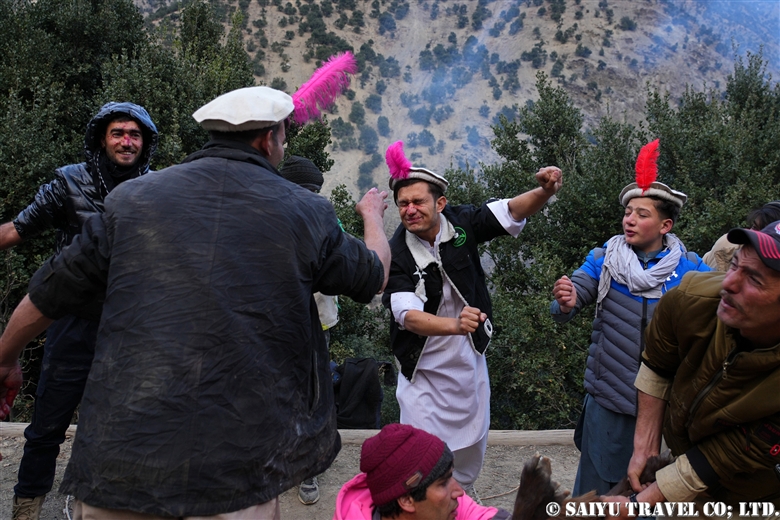
As May arrives, the Kalash Valley awakens in its full glory. We’ve woven together the essence of the Joshi Festival—from the intimate ceremonies to the vibrant energy of the final day.

Joshi Festival Kalash Valley

Blog : The Joshi Spring Festival: A Kalash Ritual


Image & Text :  Mariko SAWADA

*Contact us, Indus Caravan for more information or to make arrangements for visiting Kalash valley.

*Please follow us on YoutubeInstagram & Facebook

Category : = Video Clip KPK > ◆ Video Breathtaking Views of Pakistan > - Kalash Valley > ◆Khyber Pakhtunkhwa
Tag : , , , , , , , , , , , , , , , ,

Chawmos Festival – Mandaik : The Kalash Rituals Still Alive to This Day

Here is a report on the Kalash’s Chawmos Festival. The day after the ritual of ‘Kuta Mru’, the ‘ Mandaik ‘ takes place.”

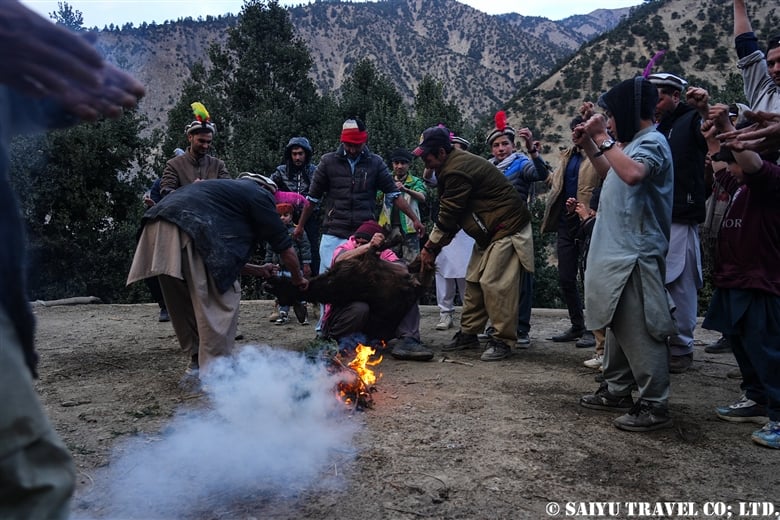
I woke up at about 4:00 a.m. to the sound of villagers shouting ‘Chi, chi, chi.’ They were ushering the spirits of the Shalabira (sacred figures of markhors and goats made during ‘Kuta Mru’) to the mythical land of Dezhirawat.”

> Read more about the ‘Kuta Mru’ ritual here


Mandaik: The Ritual to Welcome Ancestral Spirits

In the Kalash language, “to arrive” is called “ik” and “cemetery” is “Mandaw jaw.” Therefore, the terms Mandaik or Madahik literally mean “arriving from the cemetery.” On this day, the Kalash people honor their deceased ancestors, creating a spiritual bridge that unites the living and the dead.

From the morning, people visit the homes of those who have lost family members during the past year. At each home, two specific types of bread are baked for the temple rituals, along with assortments of fruit prepared as sacred offerings.

As dusk falls, the community gathers at the Jestak Han temple. Outside, rows of baskets filled with food for the deceased are carefully placed. Near the temple entrance, a small, tower-like structure called a “Chilikotik” is built from Chilgoza pine sticks.

As more villagers gather, and once the Chilikotik is complete, everyone enters the temple carrying small branches. The Chilikotik is set ablaze, the temple doors are closed, and the people wait inside together until the structure has burned down completely.

According to tradition, a village elder or priest (Kazi) calls out loudly to the spirits: “O ancestors, come, eat, drink, and then depart in peace.” It is believed that while the Chilikotik burns, the ancestral spirits arrive, partake in the offerings, and leave satisfied. Inside, the villagers wait in the dim light, holding small, flickering branches.

Finally, the temple doors swing open. Outside, the Chilikotik has been reduced to ashes. The offerings are then distributed among the villagers as they begin their journey back home.

It is said that on this day, a sense of unease lingers as people believe spirits are wandering about. Consequently, it is a day of solemnity where people refrain from speaking loudly.

Kalash women carrying fruit offerings and visiting homes that have lost family members this year.

Visitors arrive at the home, and the family members express their gratitude.

The home was very lively with many guests. The family kindly shared fruits and ‘Shosh’ (walnut paste) with us as well.

Children in the village were playing with the Sharabira crafted during Kuta Mru. Now that the souls have left the figures, they are simply treated as toys for kids or food for the cattle.

Afternoon, the villagers began baking bread as offerings for Mandaik. Two types of bread are prepared: one to be distributed to the community at the temple, and the other for the souls of the deceased.

Baking the ritual Tatuli bread
Baking the ritual Briri bread

When we arrived at the temple around 3 o’clock, not many people had gathered yet, and children were playing nearby.

The preparation of the Chilikotik soon got underway.

Women arriving with baskets of ritual offerings.

The offerings consist of the favorite foods of the deceased. Pumpkins, in particular, are believed to be a ‘food of heaven’ that the spirits of the ancestors truly enjoy.

Inside the temple, food was being gathered to be distributed later.

Children playing at the temple while the adults are busy with preparations
People chatting around a fire

Outside, the Chilikotik is now complete.

Then, everyone enters the temple, each holding a branch in their hand.

A fire was lit in the hearth near the altar, and from there, the flame began to spread to everyone. Soon, the branch I was holding was also set alight.

The light gradually spreads throughout the temple
The inside of the temple turned into a truly magical space

It was such a beautiful moment. I was so preoccupied with taking photos that my flame went out, but a girl nearby noticed and immediately relit it for me.

The temple doors finally swung open. This was the signal that the Chilikotik had finished burning. Everyone poured out of the temple all at once.

The lively crowd was busy sharing the ritual food, but by nightfall, a deep silence had returned to the temple.

We look forward to tomorrow: Shishao Adu, the important day for women’s purification.


Text & Photo : Mariko SAWADA

Visit: Dec 2025, Kalash Valley – Khyber Pakhtunkhwa

*The information presented here is based on interviews with people in the area. Please note that the descriptions and explanations of the rituals may differ depending on the source.


■Chawmos Festival – Kutram: The Kalash Rituals Still Alive to This Day

■Chawmos Festival – Mandaik : The Kalash Rituals Still Alive to This Day

■Chawmos Festival – Shishao Adu: The Kalash Rituals Still Alive to This Day

■Chawmos Festival – Pushao Adu: The Kalash Rituals Still Alive to This Day

■Chawmos Festival – Chanja Rat: The Kalash Rituals Still Alive to This Day

■The Joshi Spring Festival: A Kalash Ritual


*Contact us, Indus Caravan for more information or to make arrangements for visiting Kalash valley.

*Please follow us on YoutubeInstagram & Facebook


Category : - Kalash Valley > ◆Khyber Pakhtunkhwa
Tag : , , , , , , , , , , , , , , , , , ,

Chawmos Festival – Chanja Rat: The Kalash Rituals Still Alive to This Day

Chanja Rat is the day of the big bonfire to bid farewell to Balimain, and it can be considered the climax of the Chawmos Festival. Even people from other villages come to take part in the Tchattai ceremony from early morning.

Young girls all dressed up in the morning.
People visiting from other villages. The men will then head to Sajigor to perform the Tali Histik ritual.
The women who cannot participate in the ceremony chat in the square among themselves. They also partake in recreational singing and dancing.
The men head to Sajigor.

Tali Histik – Pray for the prosperity

Tali Histik is a ritual where people pray for the prosperity of the Kalash and for the birth of more boys. A willow tree branch—of which said tree luckily has many—is prepared for each male member of the family. It is said that the many small branches give the image of a family with many children. If there are 10 men in a given family, an additional branch is added to make a total of 11, at which point the male representative of the family throws the whole bundle. Among the number of men counted are the boys who just completed their passage rites the day before.

Willow branches prepared for the ritual
The men getting ready to throw the branches.
The willow branches are thrown all at once towards the altar.
On their return from Sajigor, the men made their way toward the square while forming a line with their hands on each other’s shoulders.

In the square, people chat and the Chawmos songs and dances continue. In the afternoon, they take a short break in preparation for the evening’s torches and bonfire.

Chanja Rat  – The big bonfire to bid farewell to Balimain

Finally, the climax of the Chawmos Festival, the great bonfire to bid farewell to Balemain, takes place. The actual experience of the chanja rat was truly a “ceremony of fire”, both fantastic and full of vitality.

After sunset, large pieces of wood for the bonfire are carried to the square.
The girls sing around the bonfire while waiting for the torches to be brought.
People carrying torches begin to descend from the village on the mountain.
People coming down the mountain carrying torches.
Groups of people merge, and the light of the torches grows stronger.
People carrying torches head for the square.
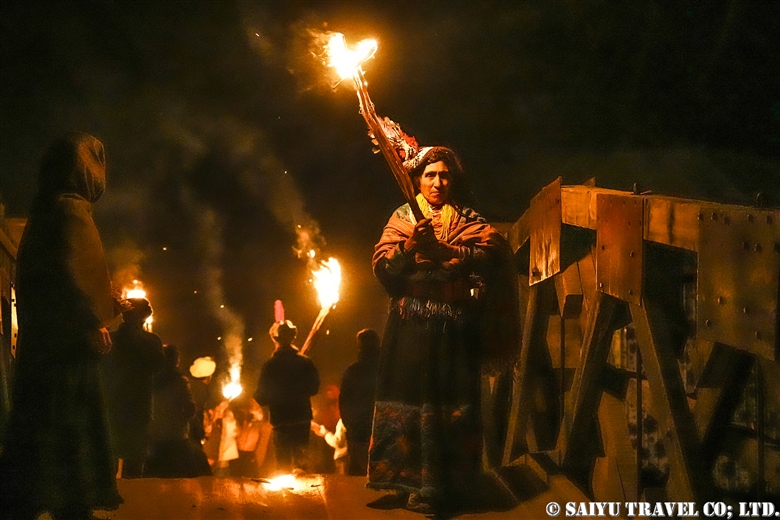
The fantastic sight of the Kalash holding torches.
When they arrive at the square, they throw the torches into the bonfire, fueling the fire and making it grow huge.
People singing and dancing around the fire.
For the Kalash people, Chawmos is the festival they enjoy most the whole year.
Chanja Rat: bidding farewell to Balimain.

Witnessing Chanja Rat that night proved to be a dreamlike experience for me. Seeing the Chawmos festival for yourself is a wonderful opportunity to deepen your understanding of Kalash traditions and faith.


Text: Mariko SAWADA

Photo: Mariko SAWADA & Jamil

Visit: Dec 2024, Kalash Valley – Khyber Pakhtunkhwa

*The information presented here is based on interviews with people in the area. Please note that the descriptions and explanations of the rituals may differ depending on the source.


■Chawmos Festival – Kutram: The Kalash Rituals Still Alive to This Day

■Chawmos Festival – Mandaik : The Kalash Rituals Still Alive to This Day

■Chawmos Festival – Shishao Adu: The Kalash Rituals Still Alive to This Day

■Chawmos Festival – Pushao Adu: The Kalash Rituals Still Alive to This Day

■Chawmos Festival – Chanja Rat: The Kalash Rituals Still Alive to This Day

■The Joshi Spring Festival: A Kalash Ritual


*Contact us, Indus Caravan for more information or to make arrangements for visiting Kalash valley.

*Please follow us on YoutubeInstagram & Facebook


Category : - Kalash Valley > ◆Khyber Pakhtunkhwa
Tag : , , , , , , , , , , , , , , , , , , , , , , , ,

Chawmos Festival – Pushao Adu: The Kalash Rituals Still Alive to This Day

The period of the Kalash Chawmos Festival known as “Ditch” is considered to be highly sacred. On the day of Pushao Adu, two sacrifices are performed: the first, called “Pushao Marat,” is a sacrifice to the gods done at Sajigor, and the second, “Istongas,” is a purification ritual for men. At the same time, a children’s rite of passage known as Goshnik is also performed.

At the guesthouse, the people were all abuzz with chatter. I heard them proclaiming that Balimain has arrived, and that the earthquake they’d had the previous night was actually the sound of Balimain’s arrival. They say that Balimain will stay to watch the sacrificial ceremony and the large bonfire at night, before moving on to the Bumburet Valley.

In the morning, all men in the valley wash their bodies and put on new clothes and shoes. The women wash all dishes and clean the house. After this, in addition to the existing rules about not touching Muslims, new rules are added until the sacred period is over. These rules state that no cleaning is to take place, that bread made before yesterday must not be eaten, and that bread must be made with new flour. Because of this, new dough was not available in time, so we had to have rice from Ayun for breakfast (which was very tasty).

Villagers singing and dancing from the early morning.

Pushao Marat – Sacrifice to God 

In the morning, the villagers gathered in the square to sing and dance, and at about 10:00 a.m., the large male goats selected from each family were taken to Sajigor. The men began to walk to Sajigor alongside the animals. Since women are not allowed to participate in the sacrificial ritual, this photo was taken by a Kalash man. While the ritual was happening, the women celebrated by singing and dancing.

Male goats for sacrifice go to Sajigor. The most magnificent male goat from each stable is chosen.
Upon arrival at Sadigor, preparations for the ritual begin.
A goat with fine horns like a markhor’s.
More than 30 male goats were sacrificed to the gods that day.
The altar of sacrifice.
The meat of the sacrificial goats is eaten especially during the sacred period and also used in a stew called Pushao Mos.

Goshnik – Rite of passage for children 

Goshnik is a rite of passage for children, after which the boy or girl becomes a member of Kalash and observes its commandments. The parents of the child who is to receive the rite prepare fruits and gifts for the uncle who performs the rite. The uncle offers a male goat as a present. The relatives gather for the celebration, and the parents serve fruit and wine. I also saw visiting relatives give money to children undergoing this rite.

An uncle performing the ceremony dresses his nephew in ceremonial garb.
Relatives receiving fruit, dried fruit, and wine from parents.
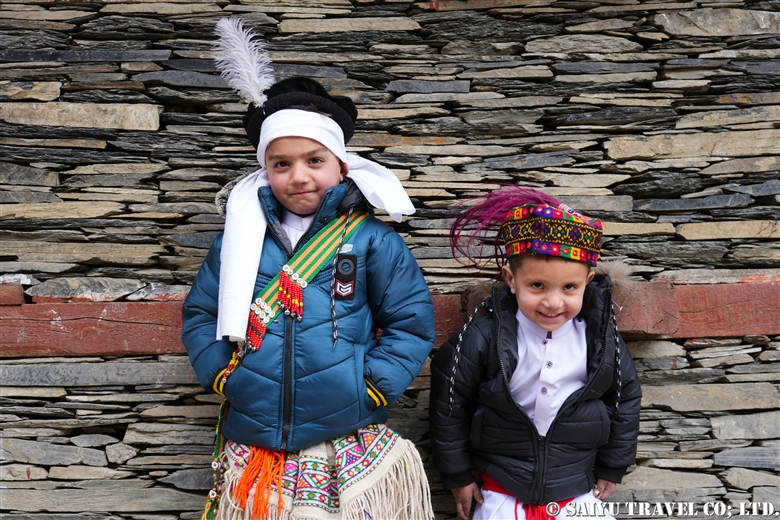
Two brothers who underwent the ceremony. Boys undergo the Goshnik ceremony twice, once between the ages of 3~5, and the second time between the ages of 5~8. Parents save money by having both brothers perform the ceremony at the same time. Incidentally, girls only have to undergo the Goshnik ceremony once.
Villagers travel around the houses singing and dancing, bringing blessings during the Goshnik ritual.
Villagers clap their hands and sing. The children respond by taking part in a ritual dance.

 Purush Istongas – Sacrifices for the Purification of Men

Sacrifices are performed on the roof of the goat stable. The blood of the sacrifice is sprinkled on the faces of the lined-up men in a purification ritual. The Istongas ritual is held in the evening. This photo was taken by a Kalash man.

The roof of the goat stable is purified and sacrifices are performed.
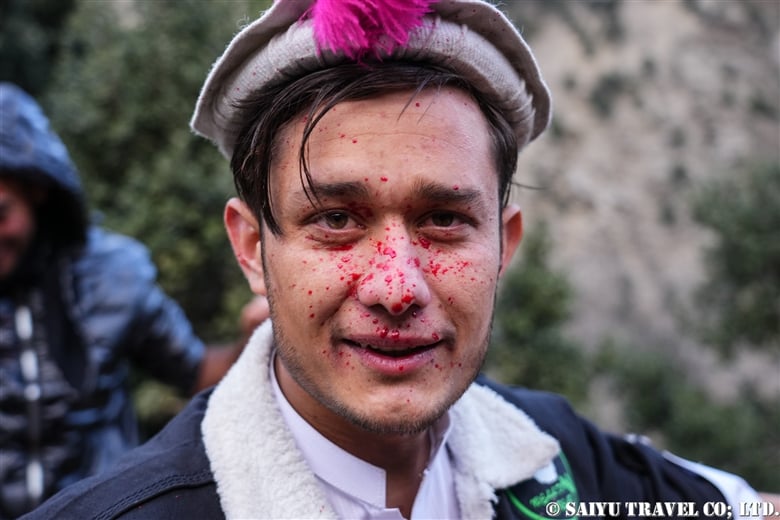
Blood is sprinkled.
A Kalash man who has now been purified.

The sacrificial goat will be dismembered here and become the meat that is eaten during this sacred period. On this day, I learned a great deal about the beliefs and lifestyle of Kalash, a place where the ritual of sacrifice is still alive.


Text: Mariko SAWADA

Photo: Mariko SAWADA & Jamil

Visit: Dec 2024, Kalash Valley – Khyber Pakhtunkhwa

*The information presented here is based on interviews with people in the area. Please note that the descriptions and explanations of the rituals may differ depending on the source.


■Chawmos Festival – Kutram: The Kalash Rituals Still Alive to This Day

■Chawmos Festival – Mandaik : The Kalash Rituals Still Alive to This Day

■Chawmos Festival – Shishao Adu: The Kalash Rituals Still Alive to This Day

■Chawmos Festival – Pushao Adu: The Kalash Rituals Still Alive to This Day

■Chawmos Festival – Chanja Rat: The Kalash Rituals Still Alive to This Day

■The Joshi Spring Festival: A Kalash Ritual


*Contact us, Indus Caravan for more information or to make arrangements for visiting Kalash valley.

*Please follow us on YoutubeInstagram & Facebook

Category : - Kalash Valley > ◆Khyber Pakhtunkhwa
Tag : , , , , , , , , , , , , , , , , , , , , , , , ,

Chawmos Festival – Shishao Adu: The Kalash Rituals Still Alive to This Day

The ceremony to welcome the god Balimain of Kalash had finally begun. The following is a report on the women’s purification day known as “Shishao Adu.”

The day before Shishao Adu is a day for preparing the stone slab with which the Shishao, the bread for the women’s purification ceremony, will be made. The men go into the mountains to look for suitable stone slabs and leave them in a safe place, so that the women don’t touch them until they are ready to use. Meanwhile, the women prepare the flour used to make Shishao.

A man carrying the stone slab to be used in the making of Shishao.

On the morning of Shishao Adu, women gather on the riverbank to prepare for the purification. They bathe in the hut and wash their hair. After this, they cannot bathe until the sacred period is over.

Girls making themselves ready.

Shishao Adu is a day of purification for women. After this day, no newcomers are allowed to enter the Rumbur Valley. No exception is made for foreigners, nor for Muslims living in the valley—they are likewise not allowed to enter the village of Kalash. The female Kalash relatives who come from Bumburet to celebrate the children’s rite of passage known as “Goshnik” must also undergo this purification. We foreigners were also purified. When I walked around the village, people asked me if I had showered, and if I was wearing new clothes. They believe that if anyone who does not follow the regulations of the Kalash religion is in the valley, it will bring them misfortune.

Shishao making begins at the Temple.

A man kneads purified dough to be used for the making of Shishao. The men’s hands are purified, and they are not allowed to touch anything other than the ingredients for Shishao—including themselves.

Using stone slabs and stones from the mountains, the men crush the walnuts which will act as filling for the bread.

Men are required to bake five Shishao for each female member of the family, and in families with many female members, baking Shishao can start even in the early morning.

The women’s purification ritual, Shishao Suchek, had begun. The women prepared new clothes, and some of the girls were dressed up almost as much as they are during the spring Joshi festival.

First, one must purify their hands with water.
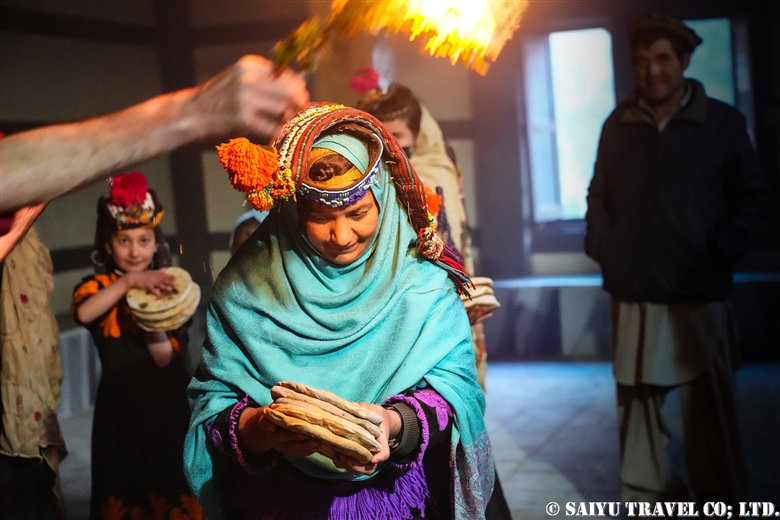
Five pieces of “Shishao” (walnut bread) are handed out.
The women are purified with smoke from a flaming juniper branch.

A woman with a very innovative headdress. She said her mother made it for her.

A traditional-style headdress known as a Kupas. Its colors are very modern. The traditional materials and colors that are typically shown in books are nowhere to be seen these days. It seems that Kalash women are always chasing the latest fashions.

The Shishao Suchek ritual at Temple Jestak Han had finally begun. Notably, it can also take place outside, in the open air.

Female members of the family gathering at the temple.
A girl receiving purification.
The female purification ritual, Shishao Suchek.

After this purification, the woman must remain pure for seven days. This involves a serious of strict rules, such as not touching Muslims, not eating chicken, eggs, cow’s milk & dairy products, honey, and so on.

Getting the opportunity to see these people live their lives and practice their faith was truly a beautiful sight.


Text & Photo: Mariko SAWADA

Visit: Dec 2024, Kalash Valley – Khyber Pakhtunkhwa

*The information presented here is based on interviews with people in the area. Please note that the descriptions and explanations of the rituals may differ depending on the source.


■Chawmos Festival – Kutram: The Kalash Rituals Still Alive to This Day

■Chawmos Festival – Mandaik : The Kalash Rituals Still Alive to This Day

■Chawmos Festival – Shishao Adu: The Kalash Rituals Still Alive to This Day

■Chawmos Festival – Pushao Adu: The Kalash Rituals Still Alive to This Day

■Chawmos Festival – Chanja Rat: The Kalash Rituals Still Alive to This Day

■The Joshi Spring Festival: A Kalash Ritual


*Contact us, Indus Caravan for more information or to make arrangements for visiting Kalash valley.

*Please follow us on YoutubeInstagram & Facebook

Category : - Kalash Valley > ◆Khyber Pakhtunkhwa
Tag : , , , , , , , , , , , , , , , , , , , , , ,

Chawmos Festival – Kuta Mru : The Kalash Rituals Still Alive to This Day

It is early December in the Kalash Valley. The harvests have all been completed and the livestock have come down from the mountains. The ceremony to welcome the God Balimain of Kalash has begun. It includes rites of passage, purification, and sacrifice—all culminating in a farewell to Balimain, complete with torches and a large bonfire. The following is a report on a trip that brought me into contact with the rituals of a deep faith that continues to thrive in the modern age.

During the sacred period of Chawmos, Muslims are not allowed to enter the valley. Since neither staff nor drivers from Islamabad could enter the valley, Kalash staff came to Ayun to pick me up.

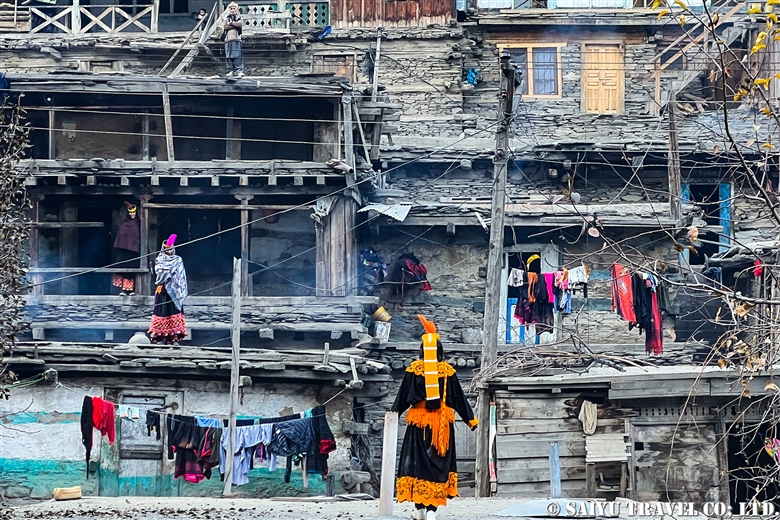
In the village of Kalash, a lot of laundry was hung out to dry to ensure people can wear new clothes during the sacred period. Before the purification ritual, one must take a bath and put on new clothes.

Sharabira displayed in a house

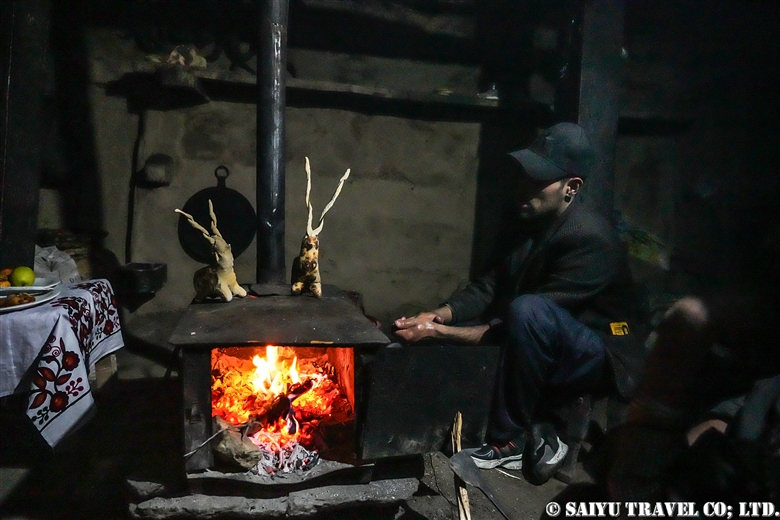
I made it just in time to be able to observe the Sharabirayak ritual in the Bumburet Valley. The word “Shara” means markhor and the word “Bira” means male goat. After the women bake walnut bread with cheese to be distributed the next day, the men knead dough, which they shape in the form of either markhor or male goats. These statues are then baked in a fireplace. This ritual is called Kuta Mru.

Sharabira making takes place at night. When I visited, there was no electricity in the valley, and I was able to glimpse the beautiful sight of a woman baking walnut bread by the light of a stove fire.

Afterward, the purified man kneads purified dough and begins to sculpt animal shapes.

He proceeded to bake them on the stove.

The completed sharabira on display

The ritual of Kuta Mru is performed in each household as well as in the temple of the goddess Jestak. The wheat collected from each family is used to make a Shara (markhor) at the Jestak Han temple. At night, the men gather to make Sharabira and spend the night painting on the walls and drinking until early in the morning. At around 4:00 a.m., they make a “tchich tchich” sound—intended to resemble the call made when chasing goats—urging the Sharabira to go to a place called “Dezelawat.” The people of Kalash believe that the souls of the Sharabira go to Dezelawat, which is located near the Afghan border.

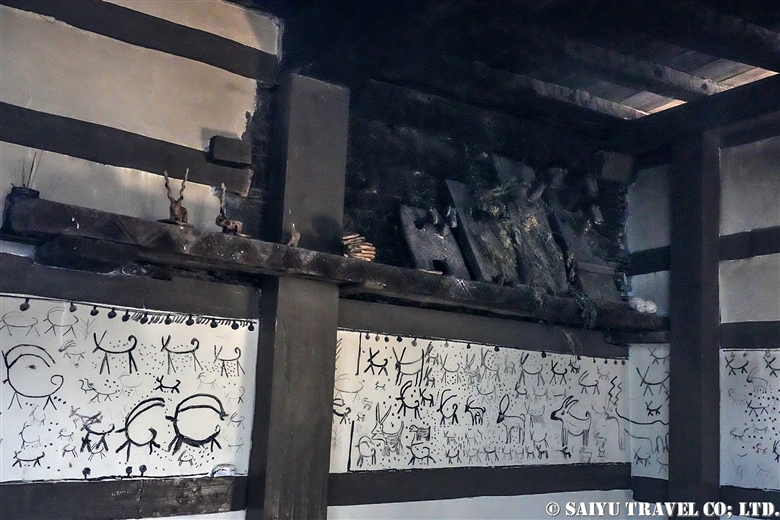
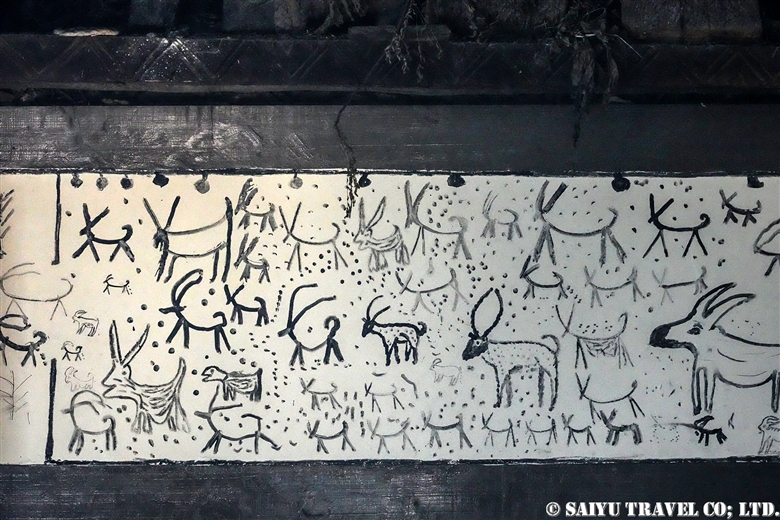
A drawing of Sharabira on the wall of the Jestak Han temple. Three Shara (markhor) are placed by the altar.

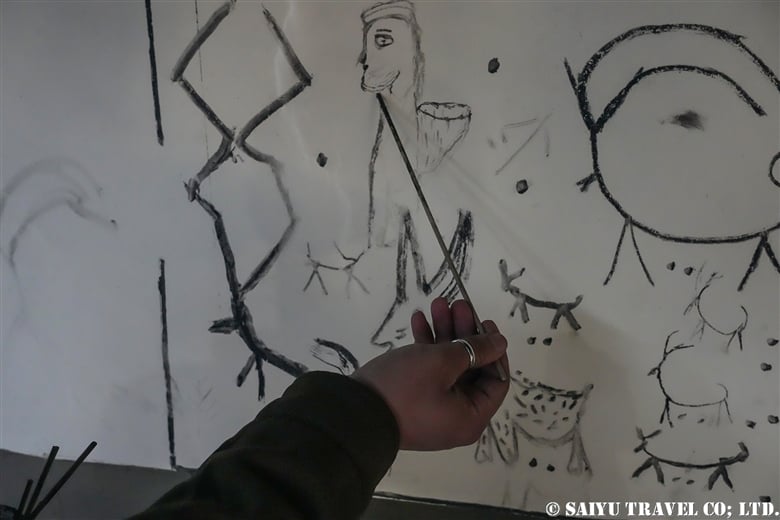
The drawings on the walls of the temple are painted with charcoal made from burning walnut bark prepared by the women.

A painting from Kutram in 2024

For those unfamiliar with the markhor, it is the national animal of Pakistan and is known to be extremely valuable for trophy hunting. In the 2024-25 winter hunting season, permission to hunt three Kashmir markhor was given, and each was auctioned off for between $231,000 and $271,000. It is said that 80% of the income from trophy hunting is returned to the local community, and in order to increase the number of trophies, conservation is carried out. Though this initiative has led to the number of markhor increasing, as someone who loves animals, I feel rather conflicted about this.

Kashimir markhor (Toshi Shasha game reserve)

The markhor is a highly sacred animal to the people of Kalash. They can be seen in Chitral Gol National Park and nearby game reserves. Males with large horns are usually found at higher elevations in the mountains, but during the winter breeding season they come down to lower elevations, making it possible to observe them. The variant in this region is a subspecies, and is known as the Kashmir markhor.


Text & Photo: Mariko SAWADA

Visit: Dec 2024, Kalash Valley, Toshi Shasha – Khyber Pakhtunkhwa

*The information presented here is based on interviews with people in the area. Please note that the descriptions and explanations of the rituals may differ depending on the source.


■Chawmos Festival – Kutram: The Kalash Rituals Still Alive to This Day

■Chawmos Festival – Mandaik : The Kalash Rituals Still Alive to This Day

■Chawmos Festival – Shishao Adu: The Kalash Rituals Still Alive to This Day

■Chawmos Festival – Pushao Adu: The Kalash Rituals Still Alive to This Day

■Chawmos Festival – Chanja Rat: The Kalash Rituals Still Alive to This Day

■The Joshi Spring Festival: A Kalash Ritual


*Contact us, Indus Caravan for more information or to make arrangements for visiting Kalash valley.

*Please follow us on YoutubeInstagram & Facebook

Category : - Kalash Valley > ◆Khyber Pakhtunkhwa
Tag : , , , , , , , , , , , , , , , , , , , , , , , ,

The Joshi Spring Festival: A Kalash Ritual

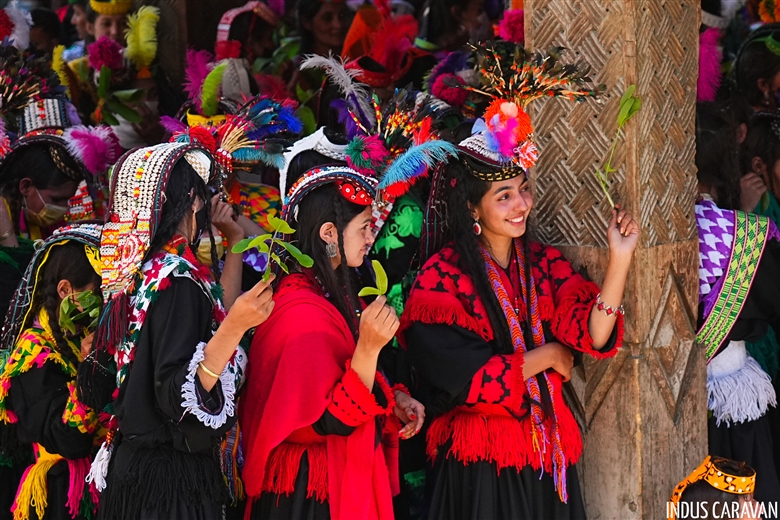
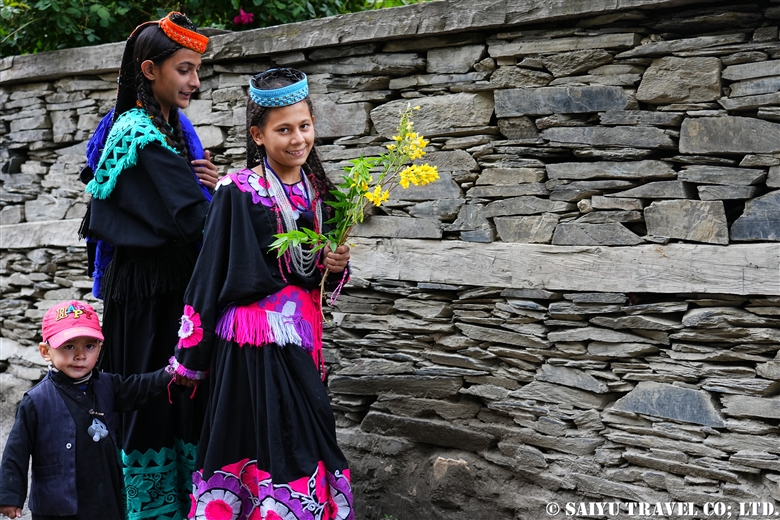
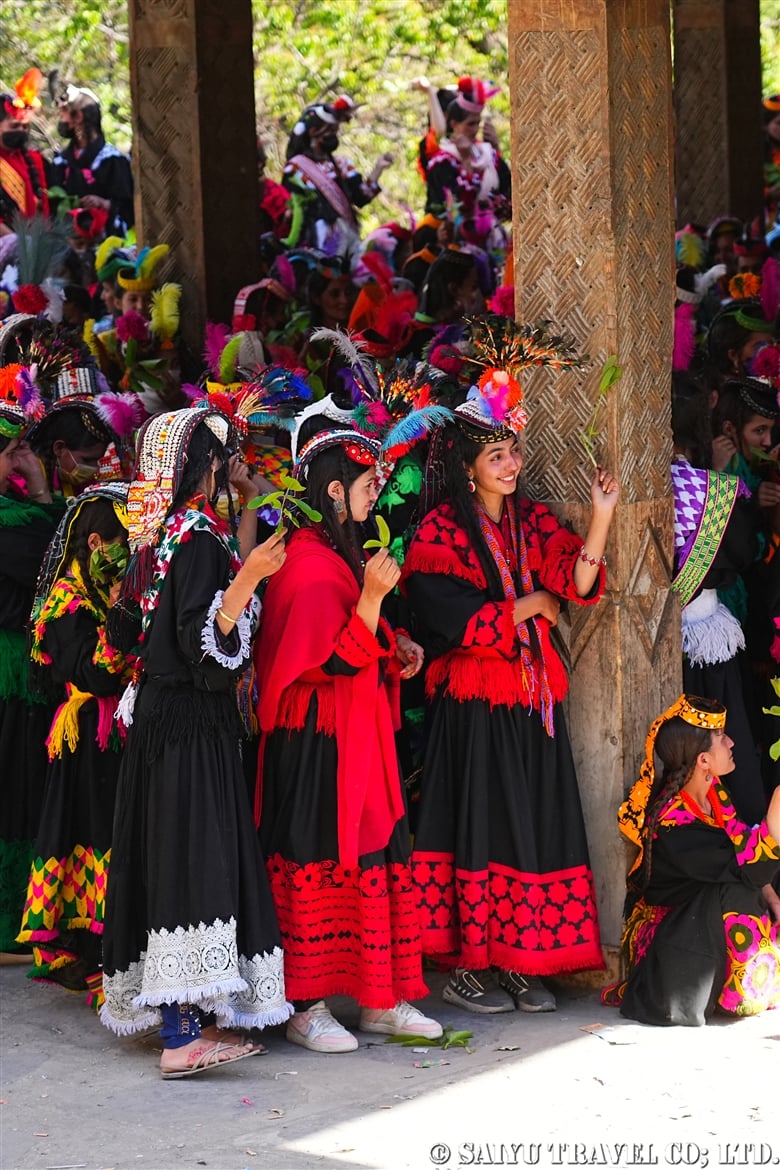
The Joshi Festival is held at the end of the long winter to celebrate the arrival of spring. Locals dress up in new clothes made during the winter and pray for the safety of livestock going out to pasture in the summer after the festival. The festival also serves as a place where young men and women can meet.

It has been a while since I last attended the Joshi festival. In the past few years, Pakistan’s frontier has been experiencing overtourism, with tourists from not only Europe and the United States but also Thailand, Malaysia, and other Southeast Asian countries now flocking to the area. In contrast, the Kalash Valley is dominated by Western tourists.

I was surprised to see the changes in the Chilam Joshi Festival via photos which recent Pakistani tourists upload on social media—for those who knew Kalash in the past, it may be an unfortunate sight to behold. I would like to share with you some of the rituals of the Joshi Festival that I experienced in the spring of 2024. The names, spellings, etc., were provided by the local people who guided me, and may differ from those found in official literature on the matter: I am merely presenting them as I saw and heard them in the field.

 To the Kalash Valley

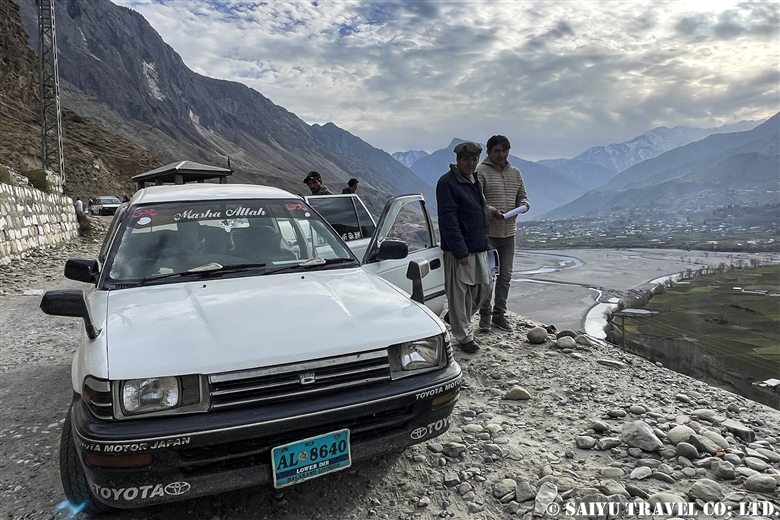
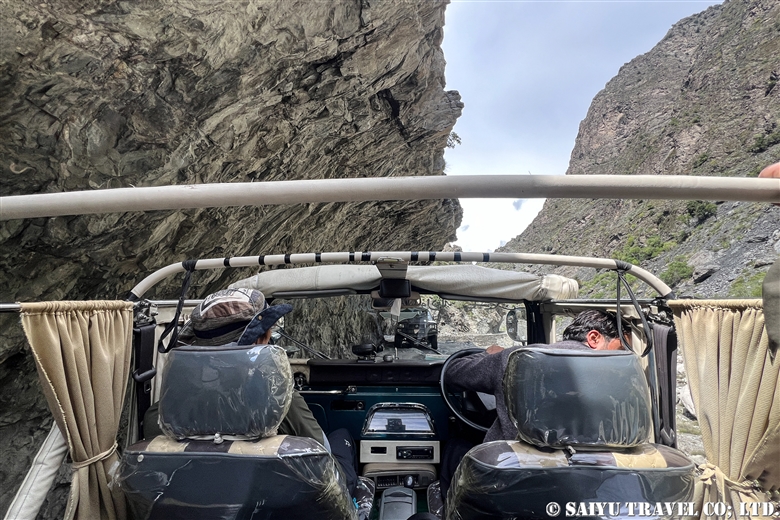
Although the suspension bridge across the Kunar River has been replaced by a concrete bridge, the traditional Ayun “villagescape” remains. Continuing on the road, there is a place where you can see the highest peak of Hindu Kush, Tirich Mir (7,708m), and if you keep going, you will drive along the river off-road with some overhanging cliffs. Then, starting from a suspension bridge, the road leads to the Bumburet valley on the left and the Rumbur valley on the right.

The road to Kalash valley

The Joshi festival of Kalash includes several rituals.

Picking Bisha Flowers (Pushen Parik)

Children go into the mountains to pick bisha flowers for temple decorations and, in the case of the Bumburet valley, for the Chirik Pipi ceremony. The bisha is a member of the bean family Piptanthus Nepalensis, and blooms earlier than other flowers. For the Kalash people, it is considered the flower that heralds the arrival of spring.

Girl heading home after picking bisha flowers

Temple Decorations (Pushi Behak)

Decorating a house or temple with bisha flowers is called pushi behak. In the Rumbur Valley, people were gathering flowers until evening, and at around 8:00 p.m., children gathered together until the start of the decorating ceremony. Around 9:00 p.m., someone banged a drum and the children all began to dance. After about 30 minutes of dancing, the children moved to their sleeping places. Early in the morning around 3:00 a.m., children carrying bisha flowers amd walnut branches started walking to the Temple of Jestak Han. At the entrance of the temple, last year’s flowers were removed and everyone decorated the temple with new flowers and walnut branches. After the outside was finished, they went inside to the altars of the four clans of the village, situated in the corner of the temple. One child went up as a representative, took down the old flowers, and decorated the altars with new ones. Then they went out to the square and danced for about half an hour.

Children heading to the Temple with bisha flowers and walnut branches
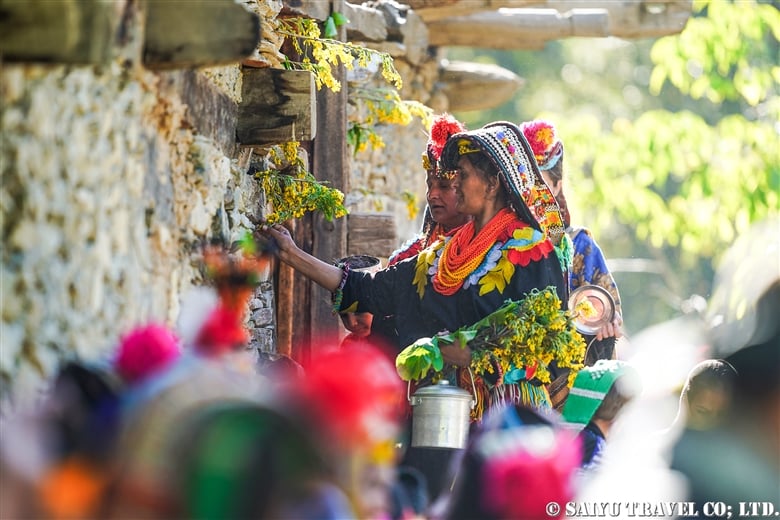
Women adorn the outer walls of the Temple of Jestak Han. Jestak is the goddess of family life, family, and marriage; the residence in which this goddess lives is called Jestak Han.
Inside the Temple of Jestak Han. When last year’s flowers are taken down, the altars of the village’s four clans are revealed
Altars covered with new bisha flowers and walnut branches

Baby Purification Ceremony (Gul Parik) in the Rumbur Valley

Gul Parik in the Rumbur Valley is performed on babies born during the period between festivals. For the Gul Parik ceremony performed during the Joshi festival, this includes babies born between the Chaumos festival in December and the Joshi festival in May. The mother and baby are considered “impure” before this ceremony, and Gul Parik purifies them both, while also acting as a prayer for the health of the baby.

The man who performs the ceremony purifies himself and the place where he bakes the ceremonial bread. He makes the sacred walnut bread from special flour that has been purified and prepared for this ceremony, using similarly purified tools. At least five pieces of bread are baked for the men and five for the women (each with a different flour), and about twenty pieces are baked, including those to be served.

Purified flour, walnuts and rock salt prepared for baking sacred bread for women and men
Man crushing walnuts and rock salt
Sacred Walnut Bread

After the sacred walnut bread is baked, the mother and baby appear in the temple and the ceremony begins.

Gul Parik, Baby Purification Ceremony

It was an amazing experience to be in such a divine space and to witness the unique “world” of Kalash prayer.

Milk Ceremony (Chirik Pipi)

The Chirik Pipi in the Bumburet valley in the morning,  girls gather with milk containers and bisha flowers collected the day before. When the ceremony begins, all the children and ladies go to the sacred livestock shed. According to the villagers, this is sacred goat’s milk that has been stored since May 1st. It is then given out to the women. Normally, the Chirik Pipi song (flower song) is sung here, but I did not get the chance to hear it. There are not one but several livestock sheds, and we visited two of them. Afterwards, we witnessed a beautiful scene of villagers dancing with the mountains in the background.

Kalash people gather to sing and dance before the ceremony
Children gathered with milk containers in hand
Distribution of milk from purified livestock. Chirik Pipi Ceremony
Women coming out of a livestock shed decorated with bisha flowers after receiving milk
Women dancing after the ceremony

Baby Purification Ceremony (Gul Parik) in Bumburet Valley

The Gul Parik in Bumburet is a different style of ceremony from that in Rumbur. All babies and mothers born since last year’s Joshi festival are purified, and prayers are made for the health of the babies. (There are actually several purification ceremonies—this is the final stage of the purification.)

A basket of walnuts and dried mulberries is delivered from the house where the baby is born to the village center. When signaled, the women of the village and the mothers and babies who are to undergo the ritual move to the area near the livestock shed. Then, a man from the village who has been assigned to perform the ritual throws milk at the gathered women and babies to purify them.

After the ceremony, the women gather again in the center of village, where baskets of walnuts and mulberries are distributed to everyone, including the tourists! Then, everyone returns to their homes to prepare for the “small Joshi (festival)” of Bumburet to be held on the same day.

Carry a basket of walnuts and dried mulberries. In some villages, it may be cheese
Mother and baby on their way to the purification ceremony
The man (chir histau) on the roof purifies the women and their babies with milk. This ritual is called Chirhistic
Walnuts and mulberries being distributed. The dog in the photo stayed with them throughout the ceremony. It seems that the people of Kalash and their dogs are very closely connected

 Joshi Festival in the Rumbur Valley

After a series of ceremonies, the small Joshi festival (Satak Joshi) and the big Joshi festival (Gonna Joshi) are held. The festival is held in a covered venue and attracts a large number of tourists.

The small Joshi consists of repeated drumming, singing, and dancing, including Cha (a fast tempo song), Dushak (a slow tempo song), and the more complex Dalaija-i-lak, while the big Joshi includes a ceremonial performance at the end.

Kalash songs consist of drumming and singing, with limited melodic repetition. The lyrics are said to vary from ritualistic, to those touching on the mythology and history of Kalash, to those about love, and so on. The basic purpose of this music is to pray for a good harvest of milk and for the Kalash people to reaffirm their common identity.

At the end of the Joshi Festival, the special songs “Gandori” and “Daginai” are performed.

”Gandori” Both women and men hold walnut branches in their hands and wait for the moment to throw them

Daginai is a song that concludes the Joshi. It is a tragic love song, sung in a Cha melody. During the song, people dance in a chain connected by a string or cloth (originally woven from willow branches). It is said that if this chain breaks, it will bring misfortune, so everyone desperately grips the string. At the end, the sound of the drums suddenly stops, and all throw this cloth at once, ending the Joshi.

”Daginai” a dance connected by strings

Lyrics of “Daginai.” (From article of “Kalash Symphony ‘Joshi’,” by Reiko Kojima, published by National Museum of Ethnology Japan in 1991)


Daginai, o’er the great valley
Some moons before the fest of Uchal, to the mountain pasture I took
O Daginai, O Daginai
With white-hilt blade, my bare stomach pierc’d
O Daginai


The background of this song is a tragic love story that is familiar to all Kalash people.


Once upon a time, a man fell in love with his wife’s sister.

Overwhelmed by jealousy, the wife killed her sister using snake poison, all while her husband was out on the pasture.

By the time he returned, the snake’s poison had already turned his lover yellow as a bisha flower; no life remained in her body.

In the throes of his sorrow, he sang the song “Daginai” and threw himself belly-first upon a blade, ending his life.

The man and his love were placed in separate coffins to rest, but when the next morning came, they were found together, sleeping peacefully beside each other.

Stunned by this, the village people separated them, returning them to their proper places. The next day, however, the couple’s bodies were found reunited in the same coffin once again.

So strong was their love, that not even death could part them.


Young people in Kalash today

The Joshi Festival is also significant because it acts as a meeting place for men and women. Traditionally, after the Joshi Festival, people go to their summer pastures, meaning the Uchaw Festival in late August (which is held after they return) is where the romance really happens. During the Uchaw Festival, the same stage as the Joshi is used, but this time only young men and women dance at night—in the hopes of finding a partner.

”Gandori”

A gentleman who has been attending the Kalash Spring Festival for more than 25 years told me that although the Kalash costumes and the lifestyle of the young people have changed, the rituals are still the same as they were 25 years ago.


Photo & Text: Mariko SAWADA

Reference :”Kalash Symphony ‘Joshi’,” by Reiko Kojima, published by National Museum of Ethnology Japan in 1991)

*Contact us, Indus Caravan for more information or to make arrangements for visiting Kalash valley.

*Please follow us on YoutubeInstagram & Facebook

Category : - Kalash Valley > ◆Khyber Pakhtunkhwa
Tag : , , , , , , , , , , , , , , , , , , ,

Hunza, “Shangri-la” surrounded by apricot blossoms

In late March, the Hunza Valley is blanketed in pale pink apricot blossoms. The fields are green with wheat sprouts. After the independence of India and Pakistan in 1947, the Hunza was ruled by a dynasty until 1974. The valley is inhabited by the people of Brusho, who speak Brushaski.

Hunza is touted as the “Shangri-la” and is known as the “Village of Longevity.” This beauty and the life of this village supported by fruit trees, may be the “secret of longevity” that it is famous for.

Burushaski, the language spoken by the people of Brusho, is an “isolated language” that has not been found to be associated with any other language. It is said that they are the descendants of language groups that existed in this area before the arrival of the Indo-Aryan people. Burushashki-speakers also live in the Hunza Valley, the Nagar Valley across the Hunza River, the Yasin Valley leading to the Wakhan Corridor, and the Ishkoman Valley.

This is a view of the center of Baltit village. In the past, large buildings were limited to the surrounding of the Baltit Fort, which was the castle of the feudal lord, and the Darbar Hotel, but now large buildings (hotels) are becoming more prominent.

Rakaposhi peak (7,788m) seen from Baltit Village. It is in a mountain in the Nagar Valley on the opposite bank of the Hunza River and is a famous peak that can be viewed from everywhere in Hunza.

Also Diran Peak (7,266m) as seen from Baltit Village.

I walked between Altit Village and Duiker Hill, where the flowering apricots bloom.

The apricots in full bloom. You can see just how important the apricot trees are in the lives of the villagers, the fruit, its seeds and the oil taken from the seeds.

Altit Village was covered with many apricot trees. You can meet the beautiful villagers while walking around the village. The people of Hunza  are white in appearance and many of them have light hair.

I met such lovely children this day.

For lunch that day, we had local Hunza cuisine prepared at  Amin’s house in Baltit Village.

Photographer Toshiki Nakanishi had just come to Hunza for a phototour, where he was taking pictures of the local cuisine as it was being made.

Here they were preparing Dowdo soup, a dish representative of Hunza.

They made such a delicious cheese chapatti (called Burus Sapik in Burushaski). Hunza cheese, mint, tomato, green onion, onion and fruit oil wrapped in wheat chapatti. It is very healthy, and it is recommended for vegetarians who come to Pakistan and have trouble finding things to eat.

Today’s lunch. Local cuisine with plenty of fruit oil and Hunza’s local wine are so wonderful.


Photo & text: Mariko SAWADA
Visit: March 2023, Hunza, Gilgit-Baltistan

*Contact us, Indus Caravan for more information or to make arrangements for visiting Hunza, Northan Pakistan.

*Please follow us on YoutubeInstagram & Facebook

Category : ◆ Gilgit-Baltistan > - Hunza Valley
Tag : , , , , , , , , , , , , , , , , , , , ,

Souvenir from Hunza

Surrounded by the 7,000m-class high peaks of Karakorum, this Hunza village is famous for the amazing pink apricot flowers that bloom all over the valley.

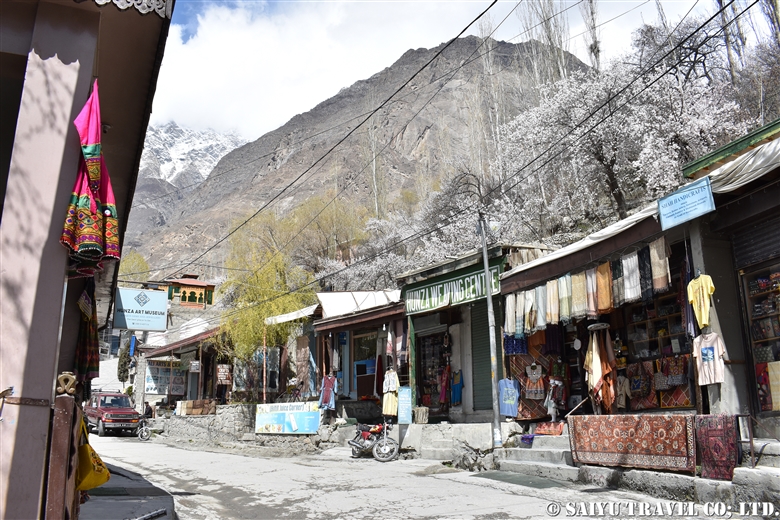
The main street of Karimabad, the center of Hunza, which is lined with stalls selling local products. It’s not very big, but it’s a place where you can go casually and enjoy a stroll while sightseeing.

Bazaar at Karimabad

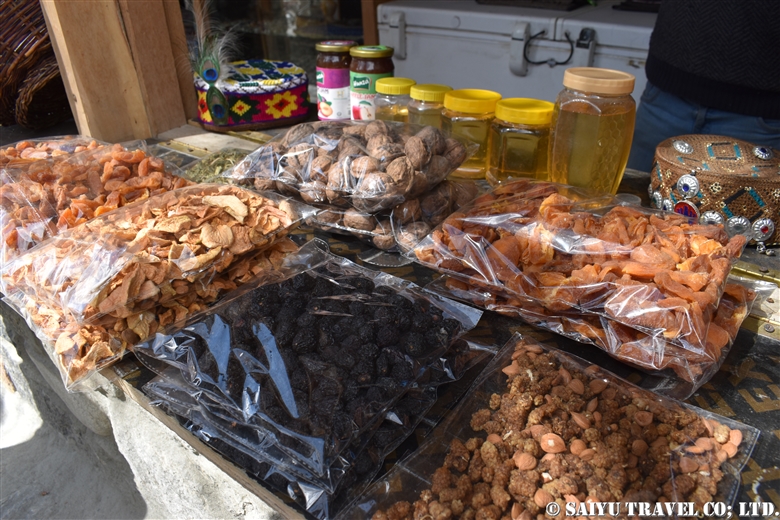
First of all, I will introduce dried fruits and nuts, which are the specialties of Hunza.

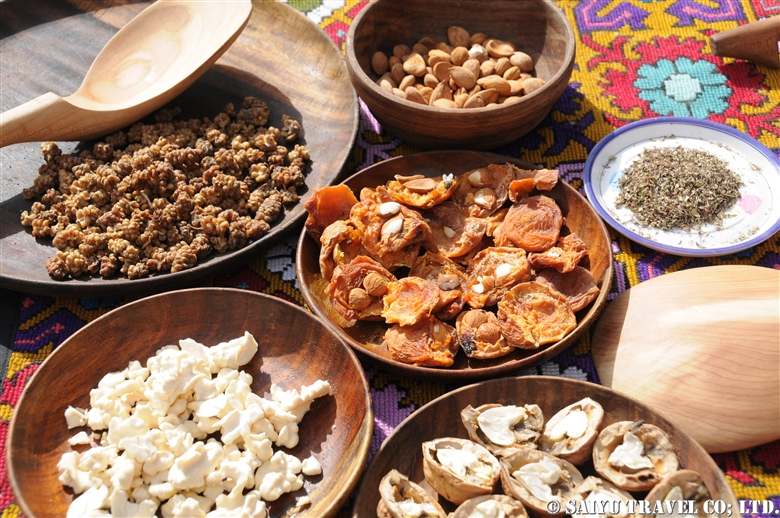
In Hunza, where apricots and other fruits thrive, the seeds are removed immediately after they are harvested. The fruits are then preserved by being dried in the sun, then sold in the market. The dried apricots are browner in color and have a firmer texture than common ones you might see in other places, but this is just proof that there are no additives in them. The more you chew the dried fruit, the more the gorgeous apricot flavor fills your mouth, and the taste becomes addictive.

The fresh nuts that are the most famous are walnuts, almonds, and apricot seeds. Apricot seeds look a lot like almonds at first glance. But you can enjoy that unique scent of the apricot that is familiar with almond tofu (the name is also confusing but it is because the two nuts are so similar). Although it has a slightly bitter taste, it is said to have the effect of boosting the immune system.

In addition, I also recommend you try the cherries, mulberries, and dried pears, as they are hard to find anywhere else.

Dried fruits sold at a souvenir shop

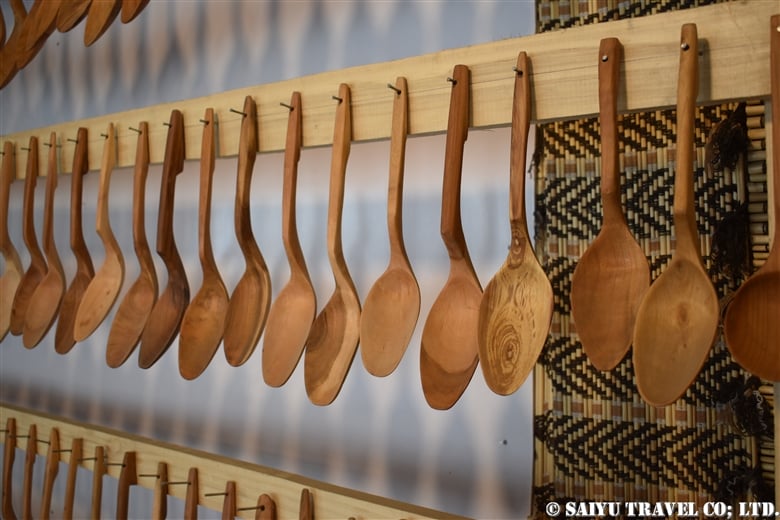
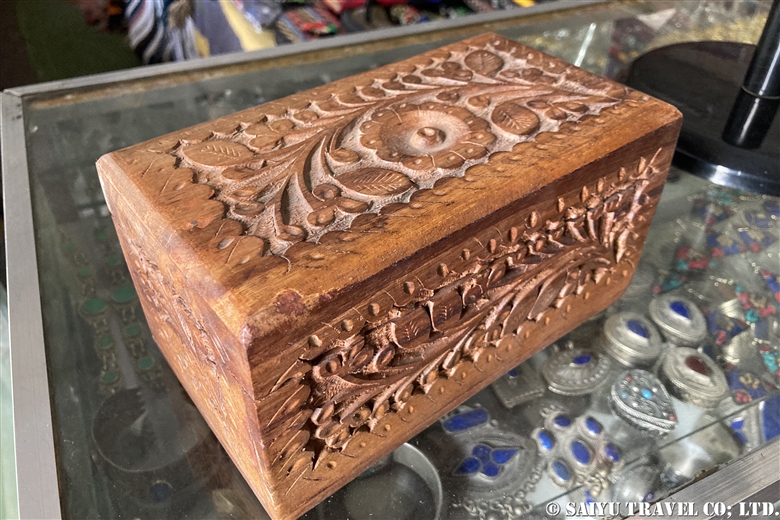
At the bazaar, souvenirs of wooden products are also conspicuous. Apricot trees and walnut trees are also suitable for woodwork, so there are ornaments, accessory cases, and tableware made from these woods.

A spoon made of apricot and walnut wood. Each piece is handmade by an artist every day.

Intricately carved tissue box

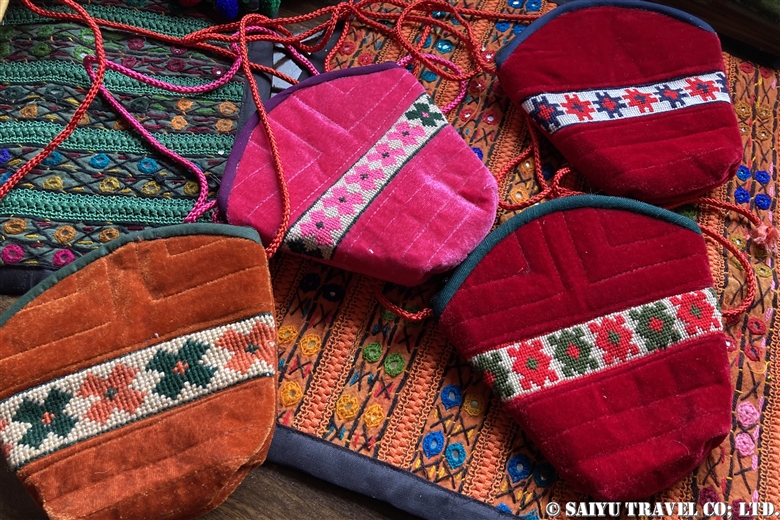
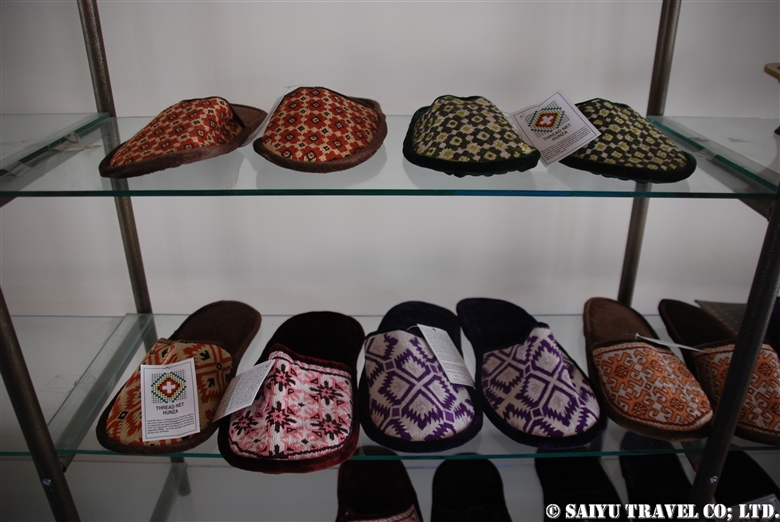
Handicrafts with traditional Hunza embroidery are also popular souvenirs. Bright embroidery is applied to wool bags, slippers and hats.

Pouches
Slipper

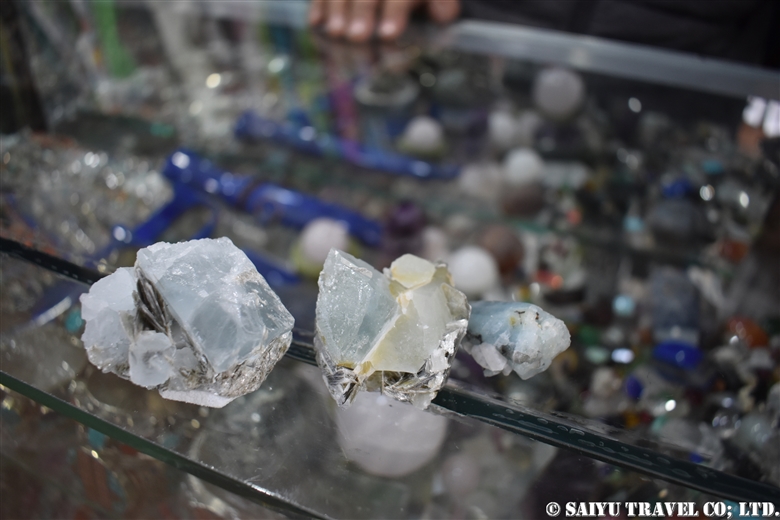
In addition, northern Pakistan around Hunza is the origin of many natural gemstones. Specialty stores sell colorful natural stones such as crystal, aquamarine, topaz, garnet and black tourmaline; and small rough stones can be obtained at relatively low prices.

Searching for your favorite stone or a birthstone will also make a special souvenir.

Aquamarine stone

When you are wanting to take a quick break while exploring the bazaar, I recommend stopping by Cafe De Hunza.

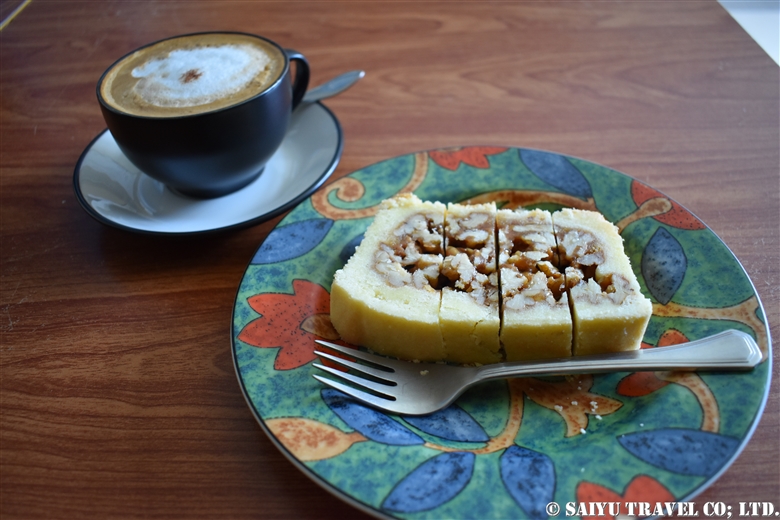
Here, you can enjoy the famous walnut cake made with plenty of locally produced walnuts.

The cake goes very well with coffee. You can also take the cake home.

A famous cake filled to the max with caramel-wrapped walnuts

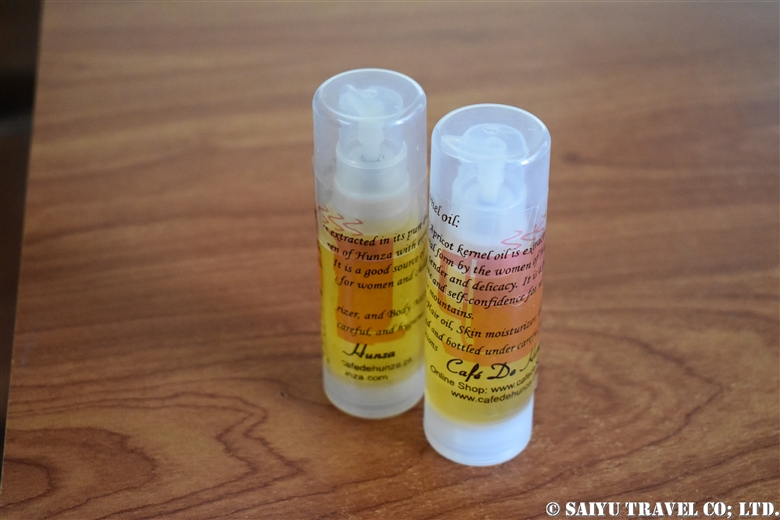
Cafe De Hunza also sold apricot oil for souvenirs.

It has a nourishing effect for sore throat, and it is a versatile oil that can also be used for skin care, as it has a very smooth application.

Apricot seed oil

Dried fruits, woodwork, nuts, oil and apricots are used in everything by the locals. For the people of Hunza, apricots are essential and a very important part of their lives.

There are many things that I haven’t introduced yet, but when you visit Hunza, why don’t you take a walk around the bazaar and look for the Apricot Blossom Spring Valley souvenirs that are unique to this beautiful place?


Photo &Text : Madoka Nishioka

Visit : March 2023, Karimabad, Hunza, Gilgit-Baltistan

*Contact us, Indus Caravan for more information or to make arrangements for visiting Hunza, Northan Pakistan.

*Please follow us on YoutubeInstagram & Facebook

Category : ◆ Gilgit-Baltistan > - Hunza Valley
Tag : , , , , , , , , , , , , , , , ,

Indus Highway, trip to Interior Sindh

First of all, I would like to express my heartfelt sympathy to those who have been affected by the flood disaster caused by the torrential rain from June to August 2022. Restoration work is progressing in some areas, and travel arrangements to Sindh and Balochistan regions were made, though we could see different sights than before, such as flooded fields.

The National Highway 55 (N-55), commonly known as Indus Highway, which goes north from Hyderabad, is a lifeline of West Sindh running through the west bank of the Indus River. During the fall harvest season, many trucks travel the road loaded with grain and chaff.

This year, due to the summer disaster, both sides of the road were still flooded, and there were many places waiting for the water to recede, unable to harvest the fields.

In some places, the fields were so water-logged they looked like lakes. I was sad to see so many people who had lost their homes and living in camps.

While some fields were water-logged, there were others that were being harvested. November is the season for harvesting rice.

I was really grateful to see this beautiful sight, which in any other time, would have been totally normal.

They were working on transferring the roadside piled up rice husks onto the trucks. Using wooden sticks to support it, they used sticks to create giant balloon-like cargo structures on the tops of the trucks.

A camel carrying firewood came our way. It is brought from the villages to the collection areas along the Indus Highway.

This firewood is an important fuel in the villages.

A handmade bell was decorated with cowry shells. A very traditional decoration, this is a camel very cherished by the owner. 

I was having lunch at a restaurant along the Indus Highway when I was invited to a wedding in the hall next door. “Wedding Gifts” decorated with bank notes were hung around the groom’s neck one after another.

Travelling on the Indus Highway with a different scenery than usual, we will soon enter the east road and reach Mohenjodaro. There were many submerged fields on the way to Mohenjodaro. I pray that the water will recede soon.

Photo & text: Mariko SAWADA
Visit: Nov 2022, Indus Highway, Sindh
*Please contact us for your own personalized itinerary.

*Please follow us on Youtube, Instagram & Facebook !

Category : - National & Indus Highway > ◆ Sindh
Tag : , , , , , , , , , , , , , , , , , ,

TOP