

English / Japanese

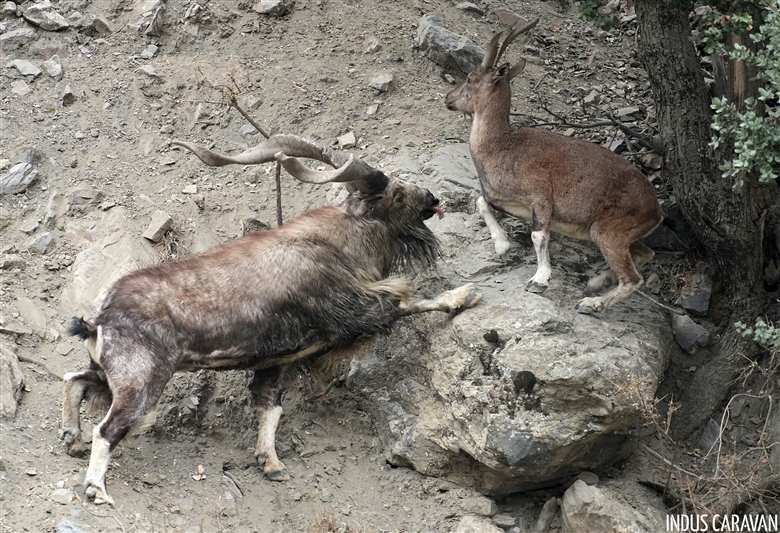
Kashmir Markhor in rut

Here is a report on the Kashmir Markhor I observed during the breeding season. Last time, they were still clashing horns to determine their ‘rank,’ but this time, the hierarchy was already settled. I was able to observe the ‘lovey-dovey’ pairs in full swing.


 Kashmir Markhor

The Markhor is one of the world’s largest species of wild goats, inhabiting the rugged mountain ranges spanning Central and South Asia. While its name means ‘snake eater’ in Persian, it is actually a herbivore. Its most striking feature is the magnificent spiral horns found on the males; I was absolutely stunned when I first saw them. Currently, three subspecies are said to live in Pakistan. The ones found here at the foot of the Hindu Kush mountains are known as Kashmir Markhor, characterized by their wide-flaring horns that curve in a graceful, gentle spiral.

↓↓ Kashmir Markhor in rut

There are a few reasons why the tongue stays out. One is the state of excitement unique to the rutting season, and the other is part of the Flehmen response. By curling back the upper lip, the Markhor exposes the ‘Jacobson’s organ’ to intake pheromones. Sticking the tongue out is thought to help sense chemical signals more directly and regulate airflow to send scents to the organ. This is how males check if a female is in heat. Nature is truly amazing!

↓↓A Kashmir Markhor exhibiting the Flehmen response(10 seconds clip)

Excited males may even chase females down to the riverbanks. This is a rare chance to observe Markhors at close range
Too close for a telephoto lens!
A male and female in rut
Even on the steep rocky cliffs, the male continues to chase the female

On a side note, I used a KOWA spotting scope with a smartphone adapter this time, and it worked brilliantly! I highly recommend it because everyone can view the screen together. The locals in Pakistan were actually quite envious of the setup!

So far, I’ve successfully observed two of Pakistan’s three Markhor subspecies: the Kashmir Markhor and the Astore Markhor. However, the Suleiman Markhor remains a major challenge, and I haven’t even been able to visit its habitat yet. If you have a moment, search for images of the ‘Suleiman Markhor’—its horns are absolutely mind-blowing! I hope to fulfill this dream one day.


Image & Text : Mariko SAWADA

Observation : Dec 2025, Chitral, KPK

*Contact us, Indus Caravan for more information or to make arrangements for Wildlife tour in Pakistan.

*Please follow us on YoutubeInstagram & Facebook

Category : = Video Clip KPK > ◆ Video Breathtaking Views of Pakistan > ◆Khyber Pakhtunkhwa > - Markhor > - Chitral > ◇ Wildlife of Pakistan
Tag : , , , , , , , , , ,

Experience the Joshi Festival: Days in Kalash Valley (Vlog)

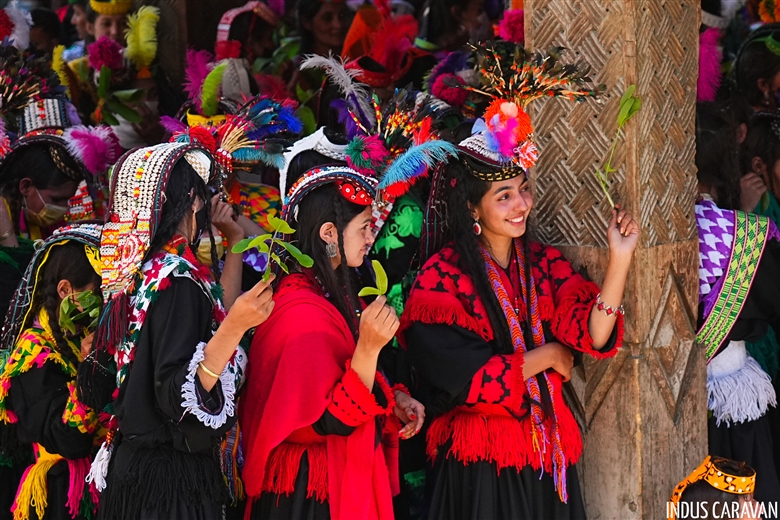
As May arrives, the Kalash Valley awakens in its full glory. We’ve woven together the essence of the Joshi Festival—from the intimate ceremonies to the vibrant energy of the final day.

Joshi Festival Kalash Valley

Blog : The Joshi Spring Festival: A Kalash Ritual


Image & Text :  Mariko SAWADA

*Contact us, Indus Caravan for more information or to make arrangements for visiting Kalash valley.

*Please follow us on YoutubeInstagram & Facebook

Category : = Video Clip KPK > ◆ Video Breathtaking Views of Pakistan > - Kalash Valley > ◆Khyber Pakhtunkhwa
Tag : , , , , , , , , , , , , , , , ,

Chawmos Festival – Mandaik : The Kalash Rituals Still Alive to This Day

Here is a report on the Kalash’s Chawmos Festival. The day after the ritual of ‘Kuta Mru’, the ‘ Mandaik ‘ takes place.”

I woke up at about 4:00 a.m. to the sound of villagers shouting ‘Chi, chi, chi.’ They were ushering the spirits of the Shalabira (sacred figures of markhors and goats made during ‘Kuta Mru’) to the mythical land of Dezhirawat.”

> Read more about the ‘Kuta Mru’ ritual here


Mandaik: The Ritual to Welcome Ancestral Spirits

In the Kalash language, “to arrive” is called “ik” and “cemetery” is “Mandaw jaw.” Therefore, the terms Mandaik or Madahik literally mean “arriving from the cemetery.” On this day, the Kalash people honor their deceased ancestors, creating a spiritual bridge that unites the living and the dead.

From the morning, people visit the homes of those who have lost family members during the past year. At each home, two specific types of bread are baked for the temple rituals, along with assortments of fruit prepared as sacred offerings.

As dusk falls, the community gathers at the Jestak Han temple. Outside, rows of baskets filled with food for the deceased are carefully placed. Near the temple entrance, a small, tower-like structure called a “Chilikotik” is built from Chilgoza pine sticks.

As more villagers gather, and once the Chilikotik is complete, everyone enters the temple carrying small branches. The Chilikotik is set ablaze, the temple doors are closed, and the people wait inside together until the structure has burned down completely.

According to tradition, a village elder or priest (Kazi) calls out loudly to the spirits: “O ancestors, come, eat, drink, and then depart in peace.” It is believed that while the Chilikotik burns, the ancestral spirits arrive, partake in the offerings, and leave satisfied. Inside, the villagers wait in the dim light, holding small, flickering branches.

Finally, the temple doors swing open. Outside, the Chilikotik has been reduced to ashes. The offerings are then distributed among the villagers as they begin their journey back home.

It is said that on this day, a sense of unease lingers as people believe spirits are wandering about. Consequently, it is a day of solemnity where people refrain from speaking loudly.

Kalash women carrying fruit offerings and visiting homes that have lost family members this year.

Visitors arrive at the home, and the family members express their gratitude.

The home was very lively with many guests. The family kindly shared fruits and ‘Shosh’ (walnut paste) with us as well.

Children in the village were playing with the Sharabira crafted during Kuta Mru. Now that the souls have left the figures, they are simply treated as toys for kids or food for the cattle.

Afternoon, the villagers began baking bread as offerings for Mandaik. Two types of bread are prepared: one to be distributed to the community at the temple, and the other for the souls of the deceased.

Baking the ritual Tatuli bread
Baking the ritual Briri bread

When we arrived at the temple around 3 o’clock, not many people had gathered yet, and children were playing nearby.

The preparation of the Chilikotik soon got underway.

Women arriving with baskets of ritual offerings.

The offerings consist of the favorite foods of the deceased. Pumpkins, in particular, are believed to be a ‘food of heaven’ that the spirits of the ancestors truly enjoy.

Inside the temple, food was being gathered to be distributed later.

Children playing at the temple while the adults are busy with preparations
People chatting around a fire

Outside, the Chilikotik is now complete.

Then, everyone enters the temple, each holding a branch in their hand.

A fire was lit in the hearth near the altar, and from there, the flame began to spread to everyone. Soon, the branch I was holding was also set alight.

The light gradually spreads throughout the temple
The inside of the temple turned into a truly magical space

It was such a beautiful moment. I was so preoccupied with taking photos that my flame went out, but a girl nearby noticed and immediately relit it for me.

The temple doors finally swung open. This was the signal that the Chilikotik had finished burning. Everyone poured out of the temple all at once.

The lively crowd was busy sharing the ritual food, but by nightfall, a deep silence had returned to the temple.

We look forward to tomorrow: Shishao Adu, the important day for women’s purification.


Text & Photo : Mariko SAWADA

Visit: Dec 2025, Kalash Valley – Khyber Pakhtunkhwa

*The information presented here is based on interviews with people in the area. Please note that the descriptions and explanations of the rituals may differ depending on the source.


■Chawmos Festival – Kutram: The Kalash Rituals Still Alive to This Day

■Chawmos Festival – Mandaik : The Kalash Rituals Still Alive to This Day

■Chawmos Festival – Shishao Adu: The Kalash Rituals Still Alive to This Day

■Chawmos Festival – Pushao Adu: The Kalash Rituals Still Alive to This Day

■Chawmos Festival – Chanja Rat: The Kalash Rituals Still Alive to This Day

■The Joshi Spring Festival: A Kalash Ritual


*Contact us, Indus Caravan for more information or to make arrangements for visiting Kalash valley.

*Please follow us on YoutubeInstagram & Facebook


Category : - Kalash Valley > ◆Khyber Pakhtunkhwa
Tag : , , , , , , , , , , , , , , , , , ,

Pakistan Railways Our Recommended Route: Peshawar to Attock, Across the Indus River Bridge

On Pakistan’s railways, you’ll be able to enjoy the country’s rich history and old-fashioned atmosphere. Each station has been preserved from the British colonial era, with its buildings and systems still in use today.

I have travelled from Peshawar to Islamabad and from Islamabad to Karachi, but my favourite route of all happens to be from Peshawar to Attock. Please allow me to introduce that route to you today.

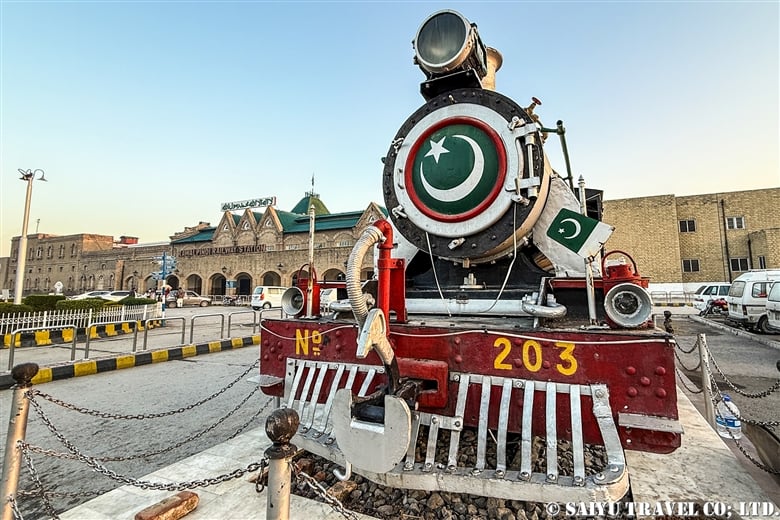
A railway station in Rawalpindi with a steam locomotive on display

↓↓↓ Highlights of the train journey from Peshawar to Rawal Pindi

Pakistan Railways is a state-owned railway operating in Pakistan. It was established in 1861 during the British colonial era (during the British Raj) as the North-Western State Railway. The first section built was 160 km long, connecting the port city of Karachi with Kotli (Hyderabad).

The headquarters of Pakistan Railways is located in Lahore. The reason it can be found here, is that Lahore was an extremely important city during the era of the British Raj. The railway network at the time connected it all the way to Peshawar in the west, Amritsar (one of the oldest lines, opened in 1862) in the east, and Multan and Karachi in the south.

Inside Lahore Station

Now, let’s talk about the train ride.
To catch the 11:00 a.m. train, I went to Peshawar Cantonment Station—ensuring I arrived 30 minutes early to buy a ticket.

Peshawar Cantonment Station was built in 1898 and served not only as a station on the line from Peshawar to Karachi, but also as the starting point of the Khyber Railway to the Afghan border (which is now a defunct line). It is a station with three platforms and seven tracks.

The entrance to the platform at Peshawar Cantonment Station
There is also a steam locomotive on display at Peshawar Station. Currently, two steam locomotives in Pakistan are still able to run, and both are stored in Lahore.

Unlike railways in India, Pakistani railways are not crowded—which proves to be quite the advantage. Recently, improvements in bus infrastructure have led to a decrease in the number of people using railways. This has been to the benefit of tourists, however, as it means they can enjoy a more relaxed train ride and have an easier time taking photos.

I recall seeing a child who had come to see off relatives with whom he had spent his summer vacation. He was crying, clearly upset at having to leave his family. The sight of the child, tears in his eyes, seeing his grandparents off and being comforted by them was incredibly touching.

A platform at Peshawar Cantonment Station
A boy bidding farewell to his relatives with tears in his eyes
It was finally time to depart, and the train slowly began to move. A flock of sheep had wandered onto the tracks

A few minutes after departure, we passed through the market in Hashnagari. In the past, there were bazaar stalls lining the railroad tracks, which made for a very fascinating sight: in order to allow trains to pass by, vendors would have to clear away stalls and shops three times a day. Following an accident, stalls were banned from the railroad tracks, but that has not stopped shops from extending right up to the edge of the tracks.

Hashnagari Market, where shops are close to the railroad tracks
Hashunagari railroad crossing
Waiting for a train to pass in Hashnagari

After that, you will pass through the historic site of Bala Hissar in Peshawar. It is an ancient fortress whose existence is noted in the records of Xuanzang’s journey in 630. During the Mughal Empire, it was a fortress at a strategic point along the Grand Trunk Road. In 1747, the Afghan dynasty conquered Peshawar, and this fortress was used as the “winter capital.” It was later used during the Sikh-Afghan War and by the British Raj, and currently serves as a headquarters for the Pakistani Army.

The train left Peshawar and ran through villages and fields, stopping occasionally at stations. Inside the train, children who wanted to take pictures with foreigners came and went, and the train conductor came to check tickets. Time passed rather quickly.

Children coming up to talk to foreign tourists
The conductor coming to check tickets
Children going to visit relatives in Attock from Peshawar

The route passes through several old small tunnels near the confluence of the Indus and Kabul rivers. Soon after, it crosses an iron bridge over the Indus River.

An old tunnel from the British colonial era (photographed from the cockpit)

The Indus River is a large river with a total length of 3,180 km, of which 2% flows through China, 5% through India, and 93% through Pakistan, making it a lifeline that runs north to south through the country.

Attock: The confluence of the Kabul River and the Indus River. The light blue river in the back is the Indus River, and the muddy river at the front is the Kabul River.
The Attock Bridge over the Indus River, completed in 1883

Attock Fort is a historically significant fort located in Attock Khurd. It stands proudly on the banks of the Indus River and has borne witness to various empires and conflicts throughout history. Built between 1581 and 1583 by order of Emperor Akbar of the Mughal Empire, this fortress is located on the Grand Trunk Road (also known as the “King’s Road”) and served to protect the strategic passageway of the Indus River. The 1-kilometer-long walls and fortifications retain many features of this era. After independence, it was used as a prison under the control of the Pakistani Army, where many important political prisoners have been incarcerated, such as Nawaz Sharif in 1999 and Imran Khan in 2023.

Attock Fort

The 425-meter-long Attock Bridge is a historically significant and iconic bridge spanning the Indus River in Pakistan, connecting Punjab Province and Khyber Pakhtunkhwa Province. It is sometimes referred to as the “Old Attock Bridge” to distinguish it from the new road bridge built in 1979.
Officially opened on May 24, 1883, the bridge was redesigned after more than 40 years of use and rebuilt in 1929. It features a unique double-deck design, with the upper deck still used by trains today. The lower deck, originally planned for road use, remains currently unused (though it is accessible on foot).

At the western end of the Attock Bridge, we finally crossed the Indus River (photo taken from the cockpit)
Crossing the Attock Bridge over the Indus River (photo taken from the cockpit)
The road under the Attock Bridge is not in use, but it is possible to cross it on foot

The train will not stop at the Attock Khurd railway station, which is located across the bridge. It’s a small, charming station with an interior that retains the atmosphere of the colonial era, and it comes highly recommended. If you have time, make sure to stop by and take a look.

Attock Khurd Station
The station master’s office at Attock Khurd Station

Shortly after that, the train arrived at Attock Station.

People seeing off their families at Attock Station

Though my introduction primarily featured the route from Peshawar to Attock, it’s important to note that many other stations on the line are also equally worth seeing. These include Rawalpindi Station, Lahore Station, and Bahawalpur Station, among others. Since there is no air conditioning in the general carriages, I recommend a train trip during the cooler months.


Image & Text: Mariko SAWADA

*Contact us, Indus Caravan for more information or to make arrangements for your  Railway trip  in Pakistan.

*Please follow us on YoutubeInstagram & Facebook

Category : - Peshawar / Khyber Pass > ◆Khyber Pakhtunkhwa > ◇ Pakistan Railways
Tag : , , , , , , , , , , , , , , , , ,

Chawmos Festival – Chanja Rat: The Kalash Rituals Still Alive to This Day

Chanja Rat is the day of the big bonfire to bid farewell to Balimain, and it can be considered the climax of the Chawmos Festival. Even people from other villages come to take part in the Tchattai ceremony from early morning.

Young girls all dressed up in the morning.
People visiting from other villages. The men will then head to Sajigor to perform the Tali Histik ritual.
The women who cannot participate in the ceremony chat in the square among themselves. They also partake in recreational singing and dancing.
The men head to Sajigor.

Tali Histik – Pray for the prosperity

Tali Histik is a ritual where people pray for the prosperity of the Kalash and for the birth of more boys. A willow tree branch—of which said tree luckily has many—is prepared for each male member of the family. It is said that the many small branches give the image of a family with many children. If there are 10 men in a given family, an additional branch is added to make a total of 11, at which point the male representative of the family throws the whole bundle. Among the number of men counted are the boys who just completed their passage rites the day before.

Willow branches prepared for the ritual
The men getting ready to throw the branches.
The willow branches are thrown all at once towards the altar.
On their return from Sajigor, the men made their way toward the square while forming a line with their hands on each other’s shoulders.

In the square, people chat and the Chawmos songs and dances continue. In the afternoon, they take a short break in preparation for the evening’s torches and bonfire.

Chanja Rat  – The big bonfire to bid farewell to Balimain

Finally, the climax of the Chawmos Festival, the great bonfire to bid farewell to Balemain, takes place. The actual experience of the chanja rat was truly a “ceremony of fire”, both fantastic and full of vitality.

After sunset, large pieces of wood for the bonfire are carried to the square.
The girls sing around the bonfire while waiting for the torches to be brought.
People carrying torches begin to descend from the village on the mountain.
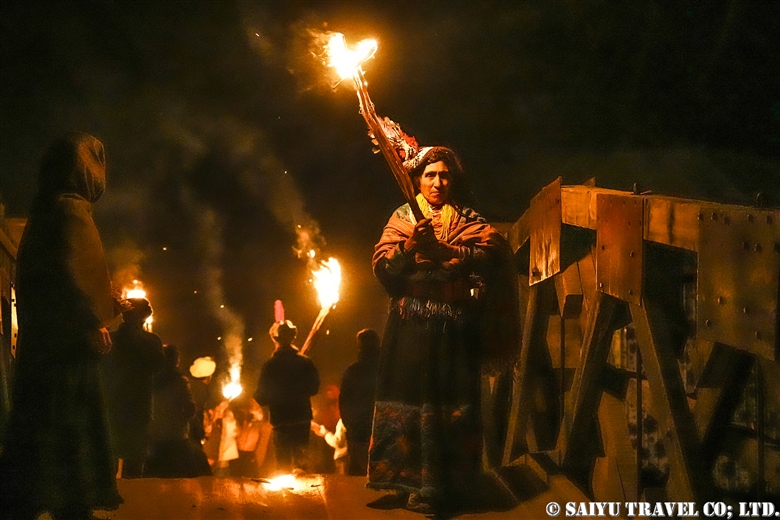
People coming down the mountain carrying torches.
Groups of people merge, and the light of the torches grows stronger.
People carrying torches head for the square.
The fantastic sight of the Kalash holding torches.
When they arrive at the square, they throw the torches into the bonfire, fueling the fire and making it grow huge.
People singing and dancing around the fire.
For the Kalash people, Chawmos is the festival they enjoy most the whole year.
Chanja Rat: bidding farewell to Balimain.

Witnessing Chanja Rat that night proved to be a dreamlike experience for me. Seeing the Chawmos festival for yourself is a wonderful opportunity to deepen your understanding of Kalash traditions and faith.


Text: Mariko SAWADA

Photo: Mariko SAWADA & Jamil

Visit: Dec 2024, Kalash Valley – Khyber Pakhtunkhwa

*The information presented here is based on interviews with people in the area. Please note that the descriptions and explanations of the rituals may differ depending on the source.


■Chawmos Festival – Kutram: The Kalash Rituals Still Alive to This Day

■Chawmos Festival – Mandaik : The Kalash Rituals Still Alive to This Day

■Chawmos Festival – Shishao Adu: The Kalash Rituals Still Alive to This Day

■Chawmos Festival – Pushao Adu: The Kalash Rituals Still Alive to This Day

■Chawmos Festival – Chanja Rat: The Kalash Rituals Still Alive to This Day

■The Joshi Spring Festival: A Kalash Ritual


*Contact us, Indus Caravan for more information or to make arrangements for visiting Kalash valley.

*Please follow us on YoutubeInstagram & Facebook


Category : - Kalash Valley > ◆Khyber Pakhtunkhwa
Tag : , , , , , , , , , , , , , , , , , , , , , , , ,

Chawmos Festival – Pushao Adu: The Kalash Rituals Still Alive to This Day

The period of the Kalash Chawmos Festival known as “Ditch” is considered to be highly sacred. On the day of Pushao Adu, two sacrifices are performed: the first, called “Pushao Marat,” is a sacrifice to the gods done at Sajigor, and the second, “Istongas,” is a purification ritual for men. At the same time, a children’s rite of passage known as Goshnik is also performed.

At the guesthouse, the people were all abuzz with chatter. I heard them proclaiming that Balimain has arrived, and that the earthquake they’d had the previous night was actually the sound of Balimain’s arrival. They say that Balimain will stay to watch the sacrificial ceremony and the large bonfire at night, before moving on to the Bumburet Valley.

In the morning, all men in the valley wash their bodies and put on new clothes and shoes. The women wash all dishes and clean the house. After this, in addition to the existing rules about not touching Muslims, new rules are added until the sacred period is over. These rules state that no cleaning is to take place, that bread made before yesterday must not be eaten, and that bread must be made with new flour. Because of this, new dough was not available in time, so we had to have rice from Ayun for breakfast (which was very tasty).

Villagers singing and dancing from the early morning.

Pushao Marat – Sacrifice to God 

In the morning, the villagers gathered in the square to sing and dance, and at about 10:00 a.m., the large male goats selected from each family were taken to Sajigor. The men began to walk to Sajigor alongside the animals. Since women are not allowed to participate in the sacrificial ritual, this photo was taken by a Kalash man. While the ritual was happening, the women celebrated by singing and dancing.

Male goats for sacrifice go to Sajigor. The most magnificent male goat from each stable is chosen.
Upon arrival at Sadigor, preparations for the ritual begin.
A goat with fine horns like a markhor’s.
More than 30 male goats were sacrificed to the gods that day.
The altar of sacrifice.
The meat of the sacrificial goats is eaten especially during the sacred period and also used in a stew called Pushao Mos.

Goshnik – Rite of passage for children 

Goshnik is a rite of passage for children, after which the boy or girl becomes a member of Kalash and observes its commandments. The parents of the child who is to receive the rite prepare fruits and gifts for the uncle who performs the rite. The uncle offers a male goat as a present. The relatives gather for the celebration, and the parents serve fruit and wine. I also saw visiting relatives give money to children undergoing this rite.

An uncle performing the ceremony dresses his nephew in ceremonial garb.
Relatives receiving fruit, dried fruit, and wine from parents.
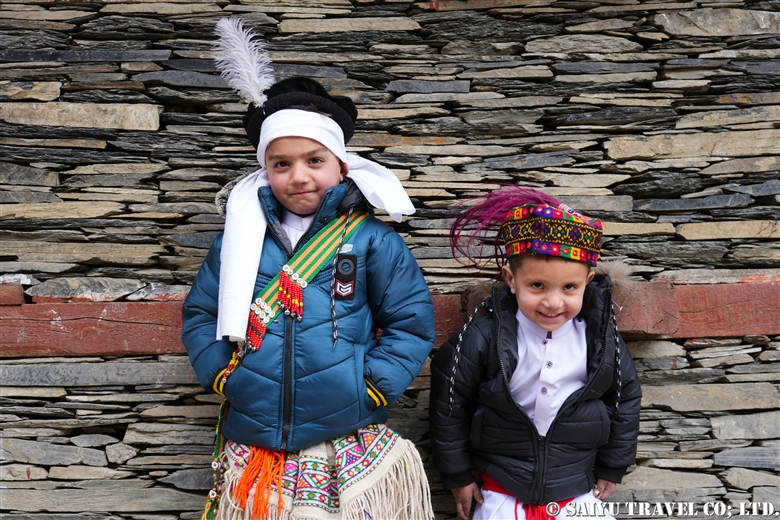
Two brothers who underwent the ceremony. Boys undergo the Goshnik ceremony twice, once between the ages of 3~5, and the second time between the ages of 5~8. Parents save money by having both brothers perform the ceremony at the same time. Incidentally, girls only have to undergo the Goshnik ceremony once.
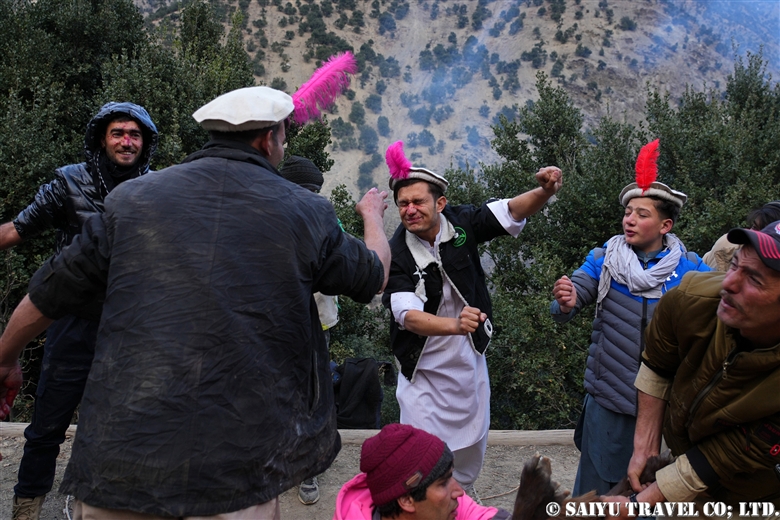
Villagers travel around the houses singing and dancing, bringing blessings during the Goshnik ritual.
Villagers clap their hands and sing. The children respond by taking part in a ritual dance.

 Purush Istongas – Sacrifices for the Purification of Men

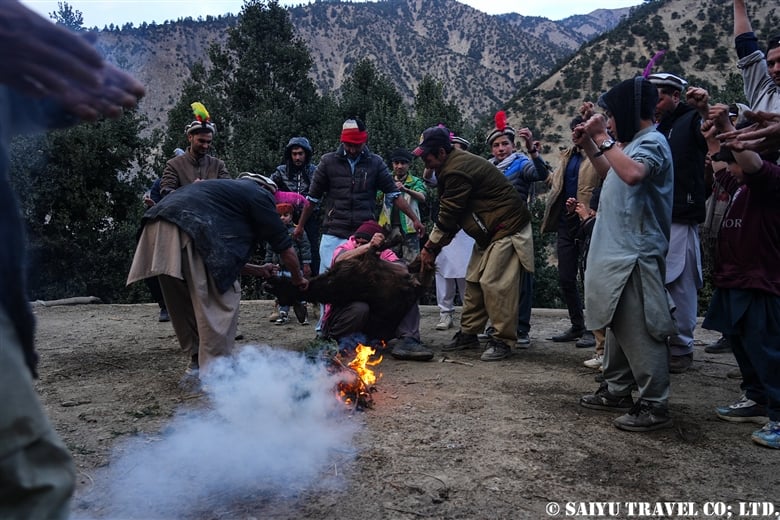
Sacrifices are performed on the roof of the goat stable. The blood of the sacrifice is sprinkled on the faces of the lined-up men in a purification ritual. The Istongas ritual is held in the evening. This photo was taken by a Kalash man.

The roof of the goat stable is purified and sacrifices are performed.
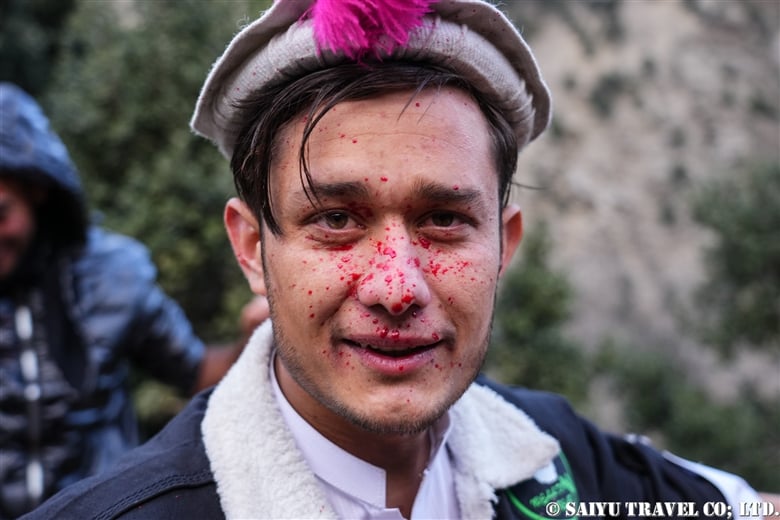
Blood is sprinkled.
A Kalash man who has now been purified.

The sacrificial goat will be dismembered here and become the meat that is eaten during this sacred period. On this day, I learned a great deal about the beliefs and lifestyle of Kalash, a place where the ritual of sacrifice is still alive.


Text: Mariko SAWADA

Photo: Mariko SAWADA & Jamil

Visit: Dec 2024, Kalash Valley – Khyber Pakhtunkhwa

*The information presented here is based on interviews with people in the area. Please note that the descriptions and explanations of the rituals may differ depending on the source.


■Chawmos Festival – Kutram: The Kalash Rituals Still Alive to This Day

■Chawmos Festival – Mandaik : The Kalash Rituals Still Alive to This Day

■Chawmos Festival – Shishao Adu: The Kalash Rituals Still Alive to This Day

■Chawmos Festival – Pushao Adu: The Kalash Rituals Still Alive to This Day

■Chawmos Festival – Chanja Rat: The Kalash Rituals Still Alive to This Day

■The Joshi Spring Festival: A Kalash Ritual


*Contact us, Indus Caravan for more information or to make arrangements for visiting Kalash valley.

*Please follow us on YoutubeInstagram & Facebook

Category : - Kalash Valley > ◆Khyber Pakhtunkhwa
Tag : , , , , , , , , , , , , , , , , , , , , , , , ,

Chawmos Festival – Shishao Adu: The Kalash Rituals Still Alive to This Day

The ceremony to welcome the god Balimain of Kalash had finally begun. The following is a report on the women’s purification day known as “Shishao Adu.”

The day before Shishao Adu is a day for preparing the stone slab with which the Shishao, the bread for the women’s purification ceremony, will be made. The men go into the mountains to look for suitable stone slabs and leave them in a safe place, so that the women don’t touch them until they are ready to use. Meanwhile, the women prepare the flour used to make Shishao.

A man carrying the stone slab to be used in the making of Shishao.

On the morning of Shishao Adu, women gather on the riverbank to prepare for the purification. They bathe in the hut and wash their hair. After this, they cannot bathe until the sacred period is over.

Girls making themselves ready.

Shishao Adu is a day of purification for women. After this day, no newcomers are allowed to enter the Rumbur Valley. No exception is made for foreigners, nor for Muslims living in the valley—they are likewise not allowed to enter the village of Kalash. The female Kalash relatives who come from Bumburet to celebrate the children’s rite of passage known as “Goshnik” must also undergo this purification. We foreigners were also purified. When I walked around the village, people asked me if I had showered, and if I was wearing new clothes. They believe that if anyone who does not follow the regulations of the Kalash religion is in the valley, it will bring them misfortune.

Shishao making begins at the Temple.

A man kneads purified dough to be used for the making of Shishao. The men’s hands are purified, and they are not allowed to touch anything other than the ingredients for Shishao—including themselves.

Using stone slabs and stones from the mountains, the men crush the walnuts which will act as filling for the bread.

Men are required to bake five Shishao for each female member of the family, and in families with many female members, baking Shishao can start even in the early morning.

The women’s purification ritual, Shishao Suchek, had begun. The women prepared new clothes, and some of the girls were dressed up almost as much as they are during the spring Joshi festival.

First, one must purify their hands with water.
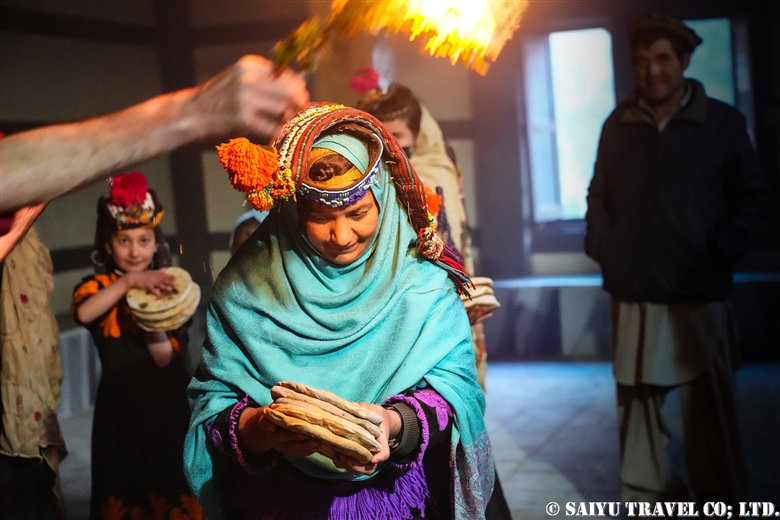
Five pieces of “Shishao” (walnut bread) are handed out.
The women are purified with smoke from a flaming juniper branch.

A woman with a very innovative headdress. She said her mother made it for her.

A traditional-style headdress known as a Kupas. Its colors are very modern. The traditional materials and colors that are typically shown in books are nowhere to be seen these days. It seems that Kalash women are always chasing the latest fashions.

The Shishao Suchek ritual at Temple Jestak Han had finally begun. Notably, it can also take place outside, in the open air.

Female members of the family gathering at the temple.
A girl receiving purification.
The female purification ritual, Shishao Suchek.

After this purification, the woman must remain pure for seven days. This involves a serious of strict rules, such as not touching Muslims, not eating chicken, eggs, cow’s milk & dairy products, honey, and so on.

Getting the opportunity to see these people live their lives and practice their faith was truly a beautiful sight.


Text & Photo: Mariko SAWADA

Visit: Dec 2024, Kalash Valley – Khyber Pakhtunkhwa

*The information presented here is based on interviews with people in the area. Please note that the descriptions and explanations of the rituals may differ depending on the source.


■Chawmos Festival – Kutram: The Kalash Rituals Still Alive to This Day

■Chawmos Festival – Mandaik : The Kalash Rituals Still Alive to This Day

■Chawmos Festival – Shishao Adu: The Kalash Rituals Still Alive to This Day

■Chawmos Festival – Pushao Adu: The Kalash Rituals Still Alive to This Day

■Chawmos Festival – Chanja Rat: The Kalash Rituals Still Alive to This Day

■The Joshi Spring Festival: A Kalash Ritual


*Contact us, Indus Caravan for more information or to make arrangements for visiting Kalash valley.

*Please follow us on YoutubeInstagram & Facebook

Category : - Kalash Valley > ◆Khyber Pakhtunkhwa
Tag : , , , , , , , , , , , , , , , , , , , , , ,

Chawmos Festival – Kuta Mru : The Kalash Rituals Still Alive to This Day

It is early December in the Kalash Valley. The harvests have all been completed and the livestock have come down from the mountains. The ceremony to welcome the God Balimain of Kalash has begun. It includes rites of passage, purification, and sacrifice—all culminating in a farewell to Balimain, complete with torches and a large bonfire. The following is a report on a trip that brought me into contact with the rituals of a deep faith that continues to thrive in the modern age.

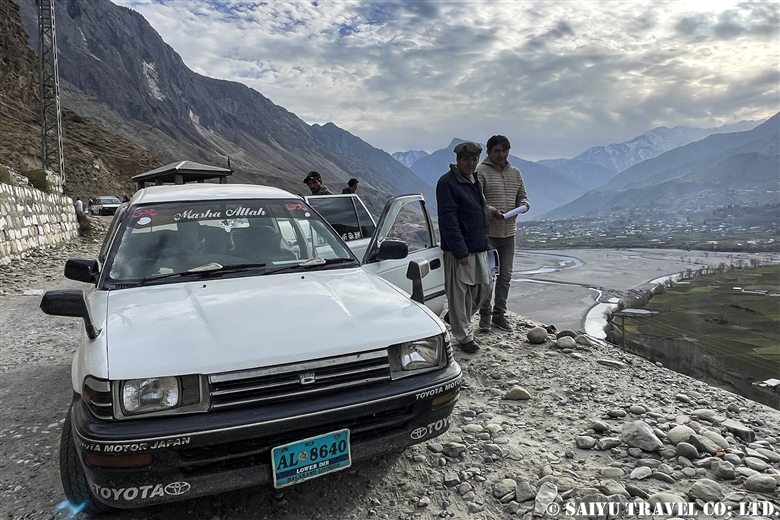
During the sacred period of Chawmos, Muslims are not allowed to enter the valley. Since neither staff nor drivers from Islamabad could enter the valley, Kalash staff came to Ayun to pick me up.

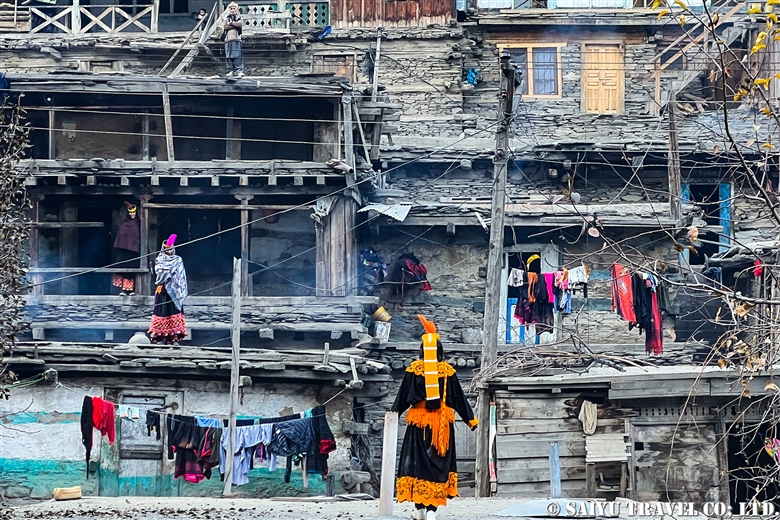
In the village of Kalash, a lot of laundry was hung out to dry to ensure people can wear new clothes during the sacred period. Before the purification ritual, one must take a bath and put on new clothes.

Sharabira displayed in a house

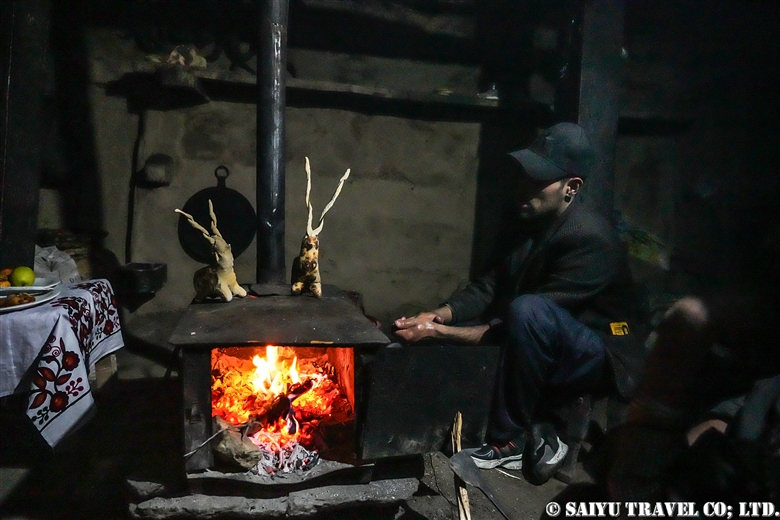
I made it just in time to be able to observe the Sharabirayak ritual in the Bumburet Valley. The word “Shara” means markhor and the word “Bira” means male goat. After the women bake walnut bread with cheese to be distributed the next day, the men knead dough, which they shape in the form of either markhor or male goats. These statues are then baked in a fireplace. This ritual is called Kuta Mru.

Sharabira making takes place at night. When I visited, there was no electricity in the valley, and I was able to glimpse the beautiful sight of a woman baking walnut bread by the light of a stove fire.

Afterward, the purified man kneads purified dough and begins to sculpt animal shapes.

He proceeded to bake them on the stove.

The completed sharabira on display

The ritual of Kuta Mru is performed in each household as well as in the temple of the goddess Jestak. The wheat collected from each family is used to make a Shara (markhor) at the Jestak Han temple. At night, the men gather to make Sharabira and spend the night painting on the walls and drinking until early in the morning. At around 4:00 a.m., they make a “tchich tchich” sound—intended to resemble the call made when chasing goats—urging the Sharabira to go to a place called “Dezelawat.” The people of Kalash believe that the souls of the Sharabira go to Dezelawat, which is located near the Afghan border.

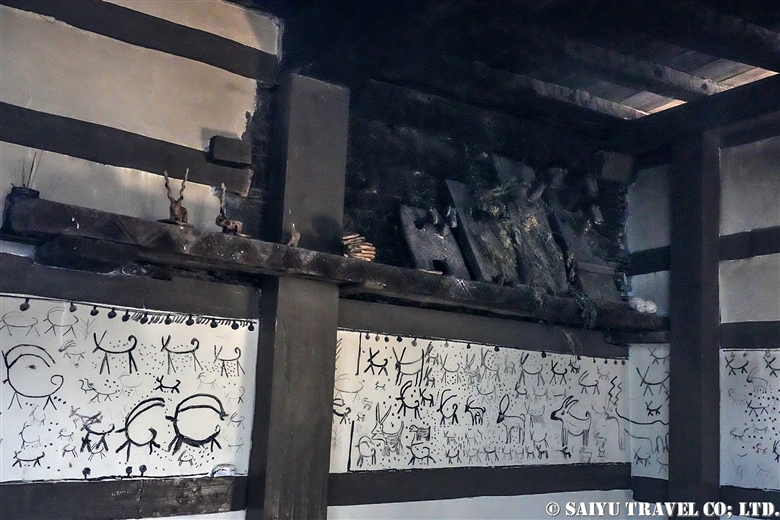
A drawing of Sharabira on the wall of the Jestak Han temple. Three Shara (markhor) are placed by the altar.

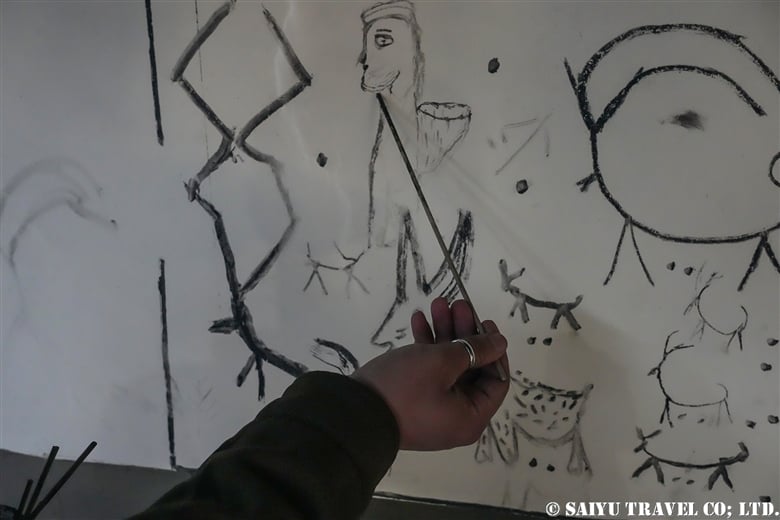
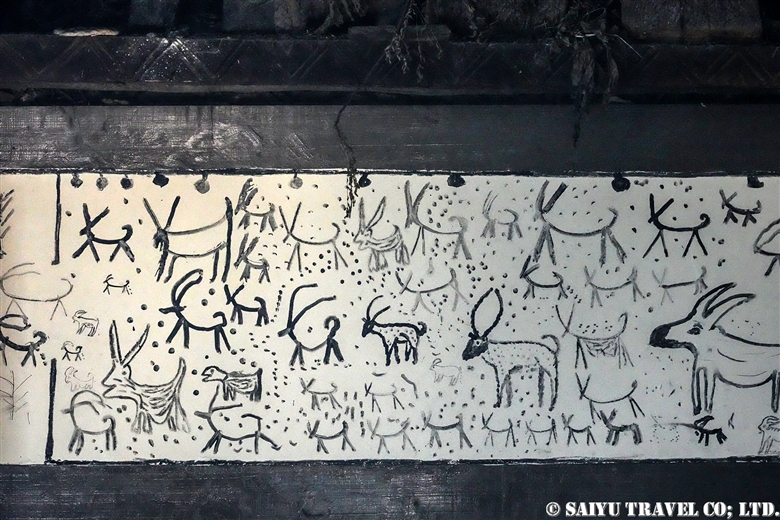
The drawings on the walls of the temple are painted with charcoal made from burning walnut bark prepared by the women.

A painting from Kutram in 2024

For those unfamiliar with the markhor, it is the national animal of Pakistan and is known to be extremely valuable for trophy hunting. In the 2024-25 winter hunting season, permission to hunt three Kashmir markhor was given, and each was auctioned off for between $231,000 and $271,000. It is said that 80% of the income from trophy hunting is returned to the local community, and in order to increase the number of trophies, conservation is carried out. Though this initiative has led to the number of markhor increasing, as someone who loves animals, I feel rather conflicted about this.

Kashimir markhor (Toshi Shasha game reserve)

The markhor is a highly sacred animal to the people of Kalash. They can be seen in Chitral Gol National Park and nearby game reserves. Males with large horns are usually found at higher elevations in the mountains, but during the winter breeding season they come down to lower elevations, making it possible to observe them. The variant in this region is a subspecies, and is known as the Kashmir markhor.


Text & Photo: Mariko SAWADA

Visit: Dec 2024, Kalash Valley, Toshi Shasha – Khyber Pakhtunkhwa

*The information presented here is based on interviews with people in the area. Please note that the descriptions and explanations of the rituals may differ depending on the source.


■Chawmos Festival – Kutram: The Kalash Rituals Still Alive to This Day

■Chawmos Festival – Mandaik : The Kalash Rituals Still Alive to This Day

■Chawmos Festival – Shishao Adu: The Kalash Rituals Still Alive to This Day

■Chawmos Festival – Pushao Adu: The Kalash Rituals Still Alive to This Day

■Chawmos Festival – Chanja Rat: The Kalash Rituals Still Alive to This Day

■The Joshi Spring Festival: A Kalash Ritual


*Contact us, Indus Caravan for more information or to make arrangements for visiting Kalash valley.

*Please follow us on YoutubeInstagram & Facebook

Category : - Kalash Valley > ◆Khyber Pakhtunkhwa
Tag : , , , , , , , , , , , , , , , , , , , , , , , ,

Kaghan Valley ; Himalayan Bird Watching in Summer

The best places to go birding and see Himalayan birds in Pakistan are the Margalla Hills in winter and the Kaghan Valley in summer. Birds that have spent the winter in the Margalla Hills, the Punjab Plains, and even in places as far away as southern India and Sri Lanka, come to the Kaghan Valley around May to breed and spend the summer. They reside in the valley’s moist temperate Himalayan forests (comprised mostly of evergreen conifers with some deciduous trees), which span an area of around 2,000~2,800 m.

The following is a record of my birding experience in the Kaghan Valley in late May. Many places in the Kaghan Valley, including Narang, have undergone development to accommodate domestic tourists (if I am to be honest, overtourism has left them in a terrible state), and birdwatchers are advised to avoid visiting during peak season or on weekends.

We walked along the slopes of a coniferous forest with giant pine trees and explored the streams and cultivated areas. During this visit, in addition to birds, we were able to observe two species of flying squirrels (the Kashmir flying squirrel and the red giant flying squirrel), as well as a rare species of Kashmir langur.

Here are some of the birds we encountered during our three days and two nights of birding.

Great Barbet

This is a species I have encountered many times. The great barbet is widely distributed in Southeast Asia and South Asia, but is found only in limited areas in Pakistan, such as the Kaghan Valley and Murree. Being of 32~35 cm in length, it is the largest bird in the barbet family.

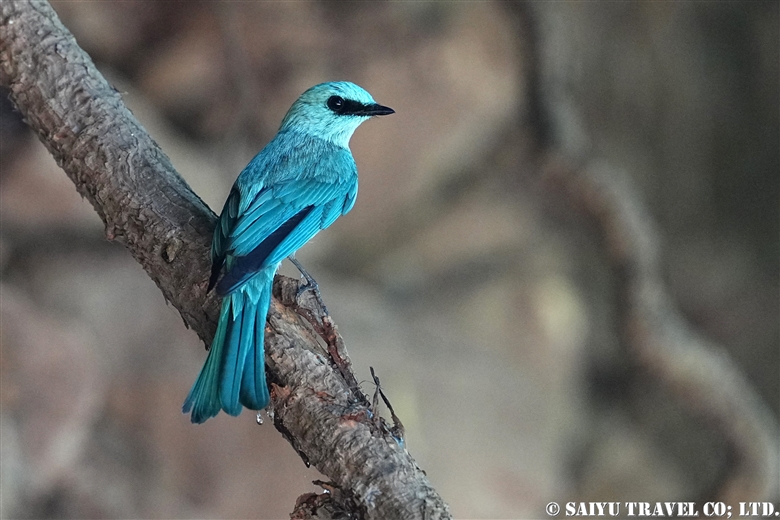
Verditer Flycatcher

A verditer flycatcher (male). This summer bird is easy to observe as it often perches on top of tall trees.

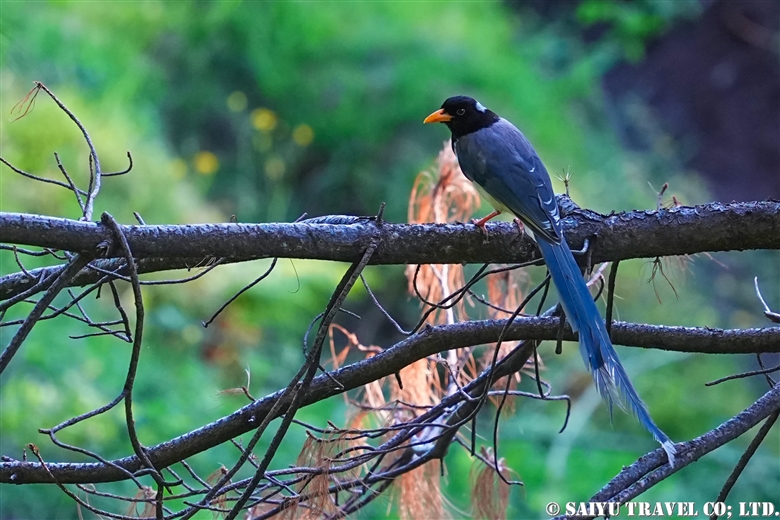
Yellow-billed Blue Magpie

Yellow-billed blue magpie are omnivores and can be encountered in a variety of situations. This family of corvids can be seen year-round in the Himalayan foothills.

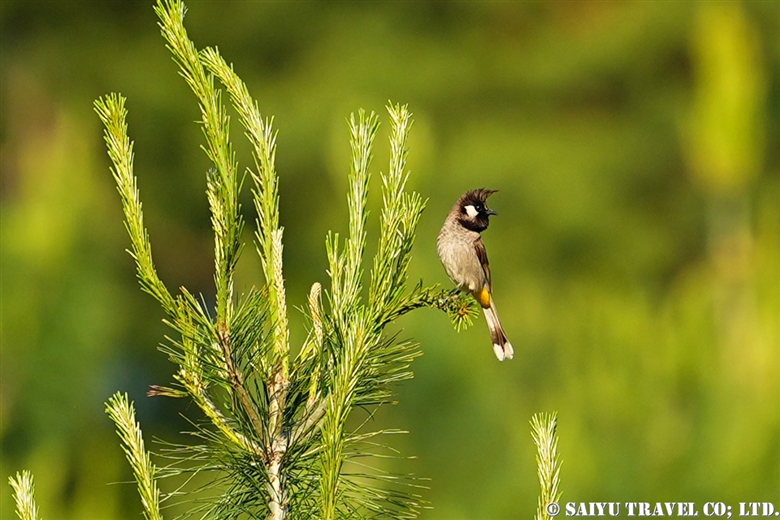
Himalayan Bulbul

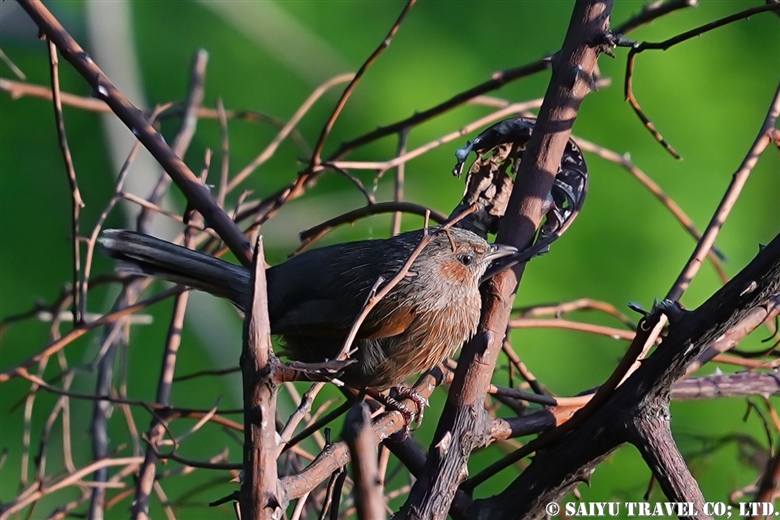
A Himalayan bulbul. This is a species of bulbul found year-round in the area from Swat Valley to Chitral, and from Margalla Hills to Kaghan Valley.

Streaked Laughingthrush

A streaked laughingthrush. This bird is found year-round in northern Pakistan and could be observed daily in the Kaghan Valley.

Grey Bushchat

A grey bushchat (male). This species makes short migrations (between 1900 m~3000 m) in the Himalayas and can be seen everywhere in the Kaghan Valley in summer. Females are buff (cream to light brown) in color.

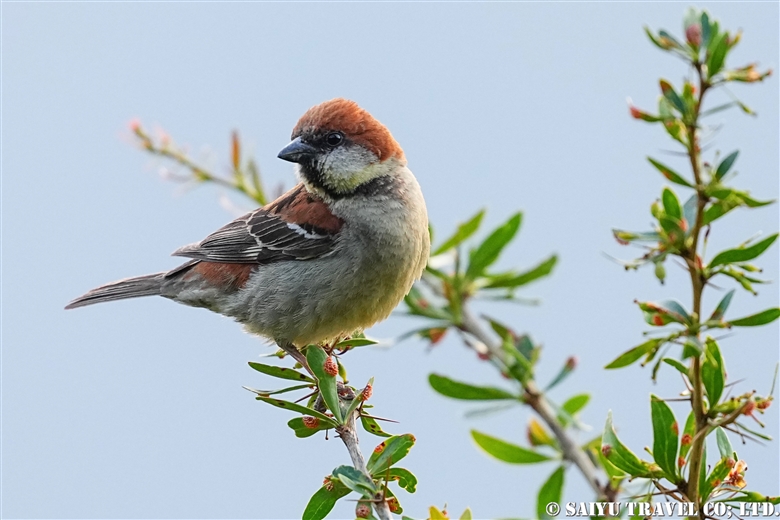
Russet Sparrow

A russet sparrow (male). This species seems to be seen year-round in the Kaghan Valley, but also migrates to the Punjab region in winter.

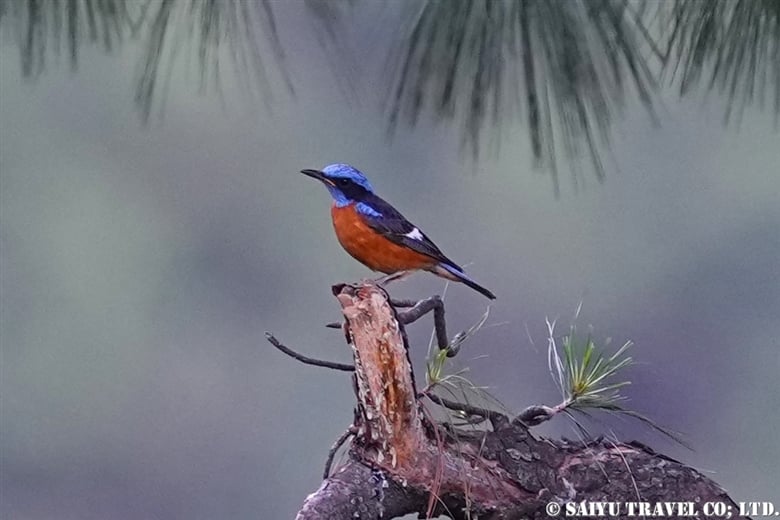
Blue-capped Rock Thrush

A blue-capped rock thrush (breeding male). A summer bird in northern Pakistan. They migrate to southern India in winter. It would be great to get a picture of the breeding males!

Lemon-rumped Warbler

A lemon-rumped warbler. This bird makes short winter and summer migrations in the Himalayan foothills.

Green-backed Tit

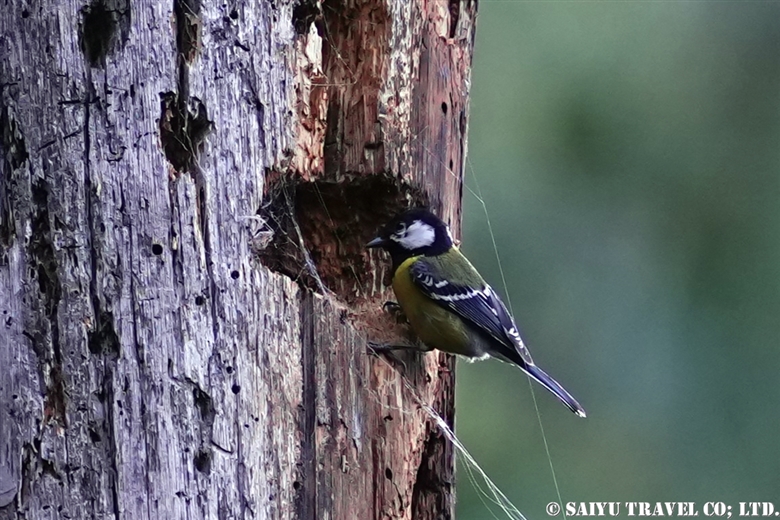
A green-backed tit breeding in a hole in a large dead pine tree. They can be seen year-round, but some migrate down to the Margalla Hills in winter.

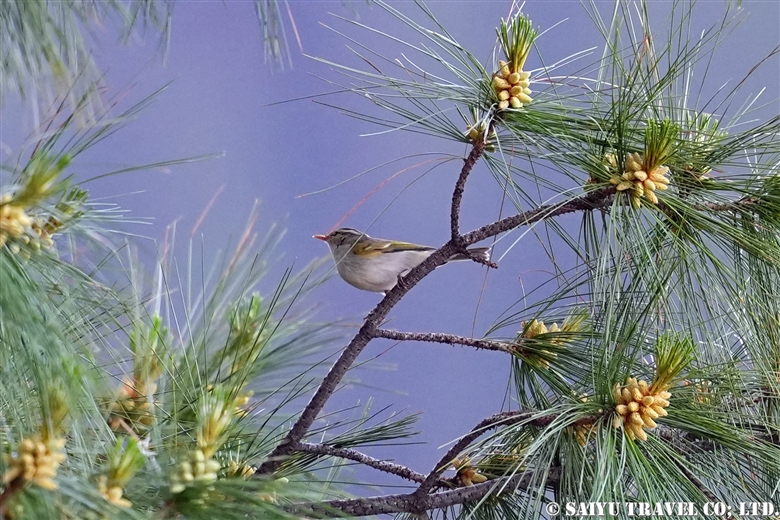
Western Crowned Warbler

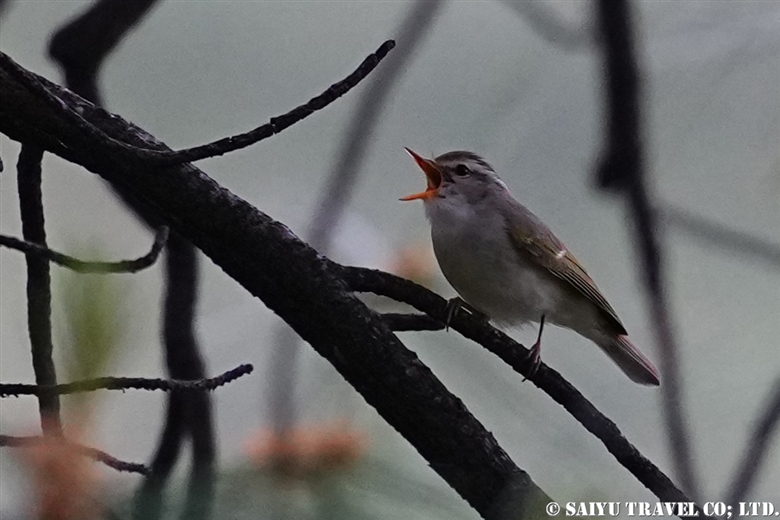
A western crowned warbler, a summer bird of northern Pakistan that migrates to peninsular India for the winter.

Rufous-bellied Niltava

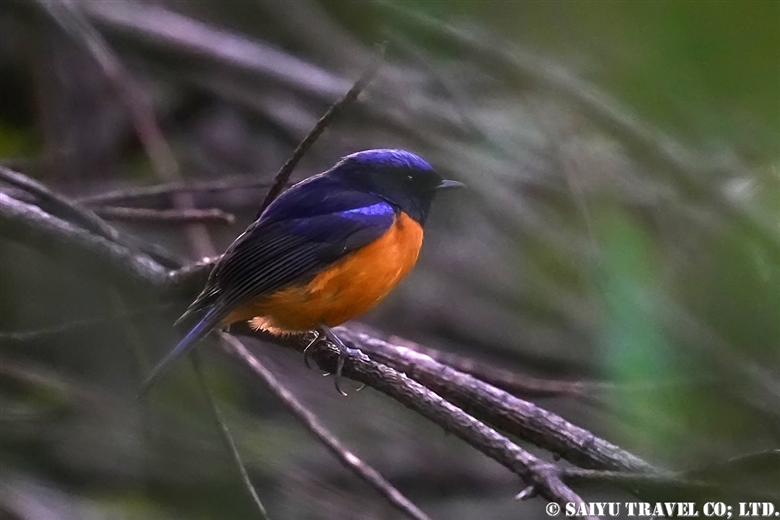
A rufous-bellied niltava. This summer bird is observed in limited areas such as Murree and Kaghan Valley.

Chestnut-bellied Nuthach

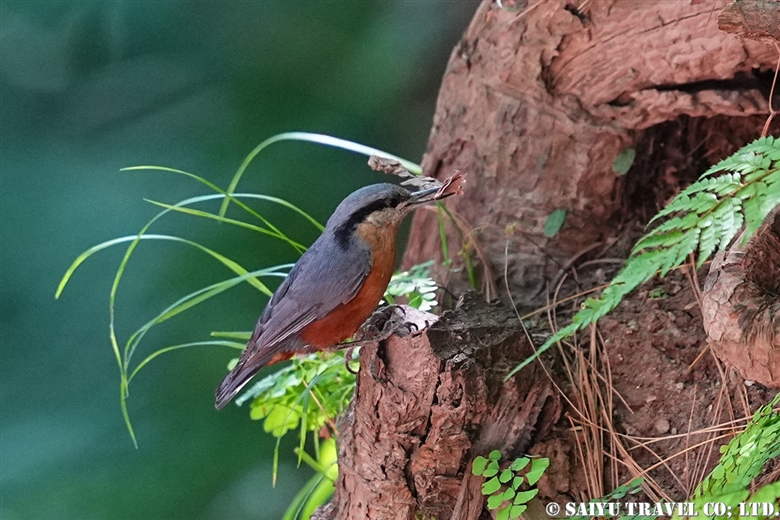
A chestnut-bellied nuthatch. A deciduous forest bird that is seen year-round in limited areas of Pakistan such as Murree and the Kaghan Valley.

Long-tailed Minivet

A long-tailed minivet (male). Migrates to the foothills of the Himalayas in summer and along the Indus system to the central Punjab Plain in winter. Females have gray backs and yellow bellies.

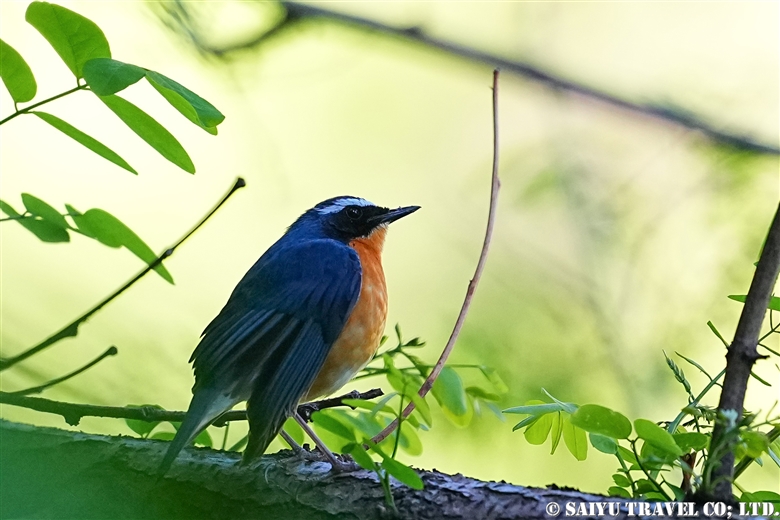
Indian Blue Robin

An Indian blue robin (male). A summer bird of the temperate Himalayan forests. Its beautiful chirping echoed in the forest while we were observing it. In winter, it migrates to peninsular India and Sri Lanka, where it can be seen not only in forests but also in tea plantations.

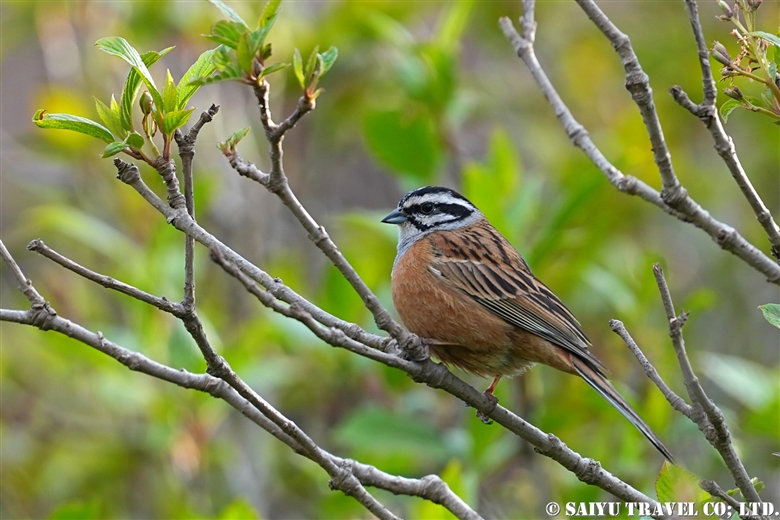
Rock Bunting

A rock bunting, a summer bird of northern Pakistan that migrates to the Punjab plains and northern Balochistan in winter.


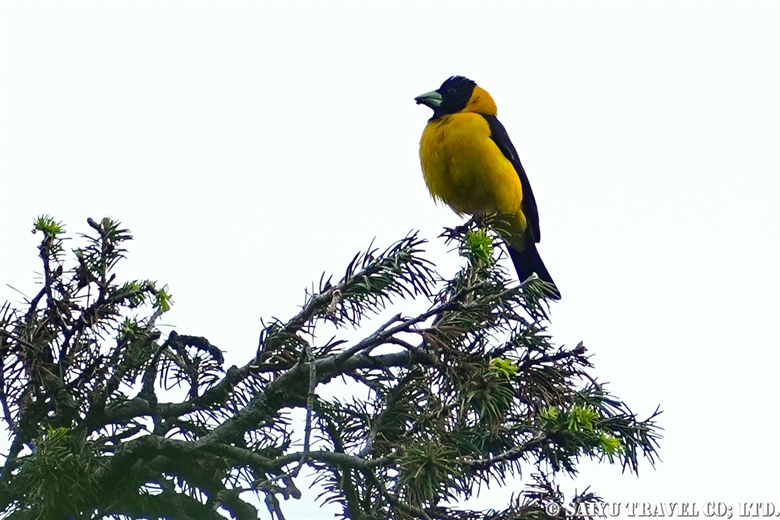
Black-and-yellow Grosbeak

A black-and-yellow grosbeak (male). Found year-round in temperate Himalayan forests.。

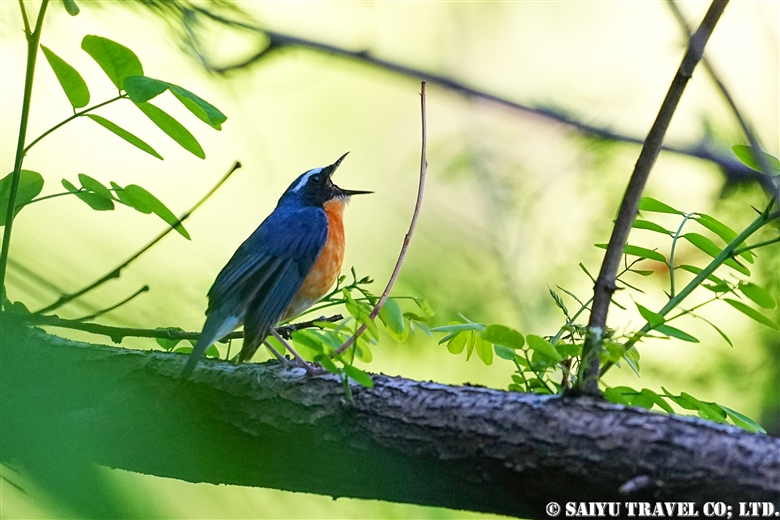
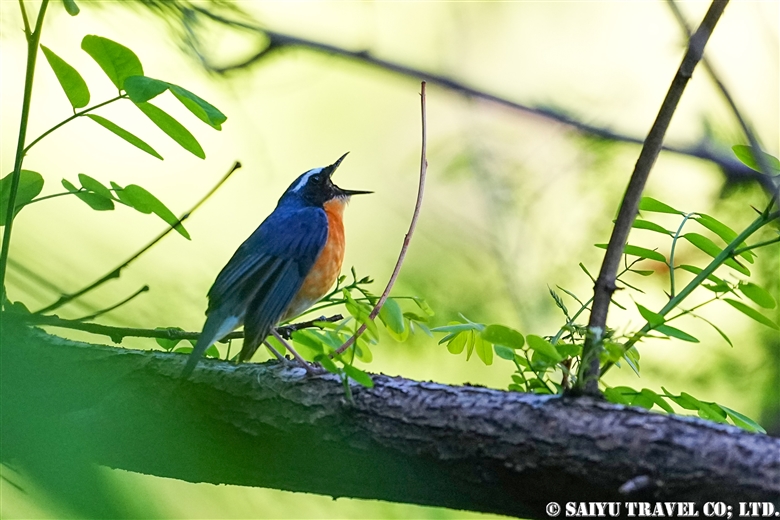
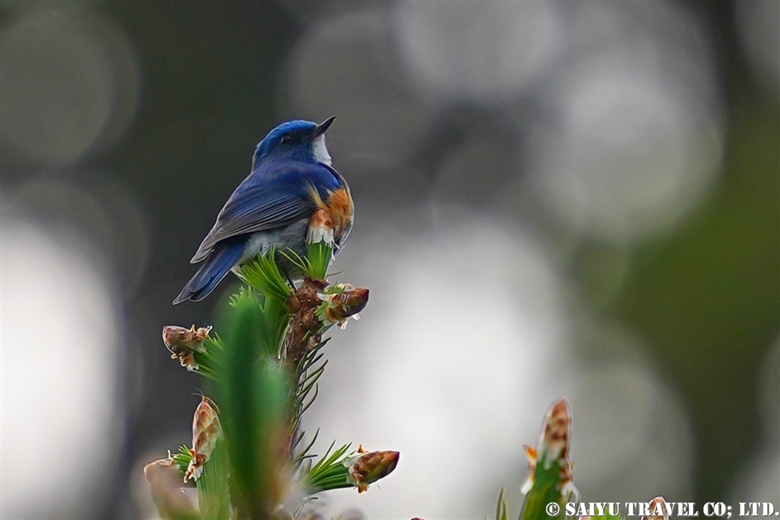
Himalayan Bluetail

A Himalayan bluetail. This summer bird of northern Pakistan migrates to the Himalayan foothills in winter. It used to be treated as a subspecies of the red-flanked bluetail, but due to differences in migration distance and the darker blue coloration of the adult male, it became an independent species.

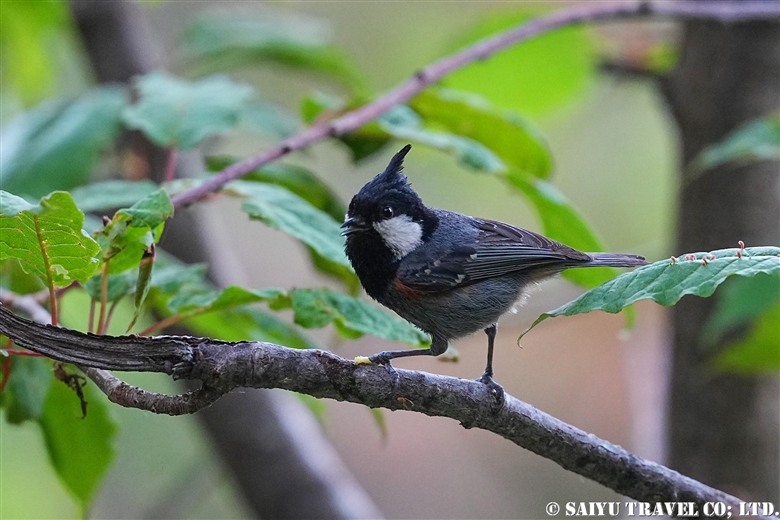
Spot-winged Tit /Black-crested Tit

The spot-winged tit or black-crested tit, a bird found year-round in the Himalayan coniferous forest zone, used to be treated independently as a species, but is now considered a subspecies of the coal tit.

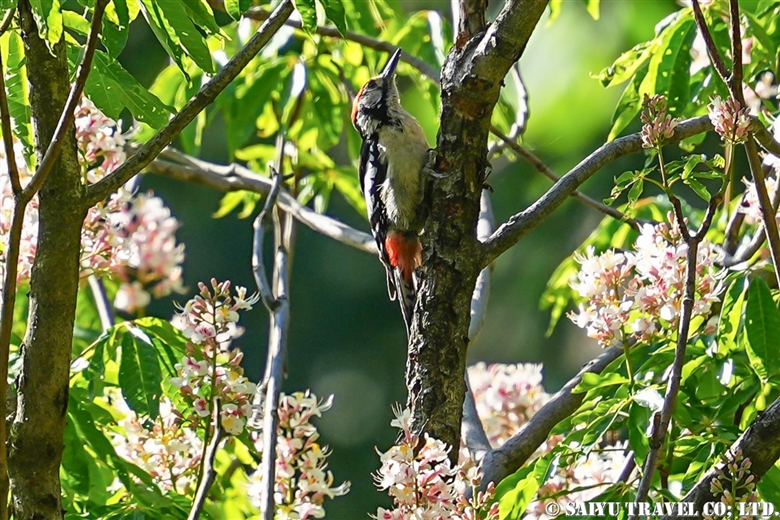
Himalayan Woodpecker

A Himalayan woodpecker (male). This woodpecker is found year-round in the Himalayan forests of northern Pakistan.

Eurasian Jackdaw

Eurasian jackdaws observed from the parking lot of the Balakot restaurant where we had lunch. Their white eyes are very distinctive. We were also able to observe an Asian paradise-flycatcher in Balakot.

On a related note, I would like to share with you some of the other wildlife we encountered besides birds. My encounter with a rare Kashmir langur was so engrossing that I briefly forgot to keep looking for birds. At night, we observed two species of flying squirrels. Thanks to these activities, we had a very busy three days from early morning to midnight.

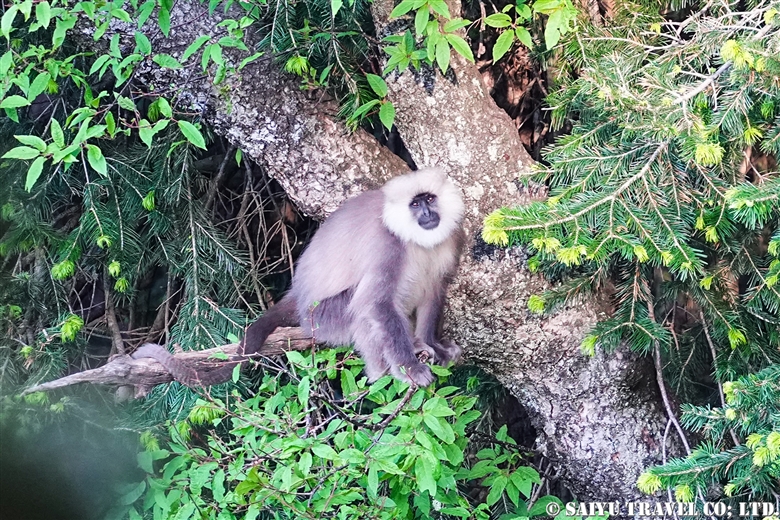
Kashmir gray langur

This animal is listed as endangered by the ICUN due to habitat loss. It is a member of the langur family, which is difficult to encounter due to its large migratory distance.

Flying squirrels start their activities at night, when they are no longer targeted by birds of prey, and we got the chance to observe two species, the red giant flying squirrel and the Kashmir flying squirrel, over the course of two evenings.

Red giant flying squirrel
Kashmir flying squirrel

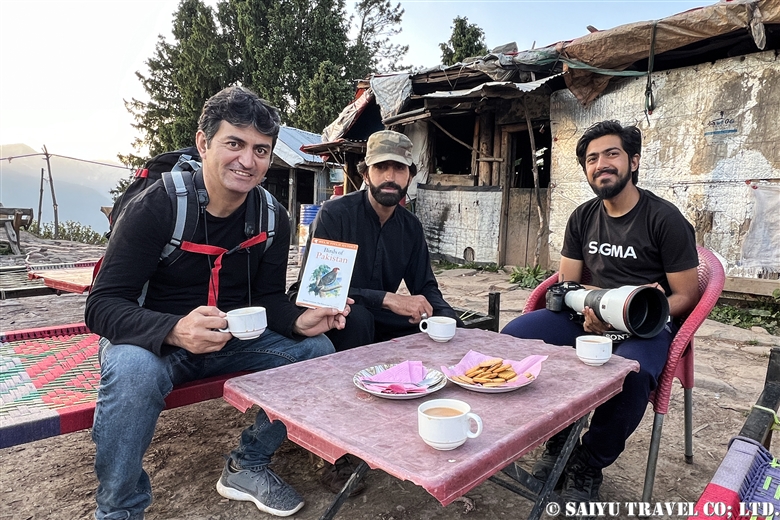
Finally, a photo of some other group members who enjoyed birding together. The birder population in Pakistan seems to be increasing!


Photo & Text : Mariko SAWADA

*Contact us, Indus Caravan for more information or to make arrangements for birding in Pakistan.  >> Visit : Wildlife of Pakistan.

*Please follow us on YoutubeInstagram & Facebook

Category : - Kaghan valley > ◇ Birds of Pakistan
Tag : , , , , , , , , , , , , , , , ,

Over the Khyber Pass

The Khyber Pass is located between Peshawar and the border with Afghanistan. Since ancient times, it has been an important pass on the trade route between the Central Asian and Indian cultural regions. The mountain where the pass is located is called Spin Ghar (in the Pashto language) and was crossed by Alexander the Great’s army in the 4th century B.C., as well as by Xuanzang in the 7th century. During the Mughal period, it developed as part of the Grand Trunk Road, the main road from Agra, India to Kabul, Afghanistan. In modern times, it was a battlefield in the Afghan War during the British colonial period. After independence, it became an autonomous region of the Pashto tribe called the Federally Administered Tribal Areas (FATA), but that system was abolished in 2018. Foreigners visiting the area must have prior permission and be accompanied by security. When tourists talk about going to the Khyber Pass, it generally means visiting the area from the Khyber gate to the Michini check post.

Bab-e-Khyber and Jamrud Fort

This monumental gate was built in 1963 and is located 18 km from the center of Peshawar city. There is a small park next to the gate where the history of the Khyber Pass is inscribed on a stone tablet. Khyber Gate also appears on the Pakistani 10-rupee bill.

Just past the Khyber Gate, on the right, is Jamrud Fort. It was built by the Sikhs in 1823 on top of an old fort. General Hari Singh Nalwa, a hero of the Sikhs, was killed and buried at Jamrud Fort while fighting Afghans. The fort is manned by the Pakistani army and entry is not allowed.

A camel milk vendor from Punjab walking through Khyber Gate
Until 2007, there was a large Afghan refugee camp (Kacha Garhi refugee camp) near the Khyber gate; many refugees came and went through this gate from the Soviet invasion in 1979 until the end of the Afghanistan war.


Khyber Pass Viewpoint

The photo of the Khyber Pass shown in the guidebook features a view looking back toward Peshawar from the road on the way to the border. The road is now newly widened and is lined with transport trucks coming and going from the border, but it must have once provided a dramatic sight of the Gandhara Plain spread out in front of the caravans coming from Afghanistan.

View toward Peshawar from Khyber Pass Viewpoint


Shagai Fort

The fortress was built by the British in the 1920s to monitor the Khyber Pass route. It is currently manned and monitored by the Pakistani Army. On the other side of the fort there is a new monument and a lookout tower.

Distant view of Shagai Fort
Entrance to Shagai Fort

Ali Masjid

This is the narrowest part of the Khyber Pass road, flanked by mountains on both sides. It was originally so narrow that two loaded camels could just barely pass each other. Because of its strategic importance, it was the site of fierce battles in past wars. The road has been gradually widened, but even today, the lanes are separated, with the lane heading toward Peshawar being built on a cliff.

The small Ali Masjid (a mosque), as well as a madrasa can be found along the road. The Ali Masjid Fort, where the Pakistani army is stationed, is located on top of the hill.

The Ali Masjid mosque along the road. A larger mosque is currently under construction.
Ali Masjid Fort overlooking the narrow road

Palatial Residence (Fort) of Ayub Afridi

Ayub Afridi is a well-known drug lord and tribal politician, known for the many interesting stories about his contacts with the United States, among other topics. Along the road is a wall of mansions with more than 100 rooms.

Sphola Stupa

The stupa dates back to the 2nd-3rd century Kushan period and is built on a three-tiered platform. Excavations in the early 20th century unearthed a Buddha statue, and as of 2024, the base of the temple is being restored. It is the only Gandhara Buddhist site in the Khyber Pass area.

Sphora Stupa and Khyber Railway tracks

Emblem of the Military Corps

The troops of various time periods who passed through the area carved their military emblems into the rock face as a commemoration of their passage.

Emblem of the Military Corps

Khyber Railway

There was a time when a steam locomotive operated once a month for tourists between Peshawar and Landi Kotal. The Khyber railway has a long history, having opened in 1926 during British rule era for the purpose of transporting military supplies. The railway runs from Peshawar to Landi Kotal, a distance of 40 km with a height difference of 600 m, crossing 34 tunnels and 92 railway bridges.

The area was devastated by heavy rains and flooding in 2006, and there is absolutely no hope of restoration. Currently, only the remains of damaged tracks, tunnels, steel bridges, and stations can be seen.

Railway tracks destroyed by flooding
The tunnel
The railway bridge
A preserved steam locomotive in Peshawar

Landi Kotal

The last town on the Pakistani side is Landi Kotal. Stores are spread out over an even lower level of the town’s main street. It was once known for its smuggled goods bazaar which dealt in arms and drugs. Today, there is still a vibrant market.

Landi Kotal’s Kabab Shop
Popular chappal kabab in town
Landi Kotal people cheerfully talking to tourists
Children on their way home from school

Michini Check Post

The last point on the Pakistan side that can be visited without an Afghanistan visa is the Michini Check Post, which overlooks the border town of Torkham. The border town of Torkham is 5 km downhill from here. The rocky mountains across the border are numbered from 1 to 3, and the border line between the two countries is the point where these lines are connected.

View of the border Torkham from Michini check post

The Michini Check Post has a viewpoint where tourists can enter. From the viewpoint, there is an old building called the Taimoor Fort or Tamerlane Fort, which according to legend was used as a prison during Timur’s invasion of India.

Taimoor Fort
A lookout with a view of the Torkham border

Torkham Border

Approaching the border there is a dry port and an immigration control building. As of 2024, the Torkham border is the only open border between Pakistan and Afghanistan.

Porters carrying luggage and money changers waiting at the border
Corridor between Pakistan and Afghanistan

The border with Afghanistan is connected by a long corridor, and from there it is 230 km to Kabul, which takes about 6 hours by car.


Photo & Text : Mariko SAWADA

*Contact us, Indus Caravan for more information or to make arrangements for visiting Khyber Pass, Border Crossing and Afghanistan. >> Our Afghanistan tour .

*Please follow us on YoutubeInstagram & Facebook

Category : - Peshawar / Khyber Pass > ◆Khyber Pakhtunkhwa > Uncategorized
Tag : , , , , , , , , , , , , , , , , ,

TOP