

English / Japanese

Chawmos Festival – Chanja Rat: The Kalash Rituals Still Alive to This Day

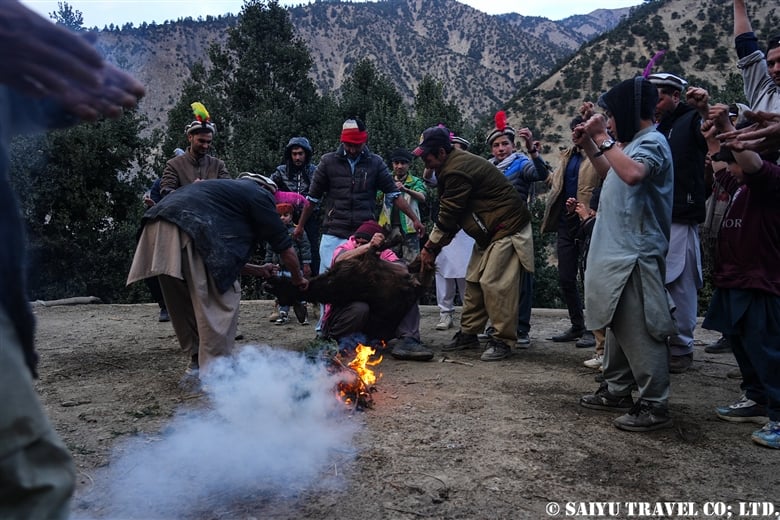
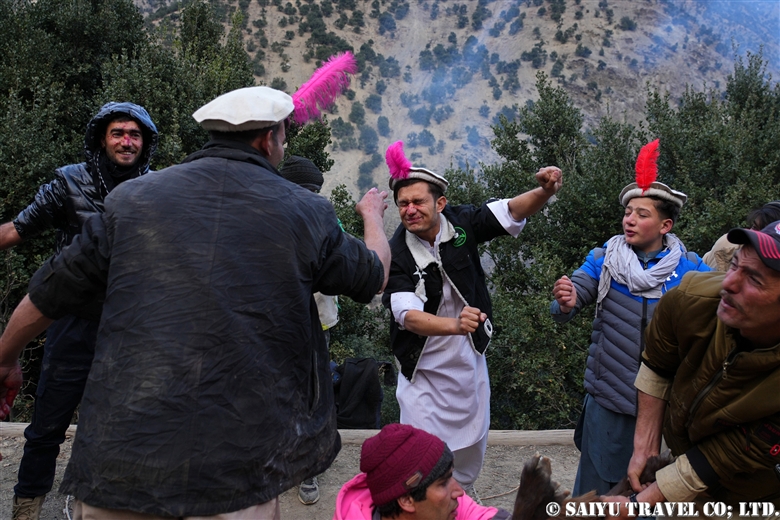
Chanja Rat is the day of the big bonfire to bid farewell to Balimain, and it can be considered the climax of the Chawmos Festival. Even people from other villages come to take part in the Tchattai ceremony from early morning.

Young girls all dressed up in the morning.
People visiting from other villages. The men will then head to Sajigor to perform the Tali Histik ritual.
The women who cannot participate in the ceremony chat in the square among themselves. They also partake in recreational singing and dancing.
The men head to Sajigor.

Tali Histik – Pray for the prosperity

Tali Histik is a ritual where people pray for the prosperity of the Kalash and for the birth of more boys. A willow tree branch—of which said tree luckily has many—is prepared for each male member of the family. It is said that the many small branches give the image of a family with many children. If there are 10 men in a given family, an additional branch is added to make a total of 11, at which point the male representative of the family throws the whole bundle. Among the number of men counted are the boys who just completed their passage rites the day before.

Willow branches prepared for the ritual
The men getting ready to throw the branches.
The willow branches are thrown all at once towards the altar.
On their return from Sajigor, the men made their way toward the square while forming a line with their hands on each other’s shoulders.

In the square, people chat and the Chawmos songs and dances continue. In the afternoon, they take a short break in preparation for the evening’s torches and bonfire.

Chanja Rat  – The big bonfire to bid farewell to Balimain

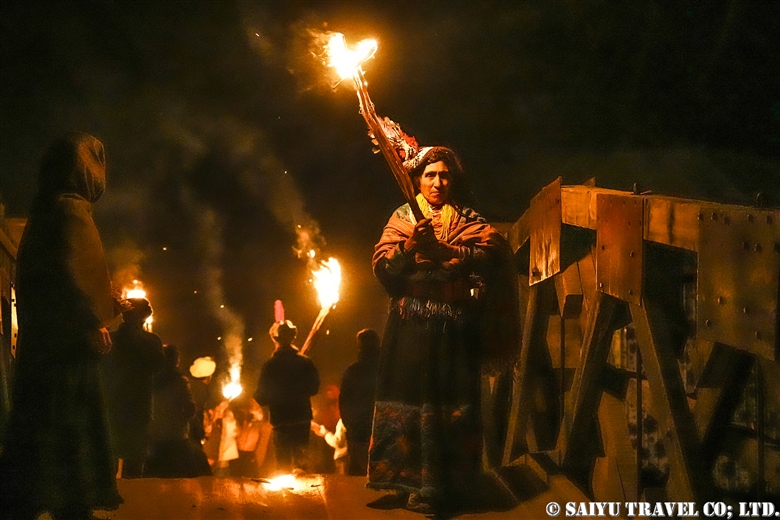
Finally, the climax of the Chawmos Festival, the great bonfire to bid farewell to Balemain, takes place. The actual experience of the chanja rat was truly a “ceremony of fire”, both fantastic and full of vitality.

After sunset, large pieces of wood for the bonfire are carried to the square.
The girls sing around the bonfire while waiting for the torches to be brought.
People carrying torches begin to descend from the village on the mountain.
People coming down the mountain carrying torches.
Groups of people merge, and the light of the torches grows stronger.
People carrying torches head for the square.
The fantastic sight of the Kalash holding torches.
When they arrive at the square, they throw the torches into the bonfire, fueling the fire and making it grow huge.
People singing and dancing around the fire.
For the Kalash people, Chawmos is the festival they enjoy most the whole year.
Chanja Rat: bidding farewell to Balimain.

Witnessing Chanja Rat that night proved to be a dreamlike experience for me. Seeing the Chawmos festival for yourself is a wonderful opportunity to deepen your understanding of Kalash traditions and faith.


Text: Mariko SAWADA

Photo: Mariko SAWADA & Jamil

Visit: Dec 2024, Kalash Valley – Khyber Pakhtunkhwa

*The information presented here is based on interviews with people in the area. Please note that the descriptions and explanations of the rituals may differ depending on the source.


■Chawmos Festival – Kutram: The Kalash Rituals Still Alive to This Day

■Chawmos Festival – Mandaik : The Kalash Rituals Still Alive to This Day

■Chawmos Festival – Shishao Adu: The Kalash Rituals Still Alive to This Day

■Chawmos Festival – Pushao Adu: The Kalash Rituals Still Alive to This Day

■Chawmos Festival – Chanja Rat: The Kalash Rituals Still Alive to This Day

■The Joshi Spring Festival: A Kalash Ritual


*Contact us, Indus Caravan for more information or to make arrangements for visiting Kalash valley.

*Please follow us on YoutubeInstagram & Facebook


Category : - Kalash Valley > ◆Khyber Pakhtunkhwa
Tag : , , , , , , , , , , , , , , , , , , , , , , , ,

Chawmos Festival – Pushao Adu: The Kalash Rituals Still Alive to This Day

The period of the Kalash Chawmos Festival known as “Ditch” is considered to be highly sacred. On the day of Pushao Adu, two sacrifices are performed: the first, called “Pushao Marat,” is a sacrifice to the gods done at Sajigor, and the second, “Istongas,” is a purification ritual for men. At the same time, a children’s rite of passage known as Goshnik is also performed.

At the guesthouse, the people were all abuzz with chatter. I heard them proclaiming that Balimain has arrived, and that the earthquake they’d had the previous night was actually the sound of Balimain’s arrival. They say that Balimain will stay to watch the sacrificial ceremony and the large bonfire at night, before moving on to the Bumburet Valley.

In the morning, all men in the valley wash their bodies and put on new clothes and shoes. The women wash all dishes and clean the house. After this, in addition to the existing rules about not touching Muslims, new rules are added until the sacred period is over. These rules state that no cleaning is to take place, that bread made before yesterday must not be eaten, and that bread must be made with new flour. Because of this, new dough was not available in time, so we had to have rice from Ayun for breakfast (which was very tasty).

Villagers singing and dancing from the early morning.

Pushao Marat – Sacrifice to God 

In the morning, the villagers gathered in the square to sing and dance, and at about 10:00 a.m., the large male goats selected from each family were taken to Sajigor. The men began to walk to Sajigor alongside the animals. Since women are not allowed to participate in the sacrificial ritual, this photo was taken by a Kalash man. While the ritual was happening, the women celebrated by singing and dancing.

Male goats for sacrifice go to Sajigor. The most magnificent male goat from each stable is chosen.
Upon arrival at Sadigor, preparations for the ritual begin.
A goat with fine horns like a markhor’s.
More than 30 male goats were sacrificed to the gods that day.
The altar of sacrifice.
The meat of the sacrificial goats is eaten especially during the sacred period and also used in a stew called Pushao Mos.

Goshnik – Rite of passage for children 

Goshnik is a rite of passage for children, after which the boy or girl becomes a member of Kalash and observes its commandments. The parents of the child who is to receive the rite prepare fruits and gifts for the uncle who performs the rite. The uncle offers a male goat as a present. The relatives gather for the celebration, and the parents serve fruit and wine. I also saw visiting relatives give money to children undergoing this rite.

An uncle performing the ceremony dresses his nephew in ceremonial garb.
Relatives receiving fruit, dried fruit, and wine from parents.
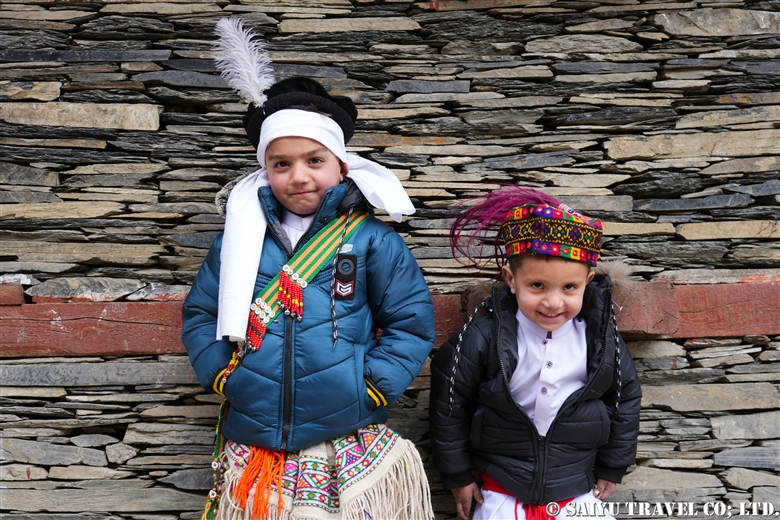
Two brothers who underwent the ceremony. Boys undergo the Goshnik ceremony twice, once between the ages of 3~5, and the second time between the ages of 5~8. Parents save money by having both brothers perform the ceremony at the same time. Incidentally, girls only have to undergo the Goshnik ceremony once.
Villagers travel around the houses singing and dancing, bringing blessings during the Goshnik ritual.
Villagers clap their hands and sing. The children respond by taking part in a ritual dance.

 Purush Istongas – Sacrifices for the Purification of Men

Sacrifices are performed on the roof of the goat stable. The blood of the sacrifice is sprinkled on the faces of the lined-up men in a purification ritual. The Istongas ritual is held in the evening. This photo was taken by a Kalash man.

The roof of the goat stable is purified and sacrifices are performed.
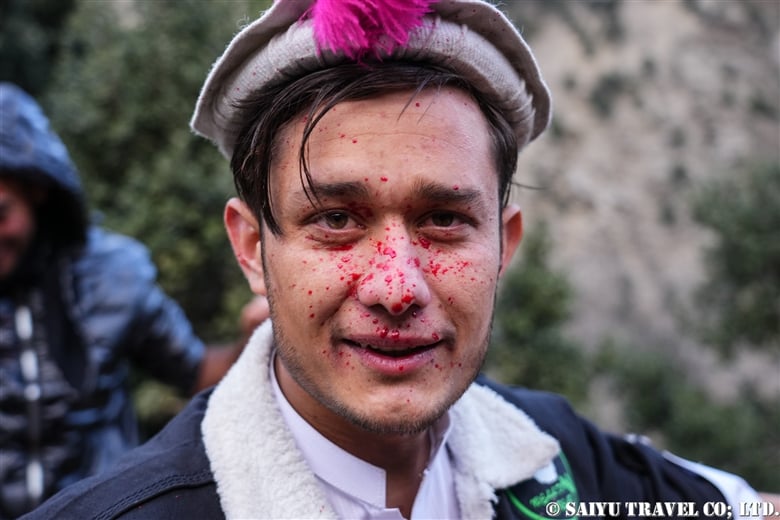
Blood is sprinkled.
A Kalash man who has now been purified.

The sacrificial goat will be dismembered here and become the meat that is eaten during this sacred period. On this day, I learned a great deal about the beliefs and lifestyle of Kalash, a place where the ritual of sacrifice is still alive.


Text: Mariko SAWADA

Photo: Mariko SAWADA & Jamil

Visit: Dec 2024, Kalash Valley – Khyber Pakhtunkhwa

*The information presented here is based on interviews with people in the area. Please note that the descriptions and explanations of the rituals may differ depending on the source.


■Chawmos Festival – Kutram: The Kalash Rituals Still Alive to This Day

■Chawmos Festival – Mandaik : The Kalash Rituals Still Alive to This Day

■Chawmos Festival – Shishao Adu: The Kalash Rituals Still Alive to This Day

■Chawmos Festival – Pushao Adu: The Kalash Rituals Still Alive to This Day

■Chawmos Festival – Chanja Rat: The Kalash Rituals Still Alive to This Day

■The Joshi Spring Festival: A Kalash Ritual


*Contact us, Indus Caravan for more information or to make arrangements for visiting Kalash valley.

*Please follow us on YoutubeInstagram & Facebook

Category : - Kalash Valley > ◆Khyber Pakhtunkhwa
Tag : , , , , , , , , , , , , , , , , , , , , , , , ,

Chawmos Festival – Shishao Adu: The Kalash Rituals Still Alive to This Day

The ceremony to welcome the god Balimain of Kalash had finally begun. The following is a report on the women’s purification day known as “Shishao Adu.”

The day before Shishao Adu is a day for preparing the stone slab with which the Shishao, the bread for the women’s purification ceremony, will be made. The men go into the mountains to look for suitable stone slabs and leave them in a safe place, so that the women don’t touch them until they are ready to use. Meanwhile, the women prepare the flour used to make Shishao.

A man carrying the stone slab to be used in the making of Shishao.

On the morning of Shishao Adu, women gather on the riverbank to prepare for the purification. They bathe in the hut and wash their hair. After this, they cannot bathe until the sacred period is over.

Girls making themselves ready.

Shishao Adu is a day of purification for women. After this day, no newcomers are allowed to enter the Rumbur Valley. No exception is made for foreigners, nor for Muslims living in the valley—they are likewise not allowed to enter the village of Kalash. The female Kalash relatives who come from Bumburet to celebrate the children’s rite of passage known as “Goshnik” must also undergo this purification. We foreigners were also purified. When I walked around the village, people asked me if I had showered, and if I was wearing new clothes. They believe that if anyone who does not follow the regulations of the Kalash religion is in the valley, it will bring them misfortune.

Shishao making begins at the Temple.

A man kneads purified dough to be used for the making of Shishao. The men’s hands are purified, and they are not allowed to touch anything other than the ingredients for Shishao—including themselves.

Using stone slabs and stones from the mountains, the men crush the walnuts which will act as filling for the bread.

Men are required to bake five Shishao for each female member of the family, and in families with many female members, baking Shishao can start even in the early morning.

The women’s purification ritual, Shishao Suchek, had begun. The women prepared new clothes, and some of the girls were dressed up almost as much as they are during the spring Joshi festival.

First, one must purify their hands with water.
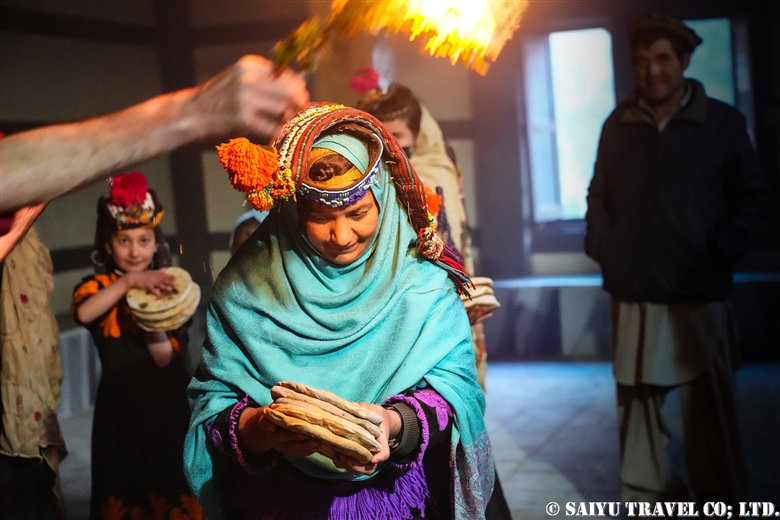
Five pieces of “Shishao” (walnut bread) are handed out.
The women are purified with smoke from a flaming juniper branch.

A woman with a very innovative headdress. She said her mother made it for her.

A traditional-style headdress known as a Kupas. Its colors are very modern. The traditional materials and colors that are typically shown in books are nowhere to be seen these days. It seems that Kalash women are always chasing the latest fashions.

The Shishao Suchek ritual at Temple Jestak Han had finally begun. Notably, it can also take place outside, in the open air.

Female members of the family gathering at the temple.
A girl receiving purification.
The female purification ritual, Shishao Suchek.

After this purification, the woman must remain pure for seven days. This involves a serious of strict rules, such as not touching Muslims, not eating chicken, eggs, cow’s milk & dairy products, honey, and so on.

Getting the opportunity to see these people live their lives and practice their faith was truly a beautiful sight.


Text & Photo: Mariko SAWADA

Visit: Dec 2024, Kalash Valley – Khyber Pakhtunkhwa

*The information presented here is based on interviews with people in the area. Please note that the descriptions and explanations of the rituals may differ depending on the source.


■Chawmos Festival – Kutram: The Kalash Rituals Still Alive to This Day

■Chawmos Festival – Mandaik : The Kalash Rituals Still Alive to This Day

■Chawmos Festival – Shishao Adu: The Kalash Rituals Still Alive to This Day

■Chawmos Festival – Pushao Adu: The Kalash Rituals Still Alive to This Day

■Chawmos Festival – Chanja Rat: The Kalash Rituals Still Alive to This Day

■The Joshi Spring Festival: A Kalash Ritual


*Contact us, Indus Caravan for more information or to make arrangements for visiting Kalash valley.

*Please follow us on YoutubeInstagram & Facebook

Category : - Kalash Valley > ◆Khyber Pakhtunkhwa
Tag : , , , , , , , , , , , , , , , , , , , , , ,

Chawmos Festival – Kuta Mru : The Kalash Rituals Still Alive to This Day

It is early December in the Kalash Valley. The harvests have all been completed and the livestock have come down from the mountains. The ceremony to welcome the God Balimain of Kalash has begun. It includes rites of passage, purification, and sacrifice—all culminating in a farewell to Balimain, complete with torches and a large bonfire. The following is a report on a trip that brought me into contact with the rituals of a deep faith that continues to thrive in the modern age.

During the sacred period of Chawmos, Muslims are not allowed to enter the valley. Since neither staff nor drivers from Islamabad could enter the valley, Kalash staff came to Ayun to pick me up.

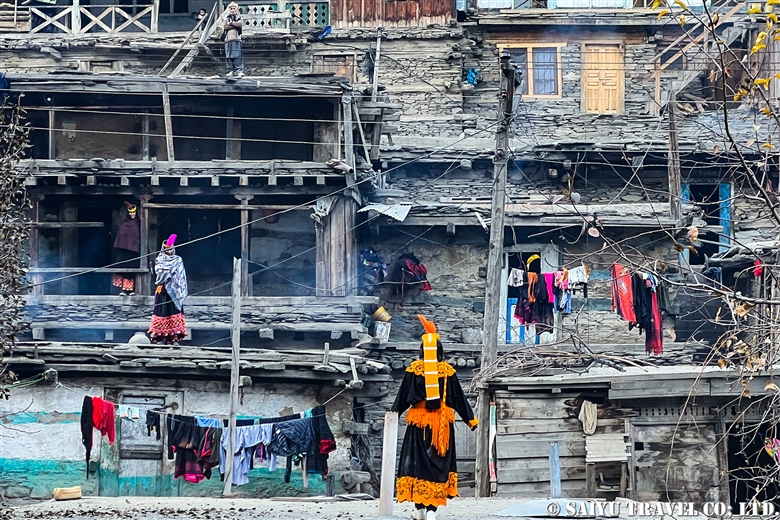
In the village of Kalash, a lot of laundry was hung out to dry to ensure people can wear new clothes during the sacred period. Before the purification ritual, one must take a bath and put on new clothes.

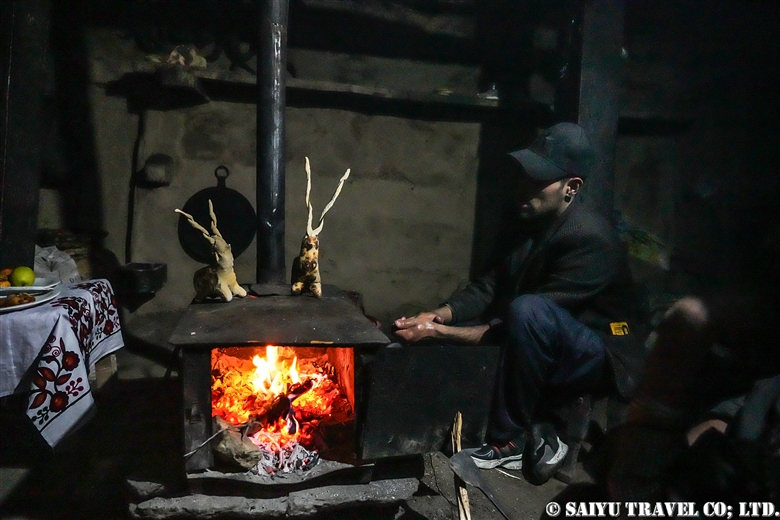
Sharabira displayed in a house

I made it just in time to be able to observe the Sharabirayak ritual in the Bumburet Valley. The word “Shara” means markhor and the word “Bira” means male goat. After the women bake walnut bread with cheese to be distributed the next day, the men knead dough, which they shape in the form of either markhor or male goats. These statues are then baked in a fireplace. This ritual is called Kuta Mru.

Sharabira making takes place at night. When I visited, there was no electricity in the valley, and I was able to glimpse the beautiful sight of a woman baking walnut bread by the light of a stove fire.

Afterward, the purified man kneads purified dough and begins to sculpt animal shapes.

He proceeded to bake them on the stove.

The completed sharabira on display

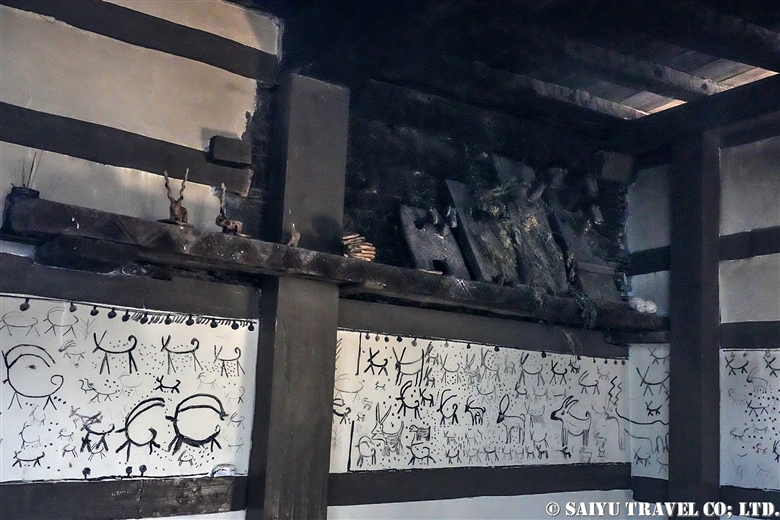
The ritual of Kuta Mru is performed in each household as well as in the temple of the goddess Jestak. The wheat collected from each family is used to make a Shara (markhor) at the Jestak Han temple. At night, the men gather to make Sharabira and spend the night painting on the walls and drinking until early in the morning. At around 4:00 a.m., they make a “tchich tchich” sound—intended to resemble the call made when chasing goats—urging the Sharabira to go to a place called “Dezelawat.” The people of Kalash believe that the souls of the Sharabira go to Dezelawat, which is located near the Afghan border.

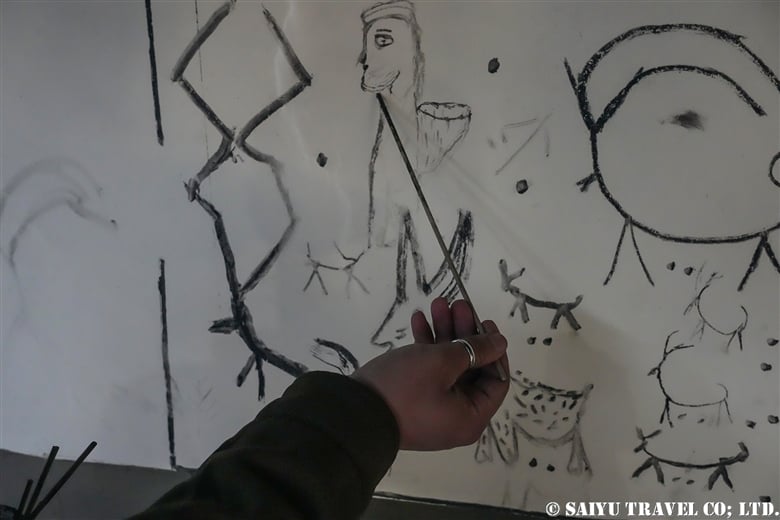
A drawing of Sharabira on the wall of the Jestak Han temple. Three Shara (markhor) are placed by the altar.

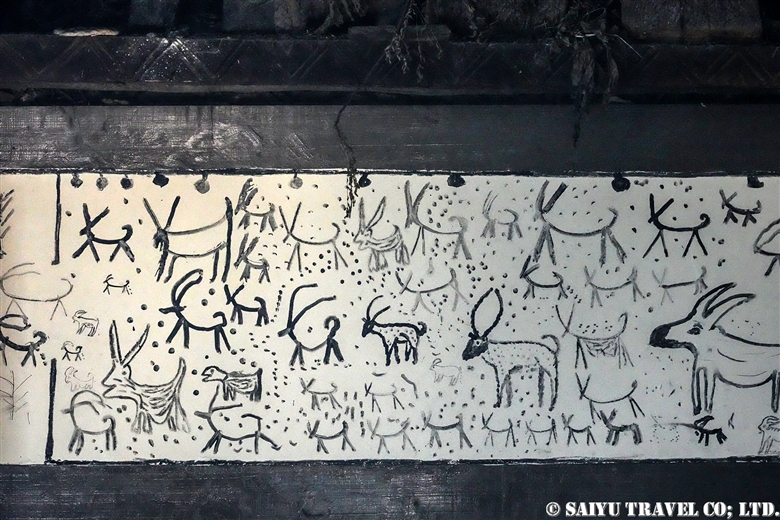
The drawings on the walls of the temple are painted with charcoal made from burning walnut bark prepared by the women.

A painting from Kutram in 2024

For those unfamiliar with the markhor, it is the national animal of Pakistan and is known to be extremely valuable for trophy hunting. In the 2024-25 winter hunting season, permission to hunt three Kashmir markhor was given, and each was auctioned off for between $231,000 and $271,000. It is said that 80% of the income from trophy hunting is returned to the local community, and in order to increase the number of trophies, conservation is carried out. Though this initiative has led to the number of markhor increasing, as someone who loves animals, I feel rather conflicted about this.

Kashimir markhor (Toshi Shasha game reserve)

The markhor is a highly sacred animal to the people of Kalash. They can be seen in Chitral Gol National Park and nearby game reserves. Males with large horns are usually found at higher elevations in the mountains, but during the winter breeding season they come down to lower elevations, making it possible to observe them. The variant in this region is a subspecies, and is known as the Kashmir markhor.


Text & Photo: Mariko SAWADA

Visit: Dec 2024, Kalash Valley, Toshi Shasha – Khyber Pakhtunkhwa

*The information presented here is based on interviews with people in the area. Please note that the descriptions and explanations of the rituals may differ depending on the source.


■Chawmos Festival – Kutram: The Kalash Rituals Still Alive to This Day

■Chawmos Festival – Mandaik : The Kalash Rituals Still Alive to This Day

■Chawmos Festival – Shishao Adu: The Kalash Rituals Still Alive to This Day

■Chawmos Festival – Pushao Adu: The Kalash Rituals Still Alive to This Day

■Chawmos Festival – Chanja Rat: The Kalash Rituals Still Alive to This Day

■The Joshi Spring Festival: A Kalash Ritual


*Contact us, Indus Caravan for more information or to make arrangements for visiting Kalash valley.

*Please follow us on YoutubeInstagram & Facebook

Category : - Kalash Valley > ◆Khyber Pakhtunkhwa
Tag : , , , , , , , , , , , , , , , , , , , , , , , ,

Visiting the Rumbur Valley, Home of the Kalash

Visiting the Rumbur Valley, where the Kalash live. It has been a long time since my last visit. I was thrilled to meet these beautiful young ladies.

The village scene at dusk. The valley’s steep slopes are used as a base for these lively dwellings.

Here is a Pashtun street merchant who was selling plates on the corner. The young lady is negotiating with the man, but instead of money, she placed some walnuts in the bowl she wanted to buy and handed it to him. They are bartering! The white bag behind him, to the left of the photo, is full of walnuts.

Going further into the village. The ditch full of trash caught my attention.

This lady was sewing on the terrace. She was using a sewing machine powered by her foot pedal. This is one of the beautiful sights of the Kalash Valley.

These young girls were playing a rock-kicking game. It is like an old Japanese children’s game! It really surprised me how similar it is.

The girls didn’t mind at all when the camera was pointed at them, and just continue to play their game. Some of the youngsters said proudly, “Foreigners take photos of us and publish them in books.” I really enjoyed spending time with these fairy-like girls, but the time came, and I needed to leave the valley.

This is the view of Tirich Mir (7,708m/25,288 feet), the highest peak in the Hindu Kush region. The view on the way through Ayun and Kalash Valleys, of this high peak, is one of the bonus scenes of this trip.


Photo & text : Mariko SAWADA

Visit : Nov 2021, Rumbur, Kalash Valley, Khyber-Pakhtunkhwa

*Contact us, Indus Caravan for more information or to make arrangements for visiting Kalash valley.

*Please follow us on YoutubeInstagram & Facebook

Category : - Kalash Valley > ◆Khyber Pakhtunkhwa
Tag : , , , , , , , , , , , , , , , , , , , , ,

Kalash Valley: November in the Bumburet Village

In early November, I visited the Bumburet Valley. If I had a chance to go a little earlier, I could have seen the Corn Harvest season, but instead I was there during the time of everyone preparing for the coming of winter.
In this time of the year, there are very few tourists and the village is pretty quiet.

We traveled through the town of Ayun to get to the Kalash Valley. This is the amazing view along the way. The towering Tirich Mir (7,708m/25,288 feet), the highest peak in the Hindu Kush, appears over the hills of Ayun. The massive form shines in the morning sunlight.

After crossing this suspension bridge, we come to the junction of the Bumburet and Rambur Valleys. We head west here and continue on to Bumburet.

The Kalash homes started to come into view. The wooden houses are built into the slopes, making efficient use of the terrace and roofs.

These young girls who were playing with a baby goat caught my attention. She has such a charming, fairy-like beauty.

I went up these stairs, made from a hollowed-out tree, to the shaman lady’s house.

This is the terrace of the shaman’s house. According to her, she has the power to foresee the future and find things people had lost, so the people asked her to become a shaman.

Inside the shaman’s house. With the light only coming in from the doorway, the traditional lifestyle of the Kalash people is simple.

These wooden statues stood in the village funeral parlour.

The handmade wine made by the Kalash people, I found it so good.

This woman is threshing crops on her roof. This is a scene that is unique to the harvest season.

It filled me with so much happiness to revisit a school teacher home in Anish village, I found daughter has now become a mother! I used to visit them often, so this is the best memory.

The last time I could visit Bumburet Village was 2 years ago. The Muslim population is increasing and the number of Kalash girls wearing hijabs was higher than before. The color of the handmade embroidery on the traditional folk clothing was quite popular and flashy.

Over the past 30 years, as a tour guide for Saiyu Travel, I have seen the decline of the traditional ethnic lifestyles and clothing in various parts of the world. For the people, the more things become more modernized, their life also becomes easier, so it means these traditional ways are lost voluntarily. But still, it makes me sad to see the sudden shift away from ancient traditions and beliefs. I send strong prayers that these precious ethnic minorities like the Kalash can hold on their culture and rich traditions as part of the Islamic Republic of Pakistan.


Photos & text: Mariko SAWADA
Visit: Nov 2021, Bumburet, Kalash Valley, Khyber-Pakhtunkhwa

Category : - Kalash Valley > ◆Khyber Pakhtunkhwa
Tag : , , , , , , , , , , , , , , , , , , , , , ,

Kalash Valley’s Bumburet and Rumbur
This is a video that highlights the scenery of the Kalash Valley when we visited in October. In the past when we visited Bumburet village, it was during the tourist season and quite crowded with domestic tourists.
However, by the middle of October, there were very few visitors at this time of year and the village was quiet.


KALASH VALLEY Bumburet & Rumbur|カラーシャの谷(ボンボレット&ランブール)


Image : Mariko SAWADA

Visit : Oct 2021, Bomboret & Rambur, Kalash valley, Khyber Pakhtunkhwa

Category : = Video Clip KPK > ◆ Video Breathtaking Views of Pakistan > - Kalash Valley > ◆Khyber Pakhtunkhwa
Tag : , , , , , , , , , , , , , , , , , , , , , ,

Crossing the Shandur Pass in the Autumn

In late October, Northern Pakistan’s poplar trees turn a golden hue, making it the most beautiful season of the year. Travel from Gilgit to Shandur Pass through the Ghizer District is spectacular. With less traffic in the valley, the view along the road is one of the best.

On this day, we left Gupis to travel towards Chitral. There were rows of golden poplar trees reflecting the sun against the clear autumn sky. However, as we kept stopping to get photos of the dynamic landscape, our progress getting to Chitral was quite slow.

As we made our way uphill to Phandar, we found a herd of yaks that were being gathered together. Due to snow in the higher elevations, they were being brought down and were being herded together to be taken to their pasture lands.

A view of the bridge near Phandar. In the past, many of the suspension bridges like this were made of stone, wood and wire. But they are steadily being replaced by concrete bridges made by China. As a photographer, it is sad to see these kinds of bridges getting phased out.

Eventually, we started up the Shandur Pass. We saw a donkey caravan passing us as they were heading down, loaded with fuel for their fires during the cold winter. Their heavy load was packed with materials for firewood, including dried cow and yak droppings

Shandur Pass at the altitude of 3,700m (12,140 ft). The Gilgit-Baltistan and Khyber-Pakhtunkhwa boarder is here. At the check post, all the foreigners will be asked to confirm their documents here.

When mentioning Shandur Pass, it is worth noting that it is famous for the “World’s highest altitude Polo Competition” the Shandur Polo Festival, which takes place in the summertime. The stadium was also covered by the snow.

This is a lake covered in ice on the Shandur Pass. This part of the road is extremely difficult to pass where the melting snow and sand mixes together into a muddy mess, causing a chaotic scene. 。

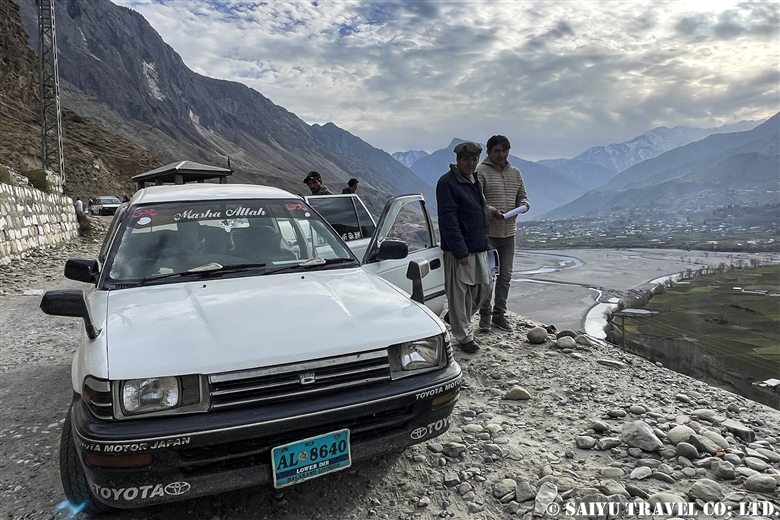
The steady, dependable vehicle of choice on these rough back country roads, is what is locally called the “Toyota Jeep.” These Toyota Land Cruisers from the 1970’s and 80’s are the go-to vehicle and have been retrofitted with the “Northern Pakistan Kit” both inside and out, which is designed to take a beating, but to get you to your destination.

These older jeep-type cars have been declining recently as newer land cruiser models become more popular, which is coming from Afghanistan into Gilgit-Baltistan and Khyber Pakhtunkhwa (Non Custom Paid Cars).

Even so, when it comes to driving in the snow, these rugged cars have a track record for being the most dependable. I’m so glad to know that even now, such an old Japanese car is still so heavily relied upon in the mountains of Pakistan. It is playing a vital role of connecting a remote village and delivering the supplies they need.

As we made our way down from the Shandur Pass, at the foot of the mountains, we stopped for a late lunch in the village of Laspur. We had lentils, curry made of freshly harvested potatoes, chicken curry, rice pilaf and naan.

In Laspur, this father and his daughter were running the wonderful “chaihana”. I was enchanted by the smile of this young lady.

We continued on our journey, taking the rough road to Mastuj, and then on to Chitral. By the time we arrived in Chitral, it was already dark.


Image & text : Mariko SAWADA

Visit  :Oct 2021, Gupis, Phandar, Shandur Pass – Gilgit-Baltistan & Khyber pakhtunkhwa

Category : ◆ Gilgit-Baltistan > - Shandur Pass > - Ghizer / Shandur Pass
Tag : , , , , , , , , , , , , , , ,

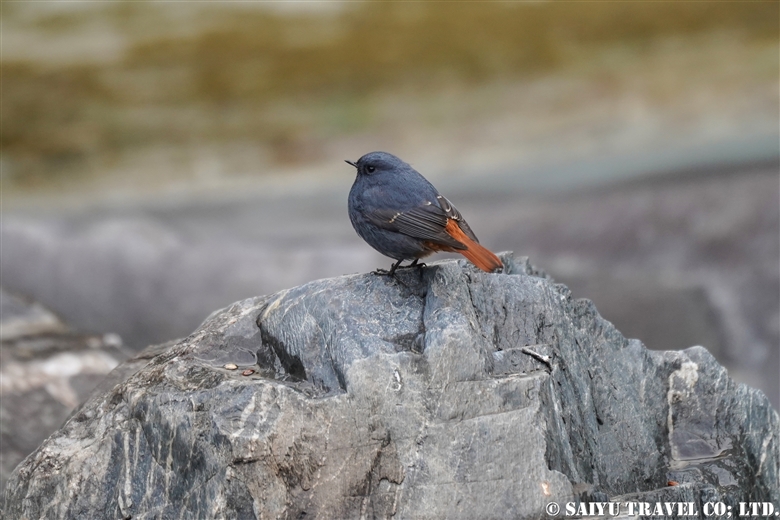
Plumbeous water redstart (Chitral)

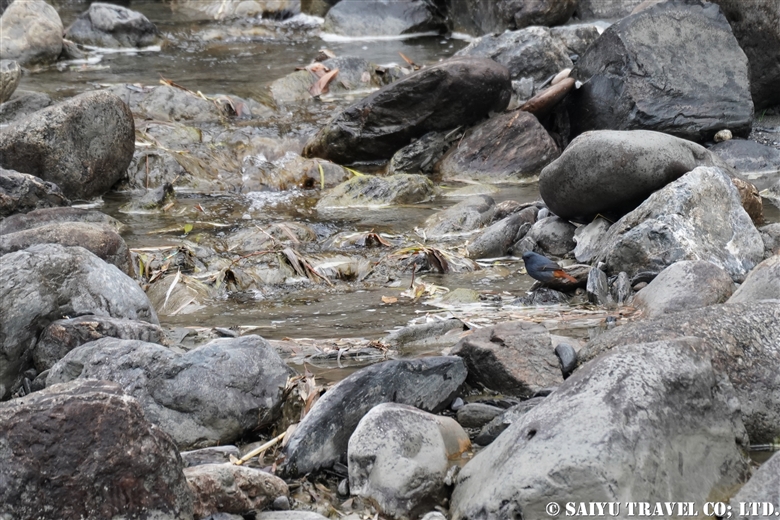
We found a male Plumbeous water redstart on the banks of the river running through Tooshi-Shasha Conservancy near Chitral, Khyber Pakhtunkhwa.


Unfortunately, it was raining; it seemed like it would turn into snow soon enough. We came in search of markhor, as we were told they often come to the riverbanks in the afternoon. So, we waited. That was when we observed both the Plumbeous water redstart and the White-capped water redstart.


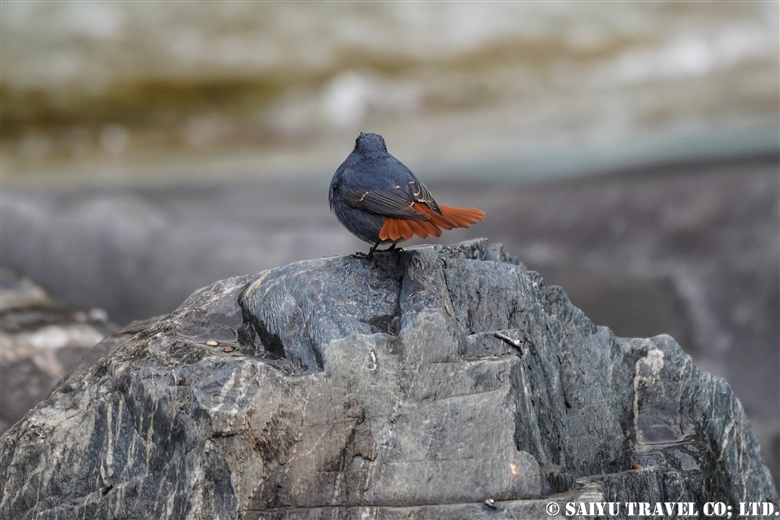
A male Plumbeous water redstart displaying, with its tail wings spread out.

These redstarts breed in South Asia, Southeast Asia and China at altitudes of 2,000 meters to 4,000 m and then in winter, they will descend to slightly lower altitudes to overwinter there. In Pakistan, they are found in the mountainous areas in the north where the altitude is not so high, and it seems to be common near Chitral and Murree.


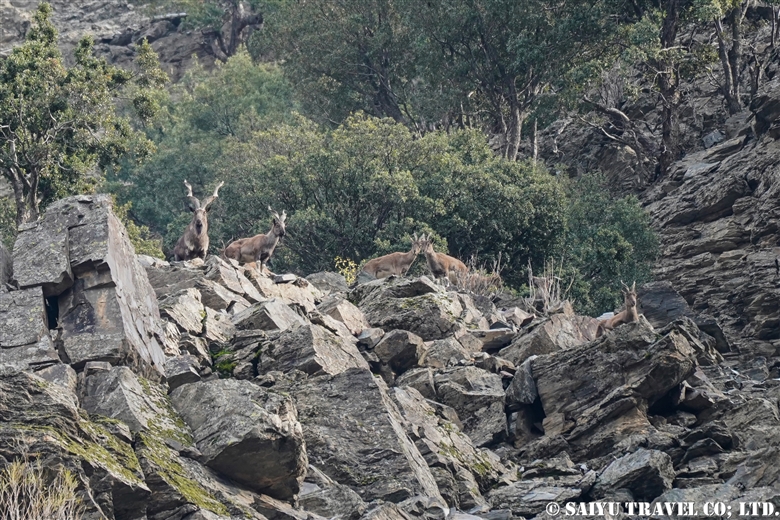
As we looked up at the mountainous slopes above the river, we could see a herd of Kashmir Markhor coming down towards us. And among them was a big male with a pair of enviable horns!


Photo & Text: Mariko SAWADA
Observation: Dec 2020, Tooshi-Shasha Conservancy, Chitral, Khyber Pakhtunkhwa
Reference: Helm Field Guides “Birds of Pakistan”

Category : ◆Khyber Pakhtunkhwa > - Chitral > ◇ Birds of Pakistan
Tag : , , , , , , , , , , , , , , , , , ,

Eversmann’s redstart(Chitral Gol National Park)

Found wintering in the Northern mountain ranges of Pakistan, the Rufous-backed Redstart (Eversmann’s Redstart), can be found at altitudes of 1,500 to 2,500 meters. They can sometimes be spotted on the mountain slopes of Gilgit-Baltistan to Khyber Pakhtunkhwa.

This is the male Eversmann’s Redstart.


In the summer, they breed in the high-altitude mountainous regions of Central Asia and South Siberia. Then, migrating south to Iraq, southern Iran, the Arabian Peninsula, northwestern Pakistan and northwestern India, they will spend their winters in the mountains.


I saw this bird at Chitral Gol National Park in northern Chitral. We came here to observe the Markhol, but was able to observe this redstart on the mountain slopes while we were waiting for the Markhol to descend.


Photo & text: Mariko SAWADA
Observation: Dec 2020, Chitral Gol National Park, Chitral, Khyber-Pakhtunkhwa
Reference: Helm Field Guide “Birds of Pakistan”

Category : ◆Khyber Pakhtunkhwa > - Chitral Gol National Park > ◇ Birds of Pakistan
Tag : , , , , , , , , , , , , , , , ,

TOP