

English / Japanese

Buddhist Archaeological Sites in the Upper Indus River: Manthal Buddha Rock and the Petroglyphs

I’ve written multiple times about the rock carvings along the Indus River near Chilas, but I’d like to do so again today and introduce to you some additional carvings located around Skardu and the upper Indus Basin, in the Baltistan region.

Interestingly, Baltistan has fewer known archaeological sites compared to other northern areas of Pakistan. Some archaeologists suggest one reason for this is that during the heyday of archaeological exploration by British India, this region was left out of the expeditions of Sir Aurel Stein, an archeologist who primarily explored Central Asia.

If you visit Skardu, one of the first places you’ll want to see is the Manthal Buddha Rock.

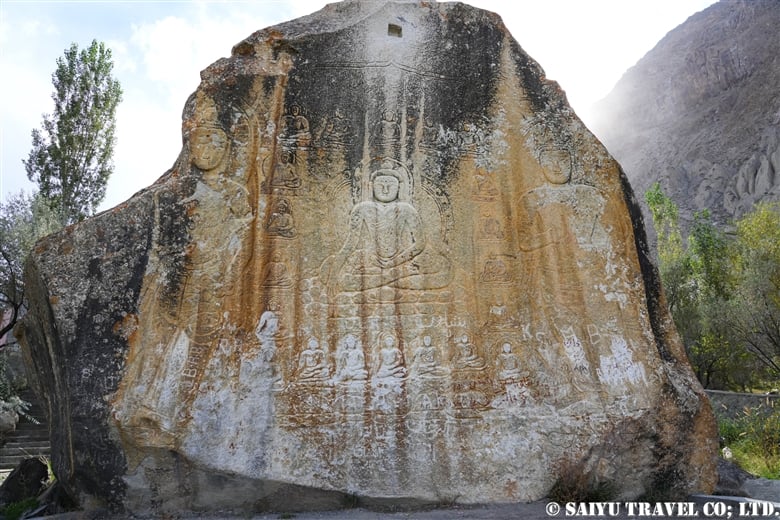
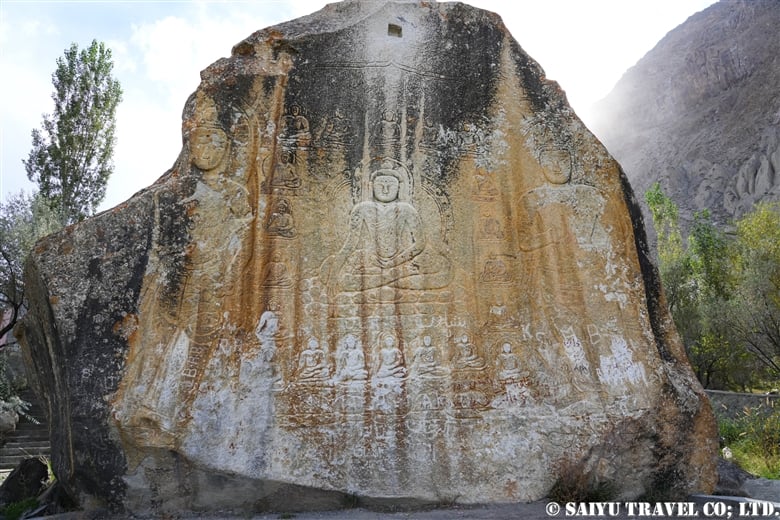
This 9th-century Buddha relief represents a style from the later “Golden Age of Buddhism,” which flourished in the upper Indus River Basin from the 8th to the 10th centuries. Carved into a large rock, the relief depicts the Buddha performing the bhumisparsha mudra gesture, and is surrounded by 20 smaller seated Buddha and two standing Maitreya Bodhisattvas.
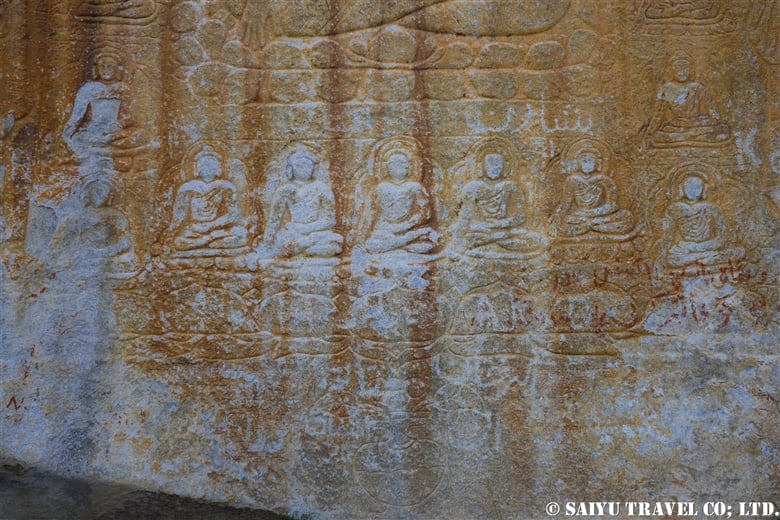
A rock carving of Buddhas surrounding the Buddha

On the left side of the rock is another Buddha carving accompanied by two Maitreya Bodhisattvas. A small swastika is also carved into a rock on the ground. On the back of the main rock, a stupa is carved into a separate stone.
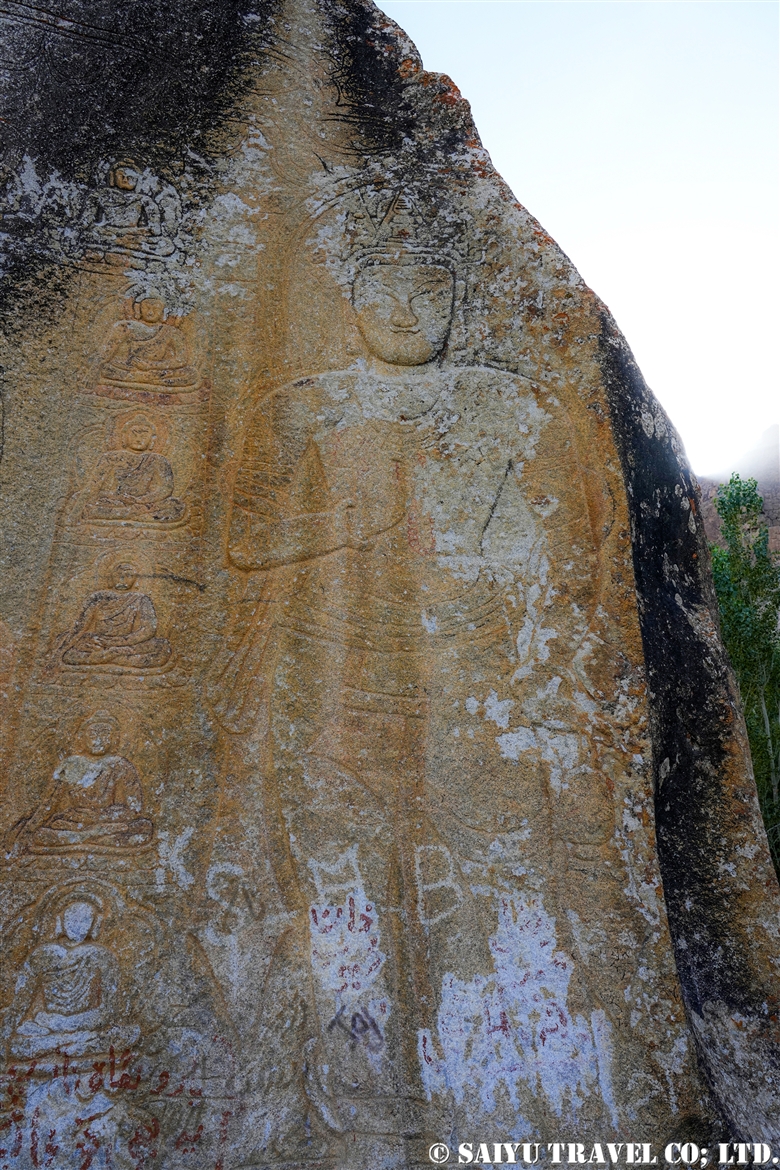
A Maitreya Bodhisattva
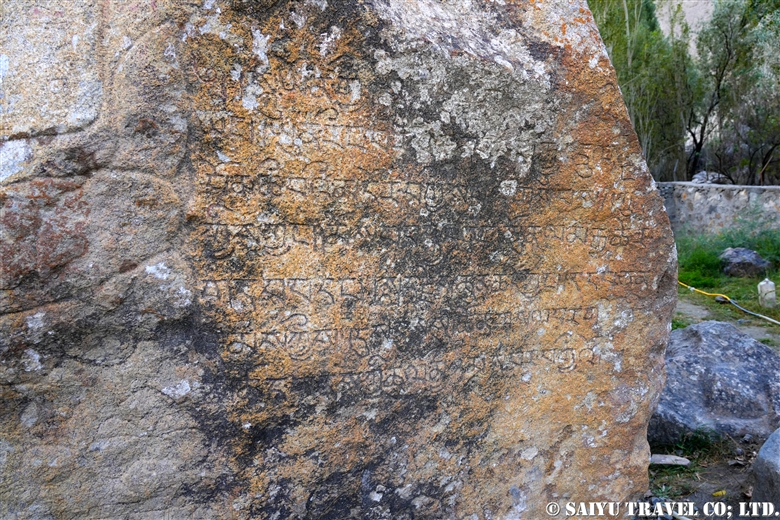
Tibetan script inscribed into the rock

The rocks contain inscriptions that were deciphered by A.H. Francke, a German scholar of Tibet. These valuable inscriptions date back to around 1000 CE. Scholars worked to record their content before they deteriorated further, as they represent a rare and precious record of the Balti language written in Tibetan script.


<English Translation of the Deciphered Portion>

Of the offering … this secret collection  (Buddha’s religion)

as it will be taught for a long time…; as many are lost through death, all men should,

showing devotion, offer very many prayers ; henceforth for ever the faithful ones

[should] from time to time [make] the colours [of] the sculptures bright,

and make a cleaning [or, and clean] the place of offering that it may not decay.


Preaching perfection with body, speech, and mind, on this firm medallion here … the five [Buddhas] in the middle (surrounded by..) through mercy it originated from me [called] Great-hand…

the very good Samantabhadra.. (row?) (mother?) (earth?) to cut…


Salutation to the three gods! offering; children (or riches?) of men, and… of the teaching which is firmer than anything … body (or statue) … of the magnified… it was looked for by him with trouble outsiders or insiders (Buddhists or Non-buddhists )…

from this medallion, which has been shown since a long time, is very long (?) …


While the Manthal Buddha Rock is located near the town of Skardu, there are also petroglyphs found along the Indus River and its tributaries.

Petroglyphs of Goal

Here are some petroglyphs found along the Indus River in Goal. Some late-period Buddhist stupas are carved on top of an older image of ibexes. Though there are other rock carvings in Goal, sadly, those along the main road have been heavily defaced with graffiti.
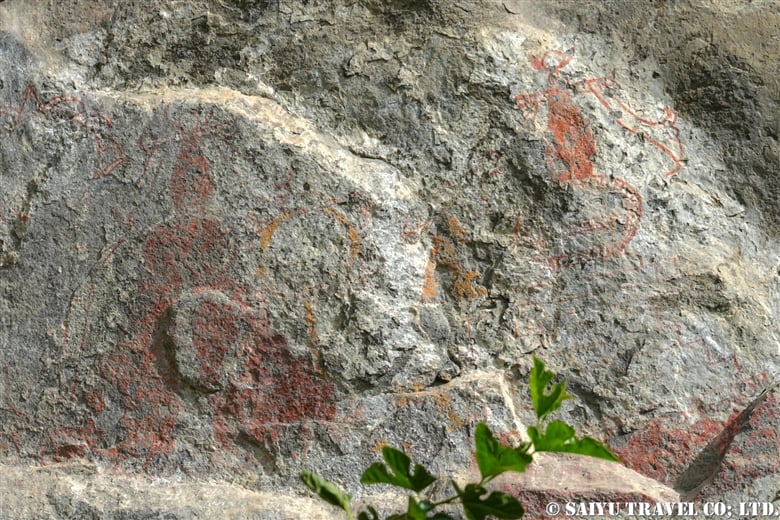
Rock painting of Nar

Rock paintings have been found in the village of Nar. Unfortunately, most of them have been lost. When they were first discovered, however, they looked something like the images below.


From “Harald Haupman : Pre-Islamic Heritage in the Northern Area of Pakistan”

The above image is a sketch from the time of the paintings’ discovery. It seems to show three stupas in the Tibetan style and people worshipping them. Unfortunately, only some parts of the stupas are visible now.
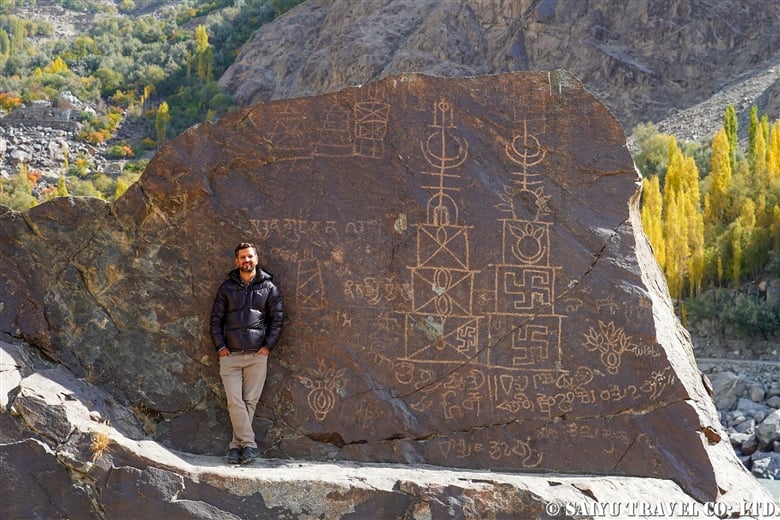
Petroglyhs of Balghar

Now that a sign has been put up on the main road, more and more people are visiting the petroglyphs at Balghar. Two large stupas, typical of later Buddhist periods, are decorated with sacred Bon and Buddhist symbols like the swastika, yundrun (reverse swastika), tridents, and lotus flowers. You can also see mantras inscribed in Tibetan script and an undeciphered script that resembles later Brahmi and Gupta scripts.

Petroglyphs of Yugo

There are also petroglyphs in the village of Yugo, located along the Shyok River, a tributary of the Indus. Though they have been heavily vandalized with graffiti, these are in fact supposed to be carvings of stupas from the late Buddhist period.

A Stupa on a Lotus Pedestal – Petroglyphs of Yugo

More petroglyphs in the village of Yugo, featuring a stupa situated on a bed of lotus flowers with auspicious motifs.

A rock carved with the mantra ‘Om Mani Padme Hum

As you travel further along the Shyok River, you’ll arrive at the village of Khaplu. This area played an important role in protecting the trade route to Ladakh. While we were walking through Khaplu’s summer village of Hanjoor, searching for petroglyphs, we found a rock inscribed with the old Tibetan mantra “Om Mani Padme Hum” right on the path. Finding such a powerful prayer from an ancient trade route was an incredibly moving experience!

Many places of the border area between Baltistan and India are restricted for foreigners, which makes me wonder if there might be new discoveries to be made once we’re allowed to go there.


Image & Text : Mariko SAWADA

*Please follow us on YoutubeInstagram & Facebook 

Category : ◆ Gilgit-Baltistan > - Indus river bank > - Skardu Valley
Tag : , , , , , , , , , ,

(Movie) Himalayan Ibex Fighting For Dominance

Normally the peak of the Ibex rutting season is in December to January, and that is when you would expect to see them battling it out for dominance with the sounds of antlers clashing. However, this time, we found a group of them challenging each other, on a snowy spring April day, using the rocky outcrop as their stage.

Himalayn Ibex fighting for the dominance

From Dec 2021 to Feb 2022, there was some unfortunate illegal hunting that took place in Khunjerab National Park, resulting in the loss of a significant number of Ibex. Up to now, trophy hunting had been tightly controlled by national parks managed and the KVO community management system. But now the carefully managed Ibex population, which had been recovering, due to the heartless actions of people who are willing to cheat the system, has started to dwindle again. This in turn, affects the snow leopards, which forces them to start hunting among the villagers’ livestock for food. This causes the human-wildlife conflict issues to escalate in the harsh winter.

By the time we arrived, the case had already been resolved by the person in charge, but the lasting impact on the wildlife populations and people who live with them, will not be restored so quickly. Now we need to worry about the situation for next winter, as well.


Image & text : Mariko SAWADA

Observation : Apr 2022, Khunjerab National Park

Category : = Video Clip Gilgit-Baltistan > ◆ Video Breathtaking Views of Pakistan > ◆ Gilgit-Baltistan > - Ibex > - Khunjerab National Park > ◇ Wildlife of Pakistan
Tag : , , , , , , , , , , , , , ,

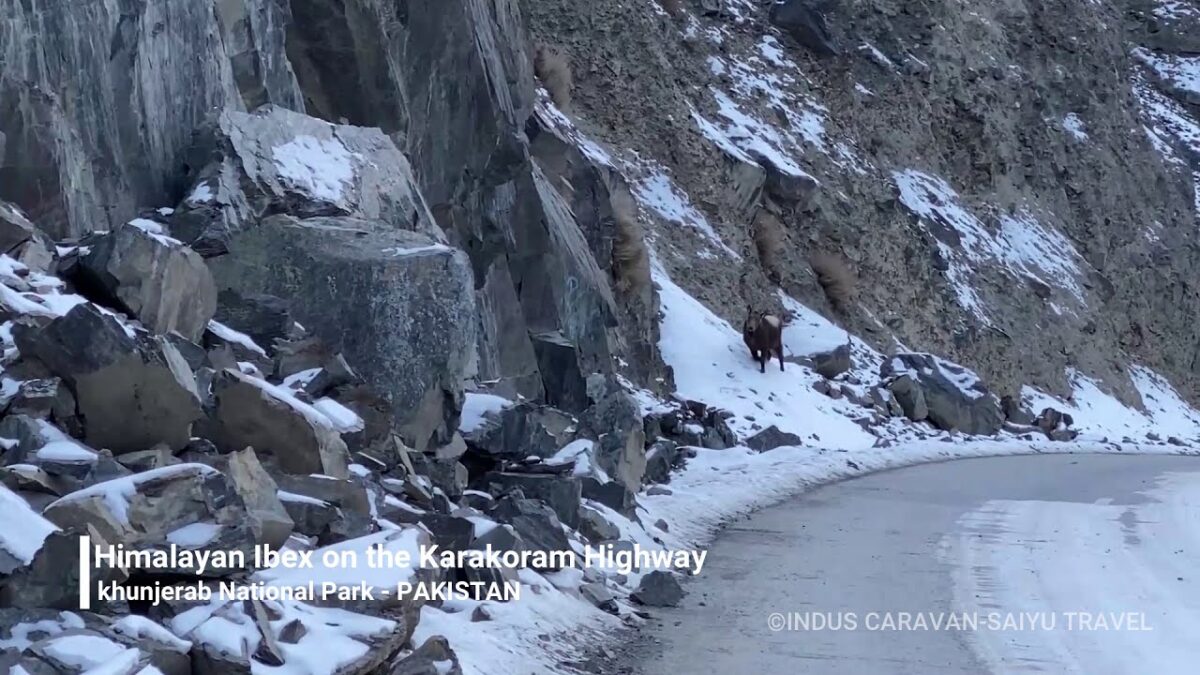
(Video)An Ibex Appeared on the Karakoram Highway!

After mid-December, Himalayan Ibex sometimes descend to the villages near Khunjerab National Park and the mountains close by. As the mountains become covered with snow in the winter, the herds of females move down to the lower altitudes. This is when ibex will start their breeding season, attracting the males to the herds.

This male ibex with his huge horns just suddenly appeared on the side of Karakoram Highway. Perhaps he was in hot pursuit of a female, and just forgot about his own safety, but he passed immediately next to us.


Himalayan Ibex on the Karakoram Highway


Text :Mariko SAWADA     Video : Yoko KADONAGA

Observation : Dec 2020, on the Karakoram Highway, Khunjerab National Park, Gilgit-Baltistan

Category : = Video Clip Gilgit-Baltistan > - the Karakoram Highway > ◆ Gilgit-Baltistan > - Ibex > - Khunjerab National Park > ◇ Wildlife of Pakistan
Tag : , , , , , , , , , , , , , , ,

Sindh Ibex – Hingol National Park

Sindh Ibex is a mountain goat family that lives in the rugged dry mountainous areas of southern Pakistan. As the name suggests, Kirthar National Park in Sindh is famous for its natural habitat. However, Sindh Ibex also lives in Hingol National Park, Balochistan.

Surprisingly it was easy to meet Sindh Ibex coming to the water in the dry Hingol National Park. It was at the sacred Hinglaj Mata Hindu Temple (also called Nani Mandir) inside the national park. When I approached the shrine, Sindh Ibex was eating grass in quite a close distance.


A male Sindh Ibex. There are two types of Ibex in Pakistan. Himalayan Ibex in the Northern Mountains and Sindh Ibex in the mountains of Sindh and Balochistan. The male horn of Sindh Ibex astoundingly grows 1m long.


Gorgeous female Sindh Ibex and its baby.


Going forward, suddenly I saw a group of Ibex emerging from just above the cliff. Generally, Sindh Ibex seems to move in relatively large groups.

There were a lot of trophy-sized males (ones with large horns permitted to trophy hunting). In Pakistan, Ibex trophy hunting is taking place. However, it is only prohibited inside the national parks and hunting is operated under the rules and regulations by the community forest. For 2019, 50 Himalayan Ibex and 24 Sindh Ibex in Pakistan are allocated for trophy hunting slots.

Hunting?? In this era?? No doubt, I am against hunting, but Pakistan’s hunting situation is likewise identified with conservation and the endurance of the local villagers. Trophy hunting targets only large horned individuals who have no more ability to reproduce. Subsequently, these profits are given to villagers, so villagers crackdown on illegal hunting. Therefore, it is said that the Ibex population has increased in both the northern and southern regions since this system was established.


Energetic young males began battling with their horns.


It’s like a fighting practice. A male Ibex show dominance by fighting with a horn over females when they reach maturity.


Photo & Text  : Mariko SAWADA
Visit : Feb 2019, Hinglaj Mata/Nani Mandir, Hingol National Park,  Balochistan

Category : - Hingol National Park > - Wildlife of Balochistan > - Ibex > ◆ Balochistan
Tag : , , , , , , , , , , , , , , , , ,

Himalayan Ibex – Khunjerab National Park

In late December, when whole of the northern region of Pakistan was enveloped with snow, we went to Khunjerab National Park – located in the border between Pakistan and China.
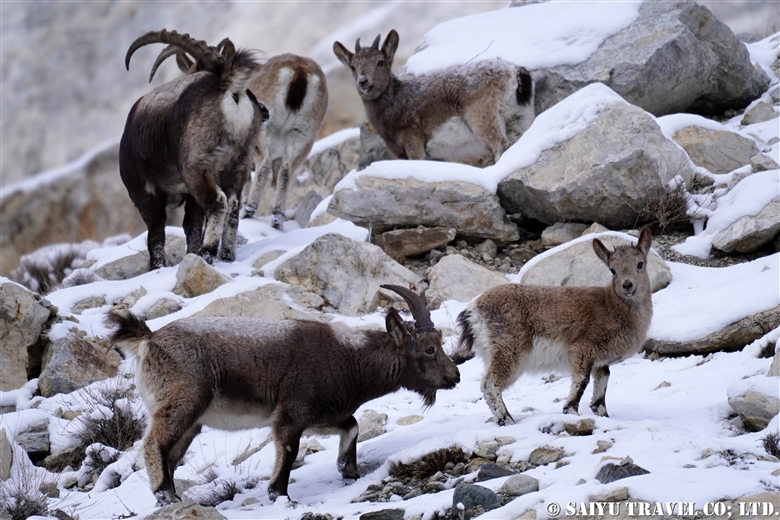
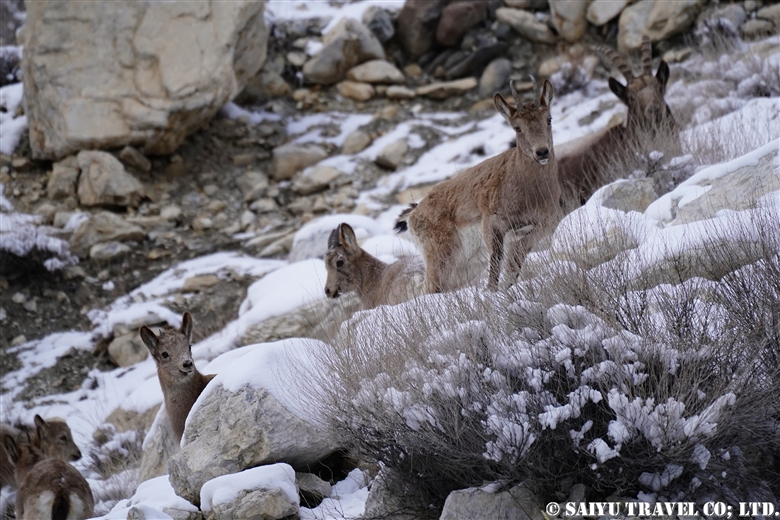
Khunjerab National Park is home to many unique species of wildlife including the snow leopard, blue sheep, Himalayan Ibex and many more. Himalayan Ibex lives in the Khunjerab National Park throughout the year. However, winter is the perfect time to witness them when they solely descend for the purposes of mating and grazing.

Ibex in northern Pakistan is a subspecies called Himalayan Ibex or Siberian Ibex, <Capra sibirica>. It seems that they are further classified by the habitat among them.

According to the National Park staff, Ibex in this area is said to gather in low places from mid-December to late January. The male was deliberately chasing the female!

Cute, young Ibex at an altitude of 4,500m, close to Khunjerab Top.


Photo & Text : Mariko SAWADA

Observation : end of Dec 2018, Khunjerab National Park

Special Thanks : Mr. Sultan Gohar – Khunjerab National Park

Category : ◆ Gilgit-Baltistan > - Ibex > - Khunjerab National Park > ◇ Wildlife of Pakistan
Tag : , , , , , , , , , , , , , , , ,

Himalayan Ibex – Khyber village in Winter

It was early January and everything was covered white with a blanket of snow. Suddenly, I was told by the Khunjerab National Park staff that there is a gathering of Himalayan Ibex  in the Khyber village.

Anxiously, I went to Khyber village immediately and luckily discovered them on the contrary bank of the Khunjerab river, where local people perform farming and cultivation. There, I could see them much closer distance than Khunjerab National Park.

The Ibex in northern Pakistan is a subspecies called Himalayan Ibex or Siberian Ibex in English (Capra sibirica).

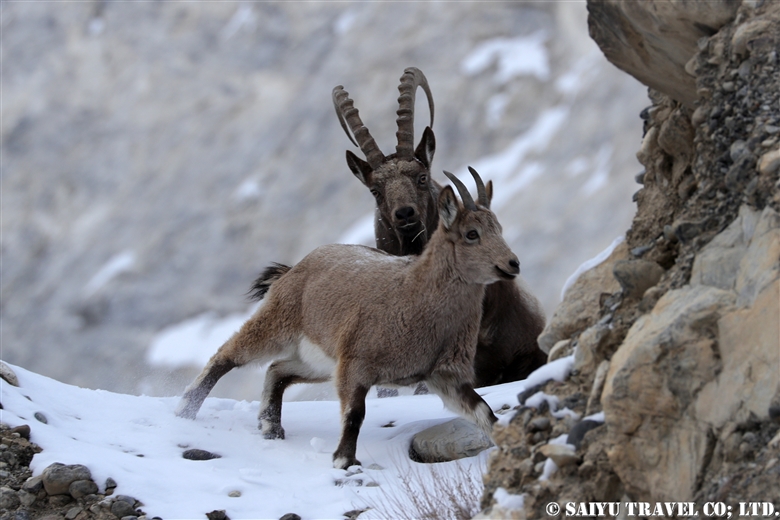
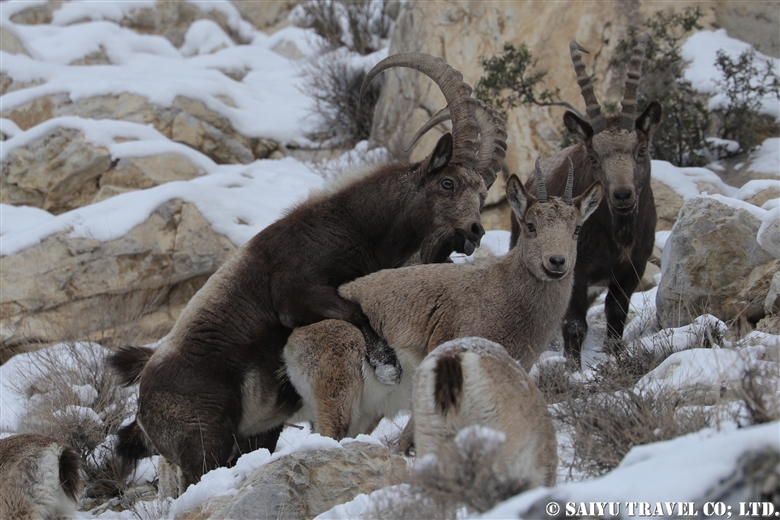
In this area, December-January is the breeding period of Ibex. A male Ibex after a female.

Ibex will have a baby, likely in the month of June.

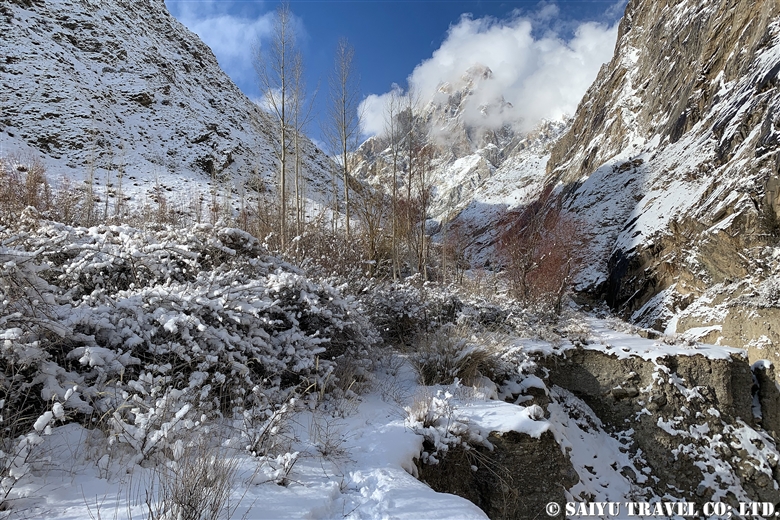
Beautiful winter juniper valley view.

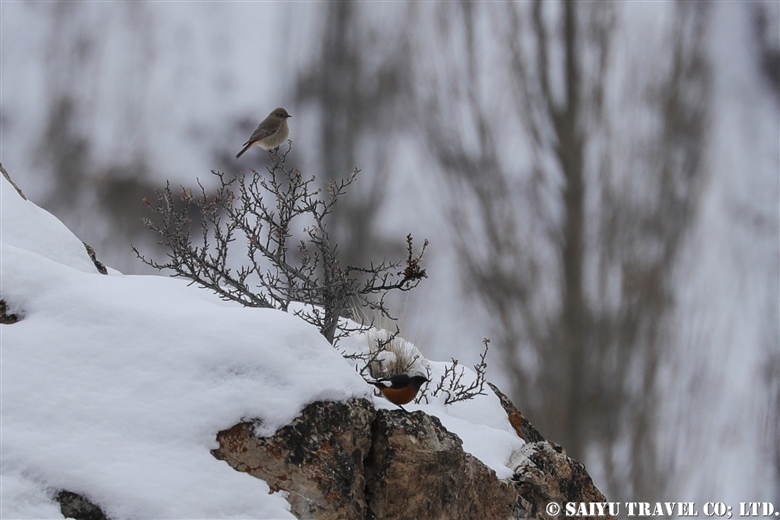
A White-winged redstart pair. In the upper Hunza, I often observe them in winter season.

Photo & Text : Mariko SAWADA
Observation: January 2019, Khyber Village – Gilgit-Baltistan
Thanks to Mr. Irfan – Khyber village &  Mr. Sultan Gohar – Khunjerab National Park

Category : ◆ Gilgit-Baltistan > - Ibex > - Khyber > ◇ Wildlife of Pakistan
Tag : , , , , , , , , , , , , , , ,

TOP