

English / Japanese

Chawmos Festival – Mandaik : The Kalash Rituals Still Alive to This Day

Here is a report on the Kalash’s Chawmos Festival. The day after the ritual of ‘Kuta Mru’, the ‘ Mandaik ‘ takes place.”

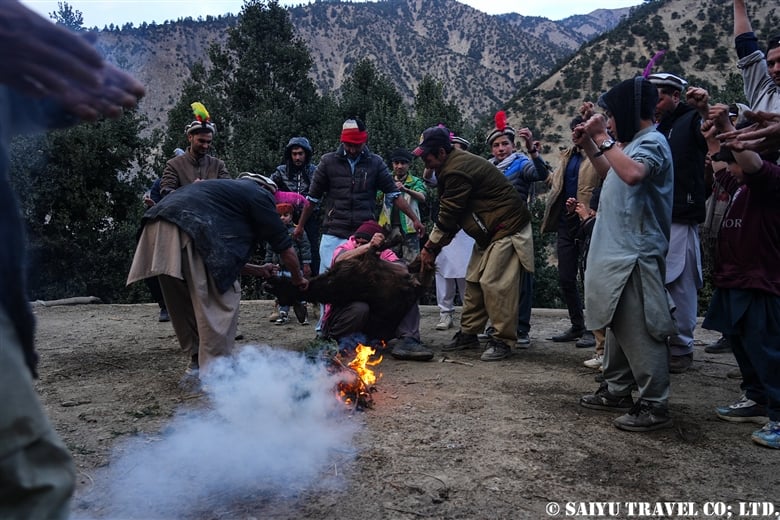
I woke up at about 4:00 a.m. to the sound of villagers shouting ‘Chi, chi, chi.’ They were ushering the spirits of the Shalabira (sacred figures of markhors and goats made during ‘Kuta Mru’) to the mythical land of Dezhirawat.”

> Read more about the ‘Kuta Mru’ ritual here


Mandaik: The Ritual to Welcome Ancestral Spirits

In the Kalash language, “to arrive” is called “ik” and “cemetery” is “Mandaw jaw.” Therefore, the terms Mandaik or Madahik literally mean “arriving from the cemetery.” On this day, the Kalash people honor their deceased ancestors, creating a spiritual bridge that unites the living and the dead.

From the morning, people visit the homes of those who have lost family members during the past year. At each home, two specific types of bread are baked for the temple rituals, along with assortments of fruit prepared as sacred offerings.

As dusk falls, the community gathers at the Jestak Han temple. Outside, rows of baskets filled with food for the deceased are carefully placed. Near the temple entrance, a small, tower-like structure called a “Chilikotik” is built from Chilgoza pine sticks.

As more villagers gather, and once the Chilikotik is complete, everyone enters the temple carrying small branches. The Chilikotik is set ablaze, the temple doors are closed, and the people wait inside together until the structure has burned down completely.

According to tradition, a village elder or priest (Kazi) calls out loudly to the spirits: “O ancestors, come, eat, drink, and then depart in peace.” It is believed that while the Chilikotik burns, the ancestral spirits arrive, partake in the offerings, and leave satisfied. Inside, the villagers wait in the dim light, holding small, flickering branches.

Finally, the temple doors swing open. Outside, the Chilikotik has been reduced to ashes. The offerings are then distributed among the villagers as they begin their journey back home.

It is said that on this day, a sense of unease lingers as people believe spirits are wandering about. Consequently, it is a day of solemnity where people refrain from speaking loudly.

Kalash women carrying fruit offerings and visiting homes that have lost family members this year.

Visitors arrive at the home, and the family members express their gratitude.

The home was very lively with many guests. The family kindly shared fruits and ‘Shosh’ (walnut paste) with us as well.

Children in the village were playing with the Sharabira crafted during Kuta Mru. Now that the souls have left the figures, they are simply treated as toys for kids or food for the cattle.

Afternoon, the villagers began baking bread as offerings for Mandaik. Two types of bread are prepared: one to be distributed to the community at the temple, and the other for the souls of the deceased.

Baking the ritual Tatuli bread
Baking the ritual Briri bread

When we arrived at the temple around 3 o’clock, not many people had gathered yet, and children were playing nearby.

The preparation of the Chilikotik soon got underway.

Women arriving with baskets of ritual offerings.

The offerings consist of the favorite foods of the deceased. Pumpkins, in particular, are believed to be a ‘food of heaven’ that the spirits of the ancestors truly enjoy.

Inside the temple, food was being gathered to be distributed later.

Children playing at the temple while the adults are busy with preparations
People chatting around a fire

Outside, the Chilikotik is now complete.

Then, everyone enters the temple, each holding a branch in their hand.

A fire was lit in the hearth near the altar, and from there, the flame began to spread to everyone. Soon, the branch I was holding was also set alight.

The light gradually spreads throughout the temple
The inside of the temple turned into a truly magical space

It was such a beautiful moment. I was so preoccupied with taking photos that my flame went out, but a girl nearby noticed and immediately relit it for me.

The temple doors finally swung open. This was the signal that the Chilikotik had finished burning. Everyone poured out of the temple all at once.

The lively crowd was busy sharing the ritual food, but by nightfall, a deep silence had returned to the temple.

We look forward to tomorrow: Shishao Adu, the important day for women’s purification.


Text & Photo : Mariko SAWADA

Visit: Dec 2025, Kalash Valley – Khyber Pakhtunkhwa

*The information presented here is based on interviews with people in the area. Please note that the descriptions and explanations of the rituals may differ depending on the source.


■Chawmos Festival – Kutram: The Kalash Rituals Still Alive to This Day

■Chawmos Festival – Mandaik : The Kalash Rituals Still Alive to This Day

■Chawmos Festival – Shishao Adu: The Kalash Rituals Still Alive to This Day

■Chawmos Festival – Pushao Adu: The Kalash Rituals Still Alive to This Day

■Chawmos Festival – Chanja Rat: The Kalash Rituals Still Alive to This Day

■The Joshi Spring Festival: A Kalash Ritual


*Contact us, Indus Caravan for more information or to make arrangements for visiting Kalash valley.

*Please follow us on YoutubeInstagram & Facebook


Category : - Kalash Valley > ◆Khyber Pakhtunkhwa
Tag : , , , , , , , , , , , , , , , , , ,

Chawmos Festival – Chanja Rat: The Kalash Rituals Still Alive to This Day

Chanja Rat is the day of the big bonfire to bid farewell to Balimain, and it can be considered the climax of the Chawmos Festival. Even people from other villages come to take part in the Tchattai ceremony from early morning.

Young girls all dressed up in the morning.
People visiting from other villages. The men will then head to Sajigor to perform the Tali Histik ritual.
The women who cannot participate in the ceremony chat in the square among themselves. They also partake in recreational singing and dancing.
The men head to Sajigor.

Tali Histik – Pray for the prosperity

Tali Histik is a ritual where people pray for the prosperity of the Kalash and for the birth of more boys. A willow tree branch—of which said tree luckily has many—is prepared for each male member of the family. It is said that the many small branches give the image of a family with many children. If there are 10 men in a given family, an additional branch is added to make a total of 11, at which point the male representative of the family throws the whole bundle. Among the number of men counted are the boys who just completed their passage rites the day before.

Willow branches prepared for the ritual
The men getting ready to throw the branches.
The willow branches are thrown all at once towards the altar.
On their return from Sajigor, the men made their way toward the square while forming a line with their hands on each other’s shoulders.

In the square, people chat and the Chawmos songs and dances continue. In the afternoon, they take a short break in preparation for the evening’s torches and bonfire.

Chanja Rat  – The big bonfire to bid farewell to Balimain

Finally, the climax of the Chawmos Festival, the great bonfire to bid farewell to Balemain, takes place. The actual experience of the chanja rat was truly a “ceremony of fire”, both fantastic and full of vitality.

After sunset, large pieces of wood for the bonfire are carried to the square.
The girls sing around the bonfire while waiting for the torches to be brought.
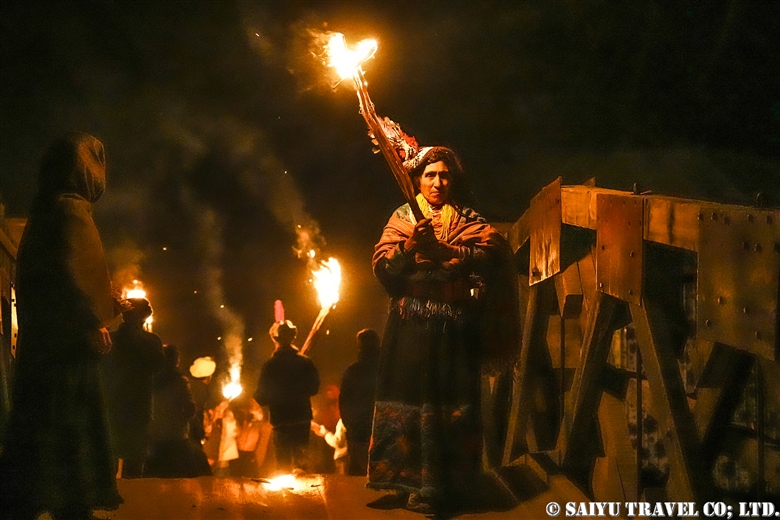
People carrying torches begin to descend from the village on the mountain.
People coming down the mountain carrying torches.
Groups of people merge, and the light of the torches grows stronger.
People carrying torches head for the square.
The fantastic sight of the Kalash holding torches.
When they arrive at the square, they throw the torches into the bonfire, fueling the fire and making it grow huge.
People singing and dancing around the fire.
For the Kalash people, Chawmos is the festival they enjoy most the whole year.
Chanja Rat: bidding farewell to Balimain.

Witnessing Chanja Rat that night proved to be a dreamlike experience for me. Seeing the Chawmos festival for yourself is a wonderful opportunity to deepen your understanding of Kalash traditions and faith.


Text: Mariko SAWADA

Photo: Mariko SAWADA & Jamil

Visit: Dec 2024, Kalash Valley – Khyber Pakhtunkhwa

*The information presented here is based on interviews with people in the area. Please note that the descriptions and explanations of the rituals may differ depending on the source.


■Chawmos Festival – Kutram: The Kalash Rituals Still Alive to This Day

■Chawmos Festival – Mandaik : The Kalash Rituals Still Alive to This Day

■Chawmos Festival – Shishao Adu: The Kalash Rituals Still Alive to This Day

■Chawmos Festival – Pushao Adu: The Kalash Rituals Still Alive to This Day

■Chawmos Festival – Chanja Rat: The Kalash Rituals Still Alive to This Day

■The Joshi Spring Festival: A Kalash Ritual


*Contact us, Indus Caravan for more information or to make arrangements for visiting Kalash valley.

*Please follow us on YoutubeInstagram & Facebook


Category : - Kalash Valley > ◆Khyber Pakhtunkhwa
Tag : , , , , , , , , , , , , , , , , , , , , , , , ,

Chawmos Festival – Pushao Adu: The Kalash Rituals Still Alive to This Day

The period of the Kalash Chawmos Festival known as “Ditch” is considered to be highly sacred. On the day of Pushao Adu, two sacrifices are performed: the first, called “Pushao Marat,” is a sacrifice to the gods done at Sajigor, and the second, “Istongas,” is a purification ritual for men. At the same time, a children’s rite of passage known as Goshnik is also performed.

At the guesthouse, the people were all abuzz with chatter. I heard them proclaiming that Balimain has arrived, and that the earthquake they’d had the previous night was actually the sound of Balimain’s arrival. They say that Balimain will stay to watch the sacrificial ceremony and the large bonfire at night, before moving on to the Bumburet Valley.

In the morning, all men in the valley wash their bodies and put on new clothes and shoes. The women wash all dishes and clean the house. After this, in addition to the existing rules about not touching Muslims, new rules are added until the sacred period is over. These rules state that no cleaning is to take place, that bread made before yesterday must not be eaten, and that bread must be made with new flour. Because of this, new dough was not available in time, so we had to have rice from Ayun for breakfast (which was very tasty).

Villagers singing and dancing from the early morning.

Pushao Marat – Sacrifice to God 

In the morning, the villagers gathered in the square to sing and dance, and at about 10:00 a.m., the large male goats selected from each family were taken to Sajigor. The men began to walk to Sajigor alongside the animals. Since women are not allowed to participate in the sacrificial ritual, this photo was taken by a Kalash man. While the ritual was happening, the women celebrated by singing and dancing.

Male goats for sacrifice go to Sajigor. The most magnificent male goat from each stable is chosen.
Upon arrival at Sadigor, preparations for the ritual begin.
A goat with fine horns like a markhor’s.
More than 30 male goats were sacrificed to the gods that day.
The altar of sacrifice.
The meat of the sacrificial goats is eaten especially during the sacred period and also used in a stew called Pushao Mos.

Goshnik – Rite of passage for children 

Goshnik is a rite of passage for children, after which the boy or girl becomes a member of Kalash and observes its commandments. The parents of the child who is to receive the rite prepare fruits and gifts for the uncle who performs the rite. The uncle offers a male goat as a present. The relatives gather for the celebration, and the parents serve fruit and wine. I also saw visiting relatives give money to children undergoing this rite.

An uncle performing the ceremony dresses his nephew in ceremonial garb.
Relatives receiving fruit, dried fruit, and wine from parents.
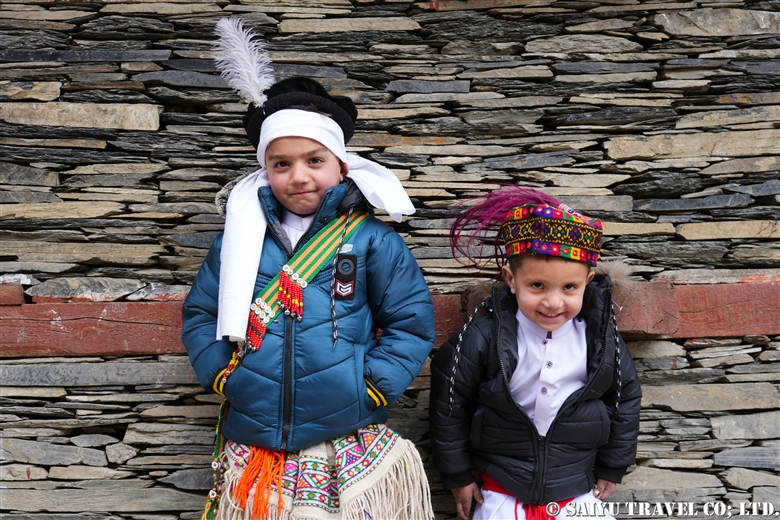
Two brothers who underwent the ceremony. Boys undergo the Goshnik ceremony twice, once between the ages of 3~5, and the second time between the ages of 5~8. Parents save money by having both brothers perform the ceremony at the same time. Incidentally, girls only have to undergo the Goshnik ceremony once.
Villagers travel around the houses singing and dancing, bringing blessings during the Goshnik ritual.
Villagers clap their hands and sing. The children respond by taking part in a ritual dance.

 Purush Istongas – Sacrifices for the Purification of Men

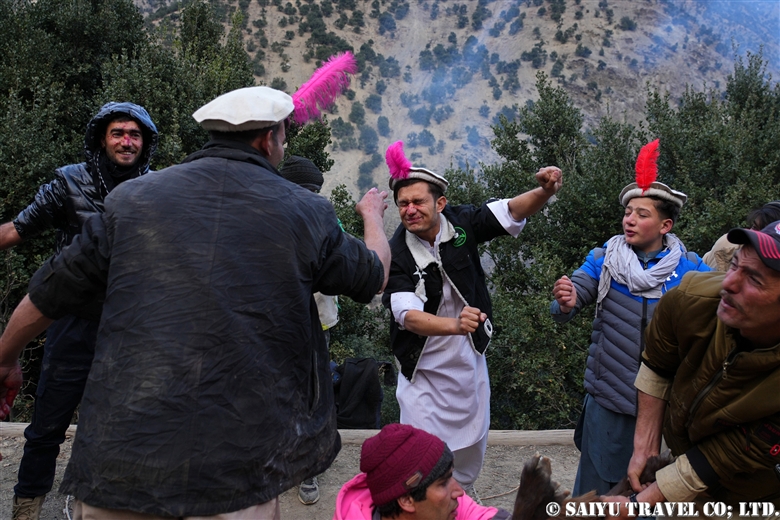
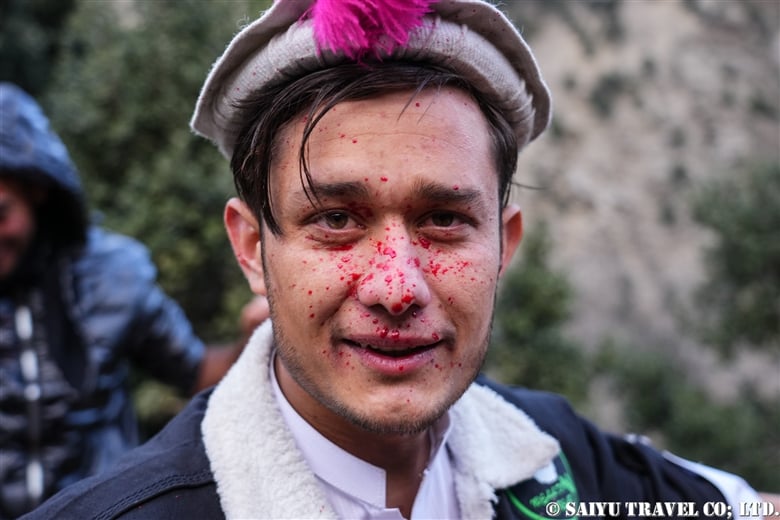
Sacrifices are performed on the roof of the goat stable. The blood of the sacrifice is sprinkled on the faces of the lined-up men in a purification ritual. The Istongas ritual is held in the evening. This photo was taken by a Kalash man.

The roof of the goat stable is purified and sacrifices are performed.
Blood is sprinkled.
A Kalash man who has now been purified.

The sacrificial goat will be dismembered here and become the meat that is eaten during this sacred period. On this day, I learned a great deal about the beliefs and lifestyle of Kalash, a place where the ritual of sacrifice is still alive.


Text: Mariko SAWADA

Photo: Mariko SAWADA & Jamil

Visit: Dec 2024, Kalash Valley – Khyber Pakhtunkhwa

*The information presented here is based on interviews with people in the area. Please note that the descriptions and explanations of the rituals may differ depending on the source.


■Chawmos Festival – Kutram: The Kalash Rituals Still Alive to This Day

■Chawmos Festival – Mandaik : The Kalash Rituals Still Alive to This Day

■Chawmos Festival – Shishao Adu: The Kalash Rituals Still Alive to This Day

■Chawmos Festival – Pushao Adu: The Kalash Rituals Still Alive to This Day

■Chawmos Festival – Chanja Rat: The Kalash Rituals Still Alive to This Day

■The Joshi Spring Festival: A Kalash Ritual


*Contact us, Indus Caravan for more information or to make arrangements for visiting Kalash valley.

*Please follow us on YoutubeInstagram & Facebook

Category : - Kalash Valley > ◆Khyber Pakhtunkhwa
Tag : , , , , , , , , , , , , , , , , , , , , , , , ,

Chawmos Festival – Kuta Mru : The Kalash Rituals Still Alive to This Day

It is early December in the Kalash Valley. The harvests have all been completed and the livestock have come down from the mountains. The ceremony to welcome the God Balimain of Kalash has begun. It includes rites of passage, purification, and sacrifice—all culminating in a farewell to Balimain, complete with torches and a large bonfire. The following is a report on a trip that brought me into contact with the rituals of a deep faith that continues to thrive in the modern age.

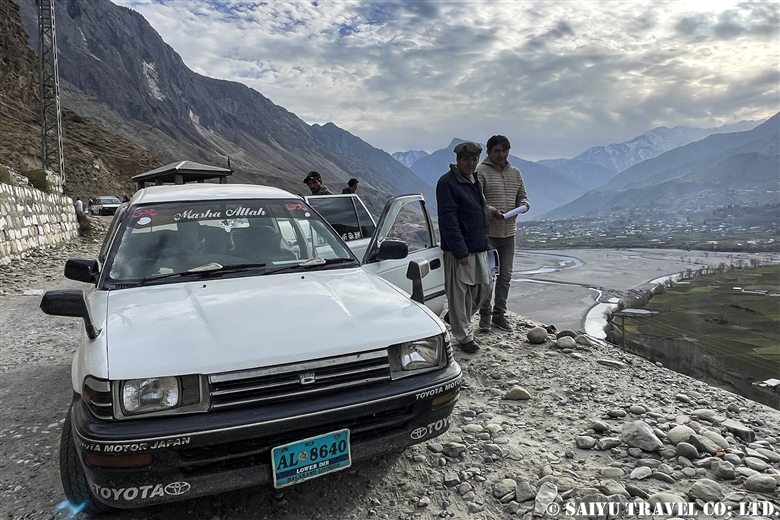
During the sacred period of Chawmos, Muslims are not allowed to enter the valley. Since neither staff nor drivers from Islamabad could enter the valley, Kalash staff came to Ayun to pick me up.

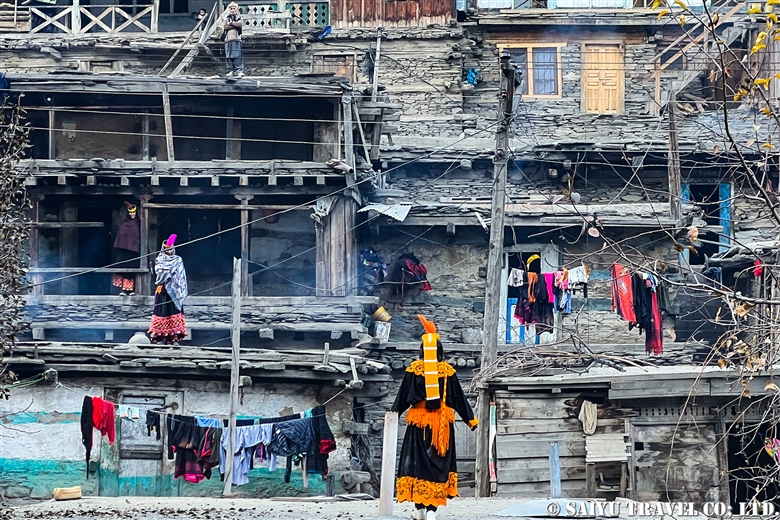
In the village of Kalash, a lot of laundry was hung out to dry to ensure people can wear new clothes during the sacred period. Before the purification ritual, one must take a bath and put on new clothes.

Sharabira displayed in a house

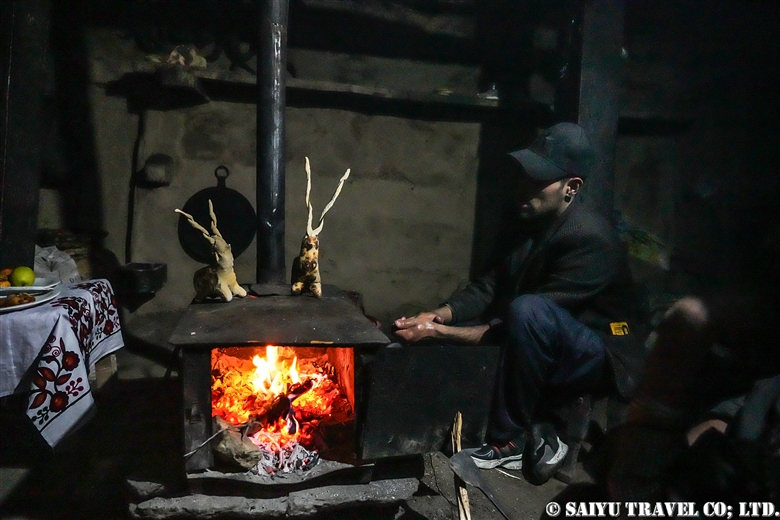
I made it just in time to be able to observe the Sharabirayak ritual in the Bumburet Valley. The word “Shara” means markhor and the word “Bira” means male goat. After the women bake walnut bread with cheese to be distributed the next day, the men knead dough, which they shape in the form of either markhor or male goats. These statues are then baked in a fireplace. This ritual is called Kuta Mru.

Sharabira making takes place at night. When I visited, there was no electricity in the valley, and I was able to glimpse the beautiful sight of a woman baking walnut bread by the light of a stove fire.

Afterward, the purified man kneads purified dough and begins to sculpt animal shapes.

He proceeded to bake them on the stove.

The completed sharabira on display

The ritual of Kuta Mru is performed in each household as well as in the temple of the goddess Jestak. The wheat collected from each family is used to make a Shara (markhor) at the Jestak Han temple. At night, the men gather to make Sharabira and spend the night painting on the walls and drinking until early in the morning. At around 4:00 a.m., they make a “tchich tchich” sound—intended to resemble the call made when chasing goats—urging the Sharabira to go to a place called “Dezelawat.” The people of Kalash believe that the souls of the Sharabira go to Dezelawat, which is located near the Afghan border.

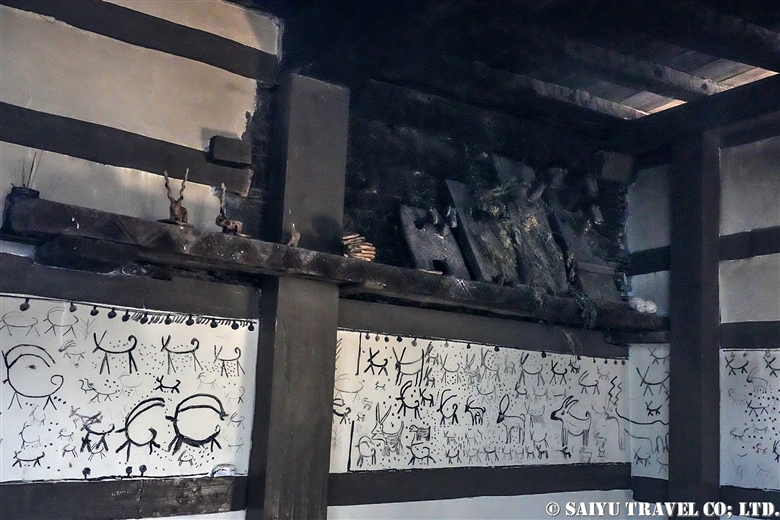
A drawing of Sharabira on the wall of the Jestak Han temple. Three Shara (markhor) are placed by the altar.

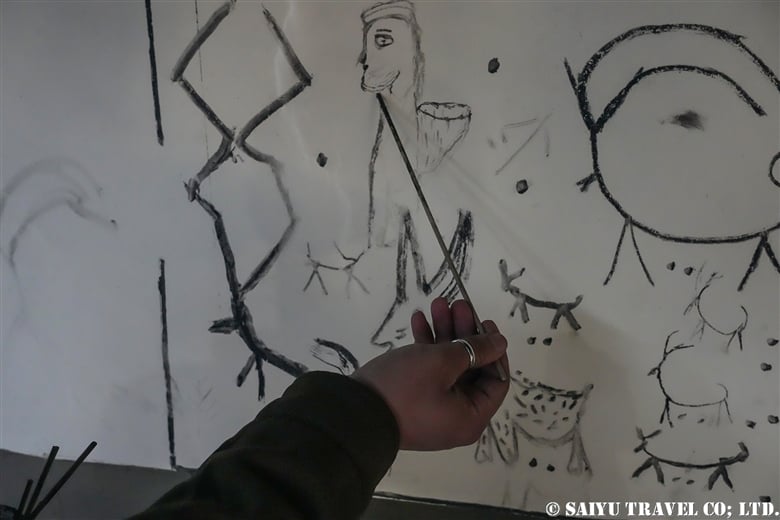
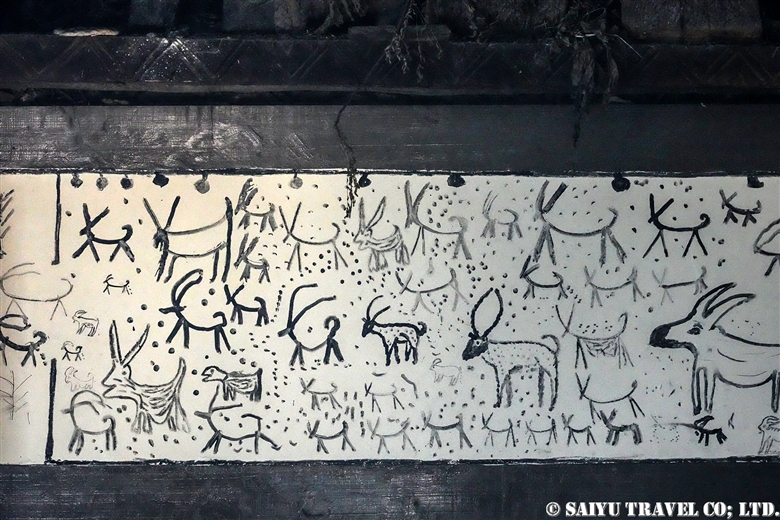
The drawings on the walls of the temple are painted with charcoal made from burning walnut bark prepared by the women.

A painting from Kutram in 2024

For those unfamiliar with the markhor, it is the national animal of Pakistan and is known to be extremely valuable for trophy hunting. In the 2024-25 winter hunting season, permission to hunt three Kashmir markhor was given, and each was auctioned off for between $231,000 and $271,000. It is said that 80% of the income from trophy hunting is returned to the local community, and in order to increase the number of trophies, conservation is carried out. Though this initiative has led to the number of markhor increasing, as someone who loves animals, I feel rather conflicted about this.
Kashimir markhor (Toshi Shasha game reserve)

The markhor is a highly sacred animal to the people of Kalash. They can be seen in Chitral Gol National Park and nearby game reserves. Males with large horns are usually found at higher elevations in the mountains, but during the winter breeding season they come down to lower elevations, making it possible to observe them. The variant in this region is a subspecies, and is known as the Kashmir markhor.
 

Text & Photo: Mariko SAWADA

Visit: Dec 2024, Kalash Valley, Toshi Shasha – Khyber Pakhtunkhwa

*The information presented here is based on interviews with people in the area. Please note that the descriptions and explanations of the rituals may differ depending on the source.


■Chawmos Festival – Kutram: The Kalash Rituals Still Alive to This Day

■Chawmos Festival – Mandaik : The Kalash Rituals Still Alive to This Day

■Chawmos Festival – Shishao Adu: The Kalash Rituals Still Alive to This Day

■Chawmos Festival – Pushao Adu: The Kalash Rituals Still Alive to This Day

■Chawmos Festival – Chanja Rat: The Kalash Rituals Still Alive to This Day

■The Joshi Spring Festival: A Kalash Ritual


*Contact us, Indus Caravan for more information or to make arrangements for visiting Kalash valley.

*Please follow us on YoutubeInstagram & Facebook

Category : - Kalash Valley > ◆Khyber Pakhtunkhwa
Tag : , , , , , , , , , , , , , , , , , , , , , , , ,

TOP