


Buddhist Archaeological Sites in the Upper Indus River: Manthal Buddha Rock and the Petroglyphs

I’ve written multiple times about the rock carvings along the Indus River near Chilas, but I’d like to do so again today and introduce to you some additional carvings located around Skardu and the upper Indus Basin, in the Baltistan region.

Interestingly, Baltistan has fewer known archaeological sites compared to other northern areas of Pakistan. Some archaeologists suggest one reason for this is that during the heyday of archaeological exploration by British India, this region was left out of the expeditions of Sir Aurel Stein, an archeologist who primarily explored Central Asia.

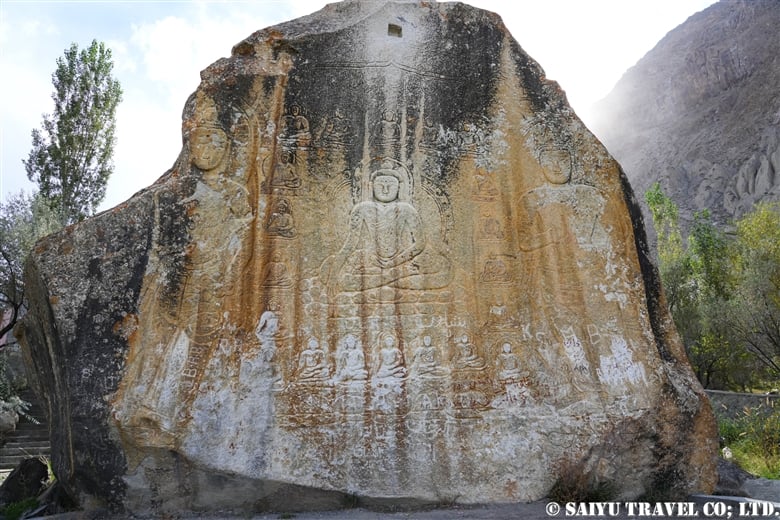
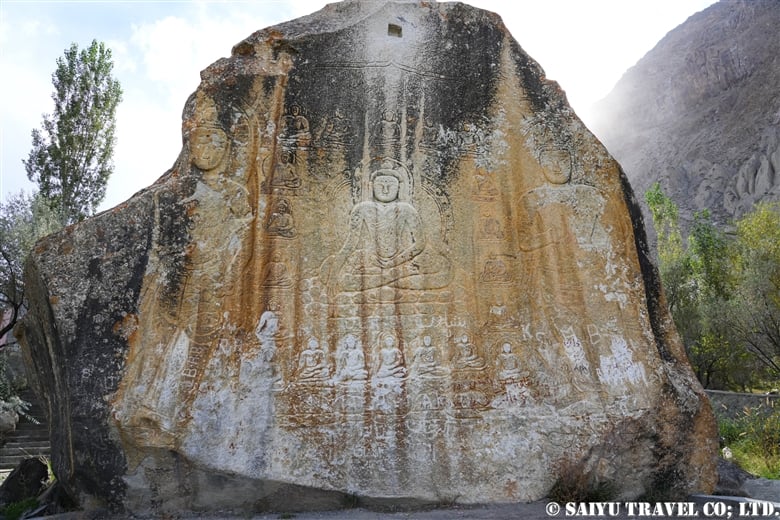
If you visit Skardu, one of the first places you’ll want to see is the Manthal Buddha Rock.

This 9th-century Buddha relief represents a style from the later “Golden Age of Buddhism,” which flourished in the upper Indus River Basin from the 8th to the 10th centuries. Carved into a large rock, the relief depicts the Buddha performing the bhumisparsha mudra gesture, and is surrounded by 20 smaller seated Buddha and two standing Maitreya Bodhisattvas.
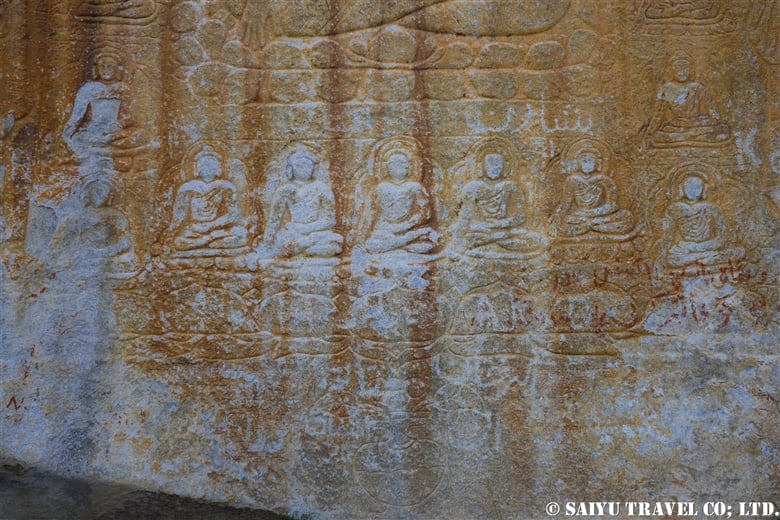
A rock carving of Buddhas surrounding the Buddha

On the left side of the rock is another Buddha carving accompanied by two Maitreya Bodhisattvas. A small swastika is also carved into a rock on the ground. On the back of the main rock, a stupa is carved into a separate stone.
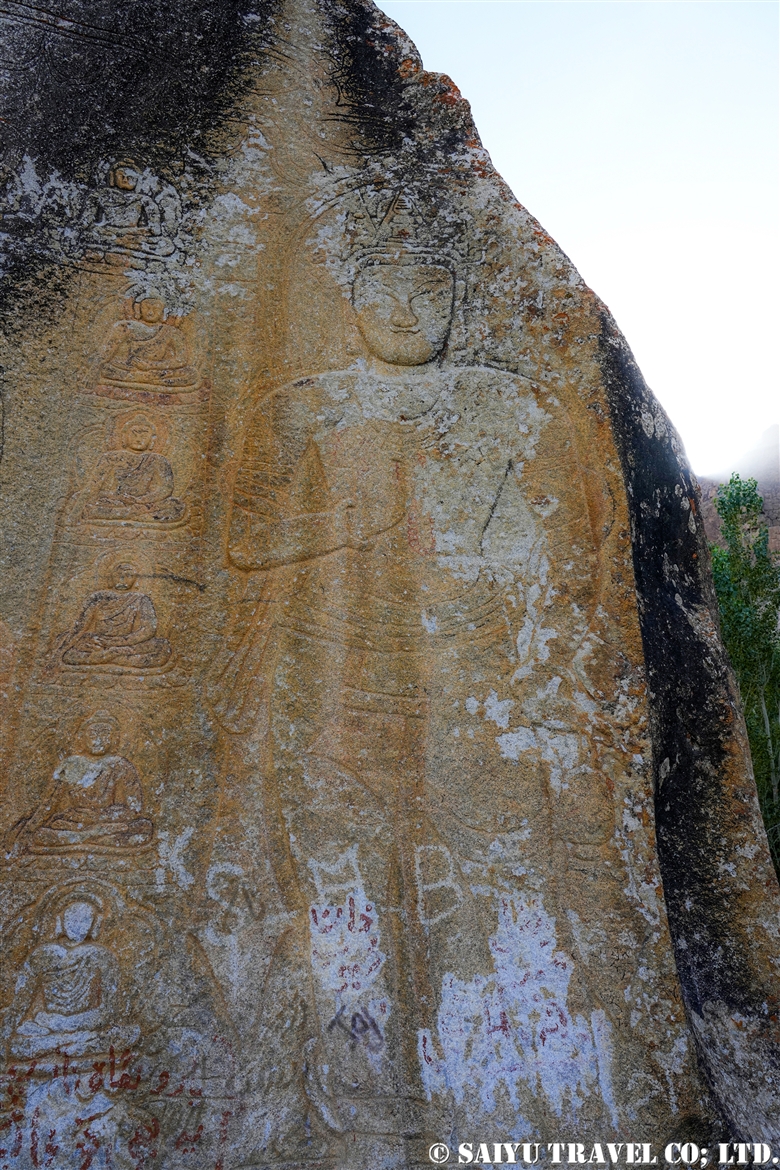
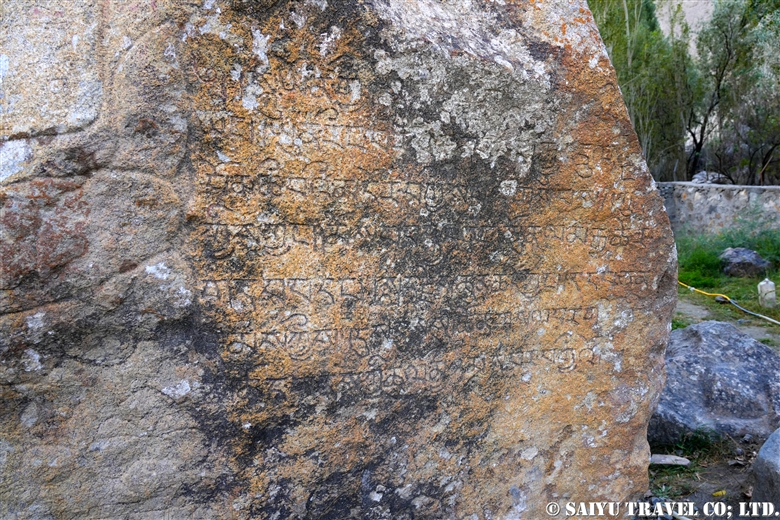
A Maitreya Bodhisattva
Tibetan script inscribed into the rock

The rocks contain inscriptions that were deciphered by A.H. Francke, a German scholar of Tibet. These valuable inscriptions date back to around 1000 CE. Scholars worked to record their content before they deteriorated further, as they represent a rare and precious record of the Balti language written in Tibetan script.


<English Translation of the Deciphered Portion>

Of the offering … this secret collection  (Buddha’s religion)

as it will be taught for a long time…; as many are lost through death, all men should,

showing devotion, offer very many prayers ; henceforth for ever the faithful ones

[should] from time to time [make] the colours [of] the sculptures bright,

and make a cleaning [or, and clean] the place of offering that it may not decay.


Preaching perfection with body, speech, and mind, on this firm medallion here … the five [Buddhas] in the middle (surrounded by..) through mercy it originated from me [called] Great-hand…

the very good Samantabhadra.. (row?) (mother?) (earth?) to cut…


Salutation to the three gods! offering; children (or riches?) of men, and… of the teaching which is firmer than anything … body (or statue) … of the magnified… it was looked for by him with trouble outsiders or insiders (Buddhists or Non-buddhists )…

from this medallion, which has been shown since a long time, is very long (?) …


While the Manthal Buddha Rock is located near the town of Skardu, there are also petroglyphs found along the Indus River and its tributaries.

Petroglyphs of Goal

Here are some petroglyphs found along the Indus River in Goal. Some late-period Buddhist stupas are carved on top of an older image of ibexes. Though there are other rock carvings in Goal, sadly, those along the main road have been heavily defaced with graffiti.
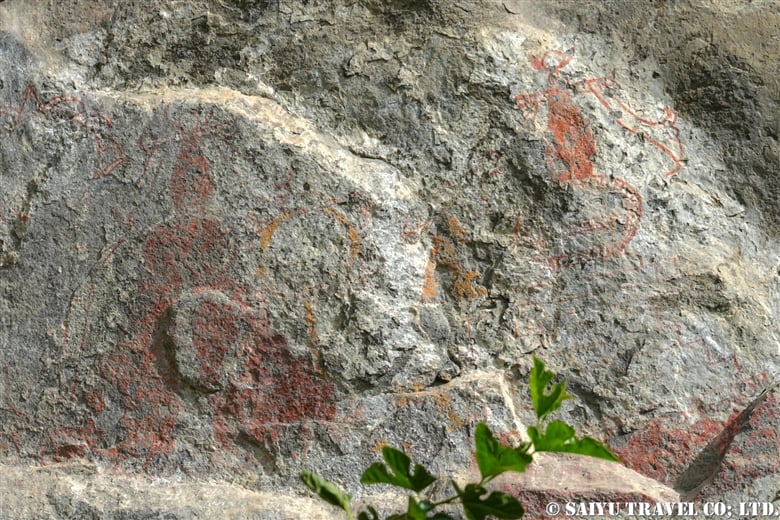
Rock painting of Nar

Rock paintings have been found in the village of Nar. Unfortunately, most of them have been lost. When they were first discovered, however, they looked something like the images below.


From “Harald Haupman : Pre-Islamic Heritage in the Northern Area of Pakistan”

The above image is a sketch from the time of the paintings’ discovery. It seems to show three stupas in the Tibetan style and people worshipping them. Unfortunately, only some parts of the stupas are visible now.
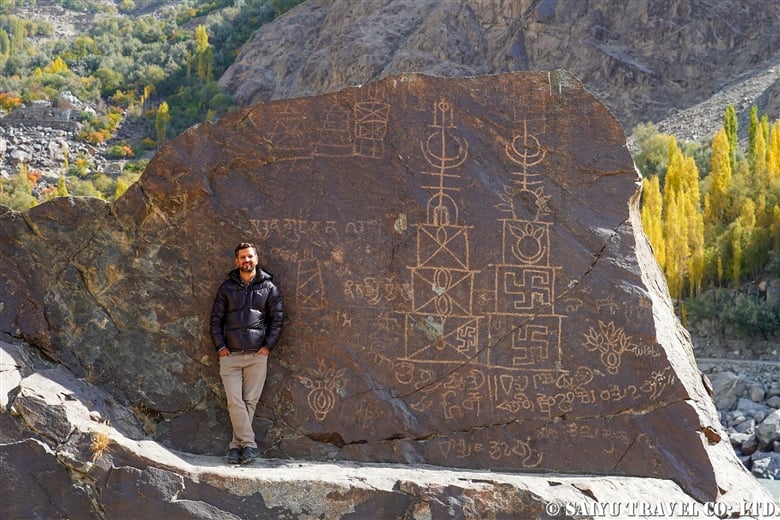
Petroglyhs of Balghar

Now that a sign has been put up on the main road, more and more people are visiting the petroglyphs at Balghar. Two large stupas, typical of later Buddhist periods, are decorated with sacred Bon and Buddhist symbols like the swastika, yundrun (reverse swastika), tridents, and lotus flowers. You can also see mantras inscribed in Tibetan script and an undeciphered script that resembles later Brahmi and Gupta scripts.

Petroglyphs of Yugo

There are also petroglyphs in the village of Yugo, located along the Shyok River, a tributary of the Indus. Though they have been heavily vandalized with graffiti, these are in fact supposed to be carvings of stupas from the late Buddhist period.

A Stupa on a Lotus Pedestal – Petroglyphs of Yugo

More petroglyphs in the village of Yugo, featuring a stupa situated on a bed of lotus flowers with auspicious motifs.

A rock carved with the mantra ‘Om Mani Padme Hum

As you travel further along the Shyok River, you’ll arrive at the village of Khaplu. This area played an important role in protecting the trade route to Ladakh. While we were walking through Khaplu’s summer village of Hanjoor, searching for petroglyphs, we found a rock inscribed with the old Tibetan mantra “Om Mani Padme Hum” right on the path. Finding such a powerful prayer from an ancient trade route was an incredibly moving experience!

Many places of the border area between Baltistan and India are restricted for foreigners, which makes me wonder if there might be new discoveries to be made once we’re allowed to go there.


Image & Text : Mariko SAWADA

*Please follow us on YoutubeInstagram & Facebook 

Category : ◆ Gilgit-Baltistan > - Indus river bank > - Skardu Valley
Tag : , , , , , , , , , ,

“Alter Rock”, Thalpan – Petroglyphs along the Indus River

The Altar Rock at Thalpan is located on the sandy north bank of the Indus River. The rock is carved with motifs, mainly animal rather than Buddhist motifs. This is a fascinating example of Petroglyphs from the ancient Silk Road.

Since ancient times, Thalpan has had many visitors who come and go through this area.  It was the nomads who first chose this site to carve. The rock face in front of the Alter Rock may have been used as a veritable ‘altar’, with various animals and slaughter scenes depicted.
These Petroglyphs with non-Buddhist motifs are thought to date from the mid-1st millennium BC.

overall view of Alter Rock

One of the Petroglyphs that stands out on this Altar Rock is this image of a Warrior with Sacrifice. It appears to be a scene of a man slaughtering an  animal (many sources call it a goat, but as an animal lover, it looks like an ibex to me). The figure of a Central Asian-style man holding a large knife is very distinctive.

The man’s dress is thought to be that of an equestrian nomad of the time, and it has been suggested that he may be from the Parthia, a dynasty that flourished on the Iranian plateau from the 3rd century BC to the 3rd century AD.

This animal sacrifice (or slaughter) Petroglyphs motif suggests that the influence of Central Asian peoples was stronger than the influence of Buddhism, which forbids the killing of animals.

This is a designed horse or unicorn with its forelegs bent at 45 degrees.

This pose, called “Knielauf,” was used in ancient Greece to depict a flying condition and was also popular in Achaemenid Persian art. The horse’s mane and tail are braided, giving them an appearance of bows.

Is it a designed ibex? The circular eyes are also an Iranian expression.

This shows a deer-like creature with antler and a predator with two tails chasing it. As a wildlife observer in Pakistan, it looks like a snow leopard attacking an ibex on a cliff to me. What is interesting, is that there is a head of a snake, at the end of the jagged line that also looks like a cliff.

One theory is that it shows an ibex in trouble, with a snake in front, a snow leopard behind, plus a hunter and his dogs, and nowhere to go.”

Such wavy designs are said to be a common feature of the art of the Altai region in southern Siberia.

The presence of Petroglyphs with Iranian elements at Altar Rock is not surprising, as Gandhara and Taxila were already satraps of the Achaemenid period. It is surprising that there was interaction between the Altai region of southern Siberia and this Indus region in the north, across one of the most mountainous regions in the world.

Petroglyphs from Thalpan Zyarat depict motifs from the Okunev culture of southern Siberia.

A large Buddha figure with a halo is seated with four smaller seated Buddha figures, also all with halos.

Each Buddha is in Dhayana Mudra sign and their garments cover their shoulders, with gracefully drawn parallel robe crests. Such garment crests are similar to designs found in the Gupta empire art, which flourished in India between AD 320 – 550.

A creature, possibly an ibex, is depicted on the same rock, and its movement and direction suggest that the ibex was carved first, and then the Buddha image was carved on top of it.

The west panel is also covered with Petroglyphs.

The Alter Rocks are the masterpieces of the Indus River Petroglyphs.

As we posted in previous blogs, it is such a shame that these rock carvings will be lost forever due to the construction of the dam.


Photo & text: Mariko SAWADA

*Contact us, Indus Caravan for more information or to make arrangements for visiting Rock carving along the Indus river.

*Please follow us on YoutubeInstagram & Facebook

Category : ◆ Gilgit-Baltistan > - Indus river bank > ◇ Rock carvings / Petroglyph
Tag : , , , , , , , , , , , , , , , , , , ,

Hungry Tigress Jataka- Rock Carving of Chilas

“This blog is documenting the precious Silk Road heritage site, the ‘Indus rock carvings’, which will be lost forever in a few years when two dams on the Indus River are completed”


Have you ever heard of the Hungry Tigress Jataka「捨身飼虎」?  In Japan, the story of the Hungry Tigress Jataka is depicted on the side of the Tamamushi Zushi「玉虫厨子」, a national treasure in the collection of ancient Horyuji Temple(法隆寺), even before Kyoto was built – when Buddhism was freshly adoped by the Japanese elite.

There are rock engravings along the Indus River in Chilas where the Hungry Tigress Jataka can still be seen, despite certain degree of deterioration the engravings underwent.


About Hungry Tigress Jataka (Vyaghri-Jataka) 

Long ago, there was a king in India who had three brothers, every of them a prince. One day, the king and the three princes went to play in a bamboo forest. There they met a mother tiger with seven cubs. The animals were starving, emaciated and on the verge of starvation.
The three princes felt deep compassion, but two of them left, saying that they could not save the animals. The third prince said, “Bodhisattvas offer themselves out of compassion to save others. I will offer myself to save the life of a starving tiger “. The prince gave himself up and the tiger ate him. The story goes that the prince who saved the lives of the tiger was the Buddha himself in one of his previous lives.

More information on Hungry Tigress Jataka and the Tamamushi Zushi at Horyu-ji Temple can be found on the websites of the respective temples.

The following is a sketch of this rock engraving, although it is quite faded and difficult to make out.

Source : The Indus – Cradle and Crossroads of Civilizations (Pakistan-German Archeological Research)

This sketch of the rock engraving shows a lying prince, a tiger cub about to eat the prince, the father king and two brother princes watching from safe distance behind a rock.

Decipherment of the Brahmi script beside this image has also proved that it is Hungry Tigress Jataka (Vyaghri-Jataka).

The entire surface of the rock on which the Hungry Tigress Jataka is depicted. A large stupa is depicted in the centre. There is a hemispherical Anda on a square base, with Harmika, symbolic umbrellas and banners, which are characteristic of the Gandhara style. It is thought that Buddhism was at its peak influence in the Upper Indus around the 5th century.

Unfortunately, this precious rock engraving will also be lost when the dam is completed. “Unfortunately” is not the right word that can be used to describe it, perhaps. The destruction of the rock engravings began with the construction of the Karakoram Highway in the 1960s, and the rock engravings have been destroyed with every expansion of the road. Some were even lost when they were painted over by people who did not like the Buddhist motif for a time.

Painted rock engravings along the Karakoram Highway. The central figure of a snow leopard chasing an ibex was washed out in December 2020.

Again, the time was limited, but we worked on washing the rock engravings that had been painted.

This is the current state of the rock engraving. From right to left, Manjushri, Bejewelled Buddha with a devotee holding an incense burner or lamp and stupa. A trefoil-shaped arch surrounds the Buddha’s entire body, is in Kashmir style.

The picture below shows how this looked before the paint was applied.

Source:The Indus – Cradle and Crossroads of Civilizations (Pakistan-German Archeological Research)

We will continue to wash off the paint from these rock engraving panels.Please come and witness this wonderful Buddhist heritage before it is submerged in the dam.


Photo & text : Mariko SAWADA

Site : Chilas, Gilgit-Baltitstan

*About the article: the article is based on an old book. I wonder if other views and explanations exist. I would be very happy if you could let me know so that I can study it.

Reference :”Huma records on Karakoram Highway”, ” The Indus, cradle and crossroads  of civilizations”

*Contact us, Indus Caravan for more information or to make arrangements for visiting Rock carving along the Indus river.

*Please follow us on YoutubeInstagram & Facebook


Category : ◆ Gilgit-Baltistan > - the Karakoram Highway > - Indus river bank > ◇ Rock carvings / Petroglyph
Tag : , , , , , , , , , , , , , , , , , , , ,

TOP